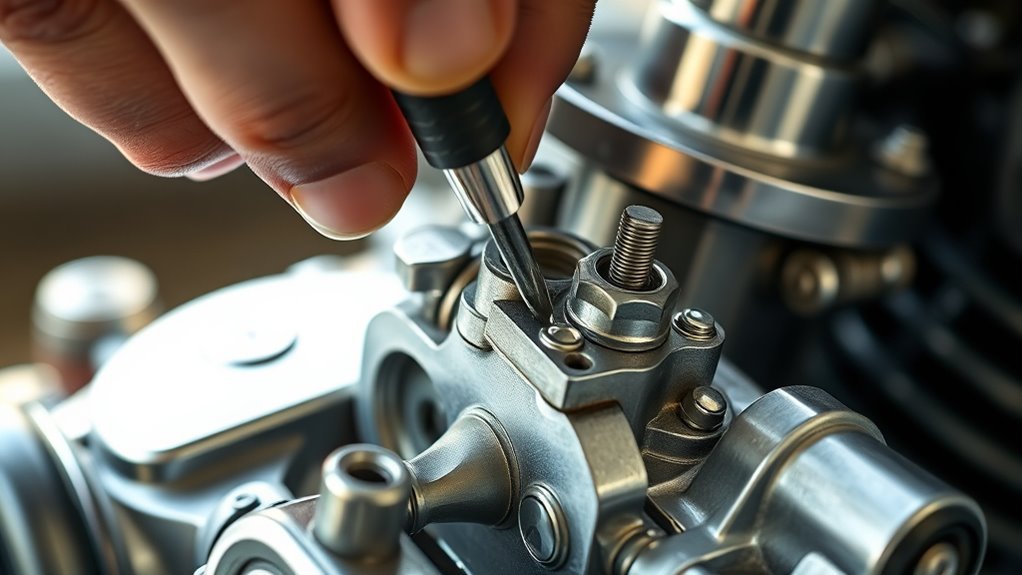

To adjust your carburetor effectively, start by gathering the necessary tools: a flathead screwdriver, a socket wrench, and a tachometer to monitor RPM. Proper adjustment is key to ensuring your engine runs smoothly and efficiently.
Begin by warming up the engine. Then, turn the idle mixture screw clockwise until the engine falters. After that, turn it counterclockwise until the engine runs smoothly again.
Next, adjust the idle speed screw to the recommended RPM. Keep an eye out for smooth idling and responsive acceleration.
Fine-tune the fuel mixture and idle speed step by step. This careful process helps avoid common issues and ensures optimal engine performance. More detailed guidance can assist you in perfecting your carburetor adjustment.
Key Takeaways
- Warm up the engine to operating temperature before starting carburetor adjustments for accurate results.
- Use the idle mixture screw to find the smoothest engine operation by turning clockwise until falter, then counterclockwise.
- Adjust the idle speed screw to reach the manufacturer’s recommended RPM for stable idling.
- Monitor engine response and throttle performance to confirm the air-fuel mixture is balanced properly.
- Clean the carburetor and check for air leaks if rough idling or poor acceleration persist before readjusting.
Tools You’ll Need for Carburetor Adjustment
Before you begin adjusting your carburetor, gather the essential tools to guarantee accuracy and efficiency. You’ll need specific carburetor tools, including a flathead screwdriver for fine-tuning screws, a socket wrench set for removing and securing bolts, and a carburetor adjustment gauge to measure fuel-air mixture precisely.
Additionally, have a tachometer on hand to monitor engine RPM during adjustments, ensuring peak performance. A clean rag and a small brush will help you remove debris before and after adjustments.
Using the correct adjustment equipment prevents damage and misalignment, improving the reliability of your work. Preparing these tools beforehand streamlines the process, minimizes errors, and saves time.
Proper tools prevent damage and errors, ensuring reliable work and a smoother tuning process.
With the right carburetor tools and adjustment equipment at hand, you’re set for an accurate and effective carburetor tuning session.
Adjust Your Carburetor: Step-by-Step Guide
Start by warming up your engine to its normal operating temperature, as this guarantees accurate carburetor adjustments.
Next, locate the idle mixture screw and slowly turn it clockwise until the engine starts to falter; then, turn it counterclockwise until the engine runs smoothly.
Adjust the idle speed screw to achieve the manufacturer’s recommended RPM. Throughout this process, closely monitor engine response to verify ideal air-fuel mixture.
Fine-tuning these settings is critical for carburetor maintenance, directly impacting your engine’s efficiency and longevity.
After adjustments, test the throttle response and acceleration to confirm performance improvement.
Always recheck idle settings after each tweak. Keeping your carburetor properly adjusted prevents rough idling and poor fuel economy, assuring your engine operates at peak performance.
How to Tell If Your Carburetor Needs Adjusting
Properly adjusting your carburetor improves engine performance, but you’ll need to know when adjustments are necessary.
Recognizing carburetor symptoms early helps prevent engine damage and guarantees efficient fuel consumption.
Key adjustment indicators include:
- Rough Idle or Stalling: If your engine frequently stalls or idles unevenly, it’s a clear sign the air-fuel mixture is off.
- Poor Acceleration: Hesitation or lag during acceleration usually points to improper carburetor settings.
- Black Smoke from Exhaust: Excessive black smoke indicates a rich fuel mixture, requiring carburetor tuning.
Fine-Tune Idle and Mixture for Smooth Running
Adjusting the idle speed and air-fuel mixture involves two key screws on the carburetor that control engine performance at low throttle.
First, locate the idle speed screw, which regulates the throttle plate opening. Turn it slowly clockwise to increase RPM or counterclockwise to reduce it until the engine runs steadily at the manufacturer’s recommended idle speed.
Next, find the fuel mixture screw, responsible for balancing air and fuel intake. Gradually turn this screw in or out to achieve the smoothest engine operation, avoiding rough idling or stalling.
Make small adjustments, allowing the engine to stabilize after each change.
Fine-tuning these screws guarantees the best fuel mixture and precise idle speed, resulting in smooth running and efficient engine performance at low throttle settings.
Troubleshooting Common Carburetor Problems
When your engine shows signs of hesitation, stalling, or poor acceleration, you’ll need to diagnose common carburetor issues promptly.
Start by inspecting the carburetor for dirt or varnish buildup. Thorough carburetor cleaning often resolves many performance problems.
Begin with a careful carburetor inspection to remove dirt and varnish buildup for improved performance.
Next, evaluate the fuel mixture; an incorrect ratio can cause rough idling or power loss. Adjust it carefully following manufacturer specifications.
Finally, check for air leaks around the carburetor base or intake manifold, as these disrupt the fuel mixture and engine efficiency.
To troubleshoot effectively:
- Perform detailed carburetor cleaning to remove deposits.
- Adjust the fuel mixture screws to achieve ideal air-fuel balance.
- Inspect and seal any air leaks impacting carburetor function.
Addressing these points guarantees smoother engine performance and prevents recurring issues.
Frequently Asked Questions
Can Carburetor Adjustment Improve Fuel Efficiency?
Yes, adjusting your carburetor optimizes the fuel mixture, improving engine performance and fuel efficiency. You’ll reduce excess fuel consumption and guarantee the engine runs smoothly, saving you money and minimizing emissions effectively.
How Often Should You Adjust a Carburetor?
Think of your carburetor as the engine’s heartbeat. For ideal carburetor maintenance, adjust it every 12,000 to 15,000 miles or annually. Regular adjustment frequency guarantees precise fuel-air mix, boosting performance and efficiency.
What Causes a Carburetor to Go Out of Adjustment?
Carburetor wear and air leaks cause your carburetor to go out of adjustment. Over time, components degrade and seals fail, disrupting fuel-air mixture balance.
You’ll need to inspect and correct these issues regularly for peak performance.
Are There Different Carburetor Types Requiring Unique Adjustments?
Like tuning a varied orchestra, you’ll find Holley carburetors need precise needle adjustments, while Quadrajet tuning demands careful secondary metering. Each type requires unique tweaks for peak performance, so tailor your approach accordingly.
Can a Bad Carburetor Damage the Engine?
Yes, a bad carburetor can harm your engine. Carburetor symptoms like rough idling or poor fuel mixture disrupt engine performance, causing damage over time.
You should address issues promptly to prevent costly repairs.
Conclusion
Now that you’ve learned how to adjust your carburetor, you’re ready to tackle it like a pro. With the right tools and these clear steps, fine-tuning your carburetor will be easier than finding a needle in a haystack.
Keep an eye on your engine’s response, and don’t hesitate to troubleshoot common issues promptly. Regular adjustments guarantee your engine runs smoothly and efficiently, saving you time and costly repairs down the road.
Mastering how to adjust your carburetor ensures optimal engine performance and longevity.