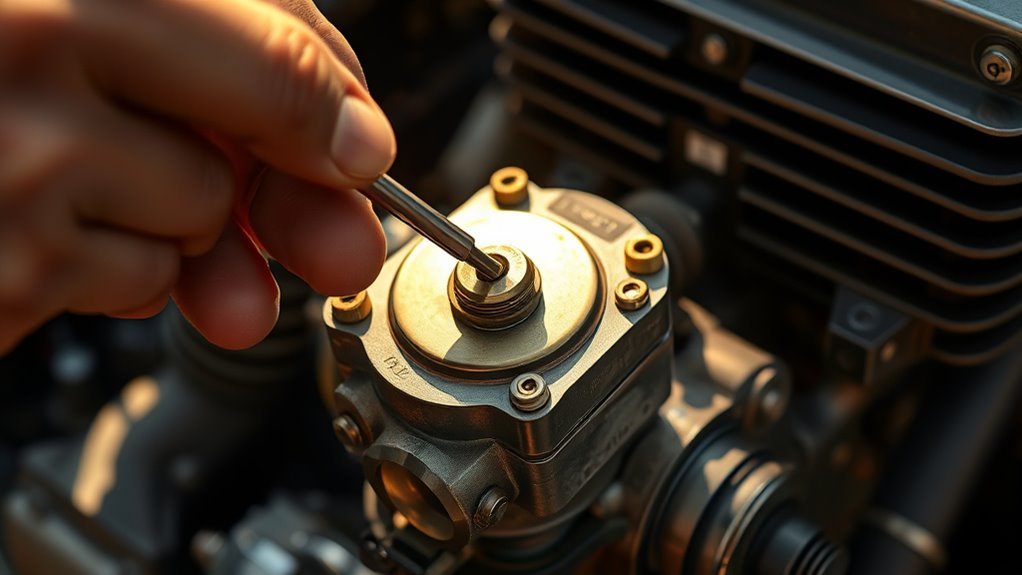

To adjust carburetor mixture screws, first locate the “L” and “H” screws near the throttle body, using the right screwdriver. Warm up your engine fully, then gently seat each screw clockwise before backing them out 1–1.5 turns.
Start the engine and adjust each screw individually to find the smoothest idle or peak RPM. Watch for signs like rough idling or poor acceleration to refine the mixture.
Proper tuning improves fuel economy and performance—explore more detailed steps and troubleshooting tips ahead.
Key Takeaways
- Locate the mixture screws marked “L” (low-speed) and “H” (high-speed) on the carburetor throttle body area.
- Warm up the engine to normal operating temperature before starting any mixture screw adjustments.
- Gently seat each mixture screw clockwise, then back out 1 to 1.5 turns as a baseline for tuning.
- Adjust one screw at a time while monitoring engine RPM or idle quality, aiming for smooth idle and stable speed.
- Fine-tune screws to eliminate rough idling or hesitation, improving fuel economy and engine performance.
Finding the Carburetor Mixture Screws on Your Engine
Where exactly are the carburetor mixture screws located on your engine? First, identify the carburetor location. It’s typically mounted between the air filter housing and the intake manifold.
Once you’ve pinpointed the carburetor, focus on the throttle body area where the fuel and air mix. The mixture screws are usually positioned on the side or bottom of the carburetor body.
For screw identification, look for small, slotted or Phillips-head screws, generally marked “L” for low-speed and “H” for high-speed adjustments. These screws control the air-fuel ratio and are often recessed or partially covered by a plug or cap.
Proper screw identification is vital before any adjustments to avoid damaging the carburetor or misadjusting the fuel mixture, which affects engine performance.
Essential Tools and Preparing Your Engine for Adjustment
Before adjusting the carburetor mixture screws, gather the necessary tools like a screwdriver, tachometer, and safety gear.
Warm up your engine to its normal operating temperature to guarantee accurate adjustments.
Always follow safety precautions to prevent injury and equipment damage during the process.
Necessary Tools Checklist
Several essential tools are required to accurately adjust your carburetor mixture screws, ensuring precise tuning and ideal engine performance.
Start with a set of flathead and Phillips screwdrivers, as carburetor types vary and may require different heads. A small, calibrated carburetor adjustment screwdriver is vital for delicate tuning.
You’ll also need a tachometer to monitor engine RPM during adjustment techniques. A vacuum gauge can help verify proper mixture settings in some carburetor designs.
Additionally, have a clean rag and penetrating oil on hand to clean screws and prevent seizing.
Finally, safety glasses and gloves protect you during the process. Gathering these tools beforehand streamlines the procedure and supports precise, repeatable adjustments aligned with your specific carburetor type.
Engine Warm-Up Procedures
Although it might seem straightforward, properly warming up your engine is critical to obtaining accurate carburetor mixture screw adjustments.
Begin by starting the engine and letting it idle until the engine temperature reaches its normal operating range, typically indicated by the temperature gauge or a specified time in the manual. This guarantees the fuel-air mixture reflects real operating conditions.
Avoid revving the engine during warm-up, as fluctuating engine temperature can lead to inconsistent readings. Maintaining the correct engine temperature stabilizes fuel vaporization and combustion, directly impacting fuel efficiency.
Only once the engine is fully warmed up should you proceed with adjusting the mixture screws, making certain the settings optimize performance under typical operating conditions.
Skipping this step risks improper tuning and degraded engine efficiency.
Safety Precautions Overview
When you prepare to adjust the carburetor mixture screws, gathering the right tools and guaranteeing your engine is properly set up is essential for both safety and accuracy. Always wear appropriate safety gear, such as gloves, goggles, and flame-resistant clothing, to minimize injury risks. Be mindful of fire hazards: keep flammable materials away and work in a well-ventilated area. Confirm the engine is cool to prevent burns and accidental ignition.
| Essential Tool | Purpose | Safety Tip |
|---|---|---|
| Screwdriver | Adjust mixture screws | Use insulated handle |
| Tachometer | Measure RPM | Avoid placing near moving parts |
| Fire extinguisher | Emergency fire control | Guarantee accessibility |
Proper preparation prevents accidents and guarantees precise carburetor tuning.
How to Adjust Carburetor Mixture Screws Step-by-Step
Before you begin adjusting the carburetor mixture screws, make certain the engine is warmed up and running at idle.
Locate the mixture screws, usually two, on the carburetor body. Using a screwdriver, turn each screw clockwise gently until it lightly seats; don’t overtighten.
Find the mixture screws on the carburetor and gently turn clockwise until they lightly seat without overtightening.
Then, back each screw out 1 to 1.5 turns as a baseline for carburetor tuning. Start the engine and listen carefully.
Slowly turn one screw clockwise in small increments while monitoring engine response. When the idle speed peaks or stabilizes, stop adjusting that screw.
Repeat the process with the second screw. This method guarantees initial fuel-air mixture balance for performance optimization.
After both screws are set, verify stable idle speed and smooth engine operation before proceeding to fine adjustments.
Fine-Tuning Carburetor Mixture Screws for Best Performance
With the initial mixture screws set to stabilize idle speed and engine operation, you can now fine-tune their positions for ideal performance.
Begin carburetor tuning by slowly turning each screw in quarter-turn increments, monitoring engine response carefully. Use a tachometer or listen for subtle changes in idle smoothness and RPM.
Your goal is to achieve the highest, most stable idle speed without causing engine hesitation or roughness. Adjust both screws equally to maintain balance, then verify overall engine response under load.
Performance enhancement requires patience and precision; small adjustments can considerably impact fuel-air mixture quality.
Once you find the best screw positions, lock them in place if applicable. This method guarantees efficient combustion, improved throttle response, and reduced emissions, maximizing your engine’s performance and reliability.
Troubleshooting Common Carburetor Mixture Screw Issues
You’ll want to start by identifying symptoms like rough idling or poor acceleration that signal mixture screw issues.
Next, check for common errors such as incorrect screw positioning or damage that disrupts fuel flow.
Correcting these adjustments guarantees peak engine performance and prevents further complications.
Identifying Mixture Screw Problems
Although mixture screw issues can be subtle, recognizing their symptoms is essential for effective carburetor tuning. You need to identify mixture screw problems early by observing specific adjustment indicators and mixture screw symptoms.
Common signs include:
- Rough idle or engine stalling at low RPMs, signaling an overly lean or rich mixture.
- Hesitation or bogging during acceleration, which suggests improper fuel-air balance.
- Excessive exhaust smoke or poor fuel economy, indicating a mixture skewed too rich.
Pay close attention to these symptoms during engine operation and idle adjustments. They serve as precise adjustment indicators, guiding you to pinpoint mixture screw faults without guesswork.
Detecting these issues accurately allows you to prepare for proper correction and avoid further engine performance degradation.
Correcting Adjustment Errors
When mixture screw adjustments lead to persistent engine issues, you must methodically troubleshoot to restore peak performance. Begin by reviewing your mixture screw calibration and adjustment techniques for accuracy. Incorrect calibration often causes rough idling, stalling, or poor throttle response.
Use the table below to identify common errors and corrective actions:
| Symptom | Correction |
|---|---|
| Engine stalls | Lean mixture; enrich by turning screw in slowly |
| Rough idle | Rich mixture; lean out by turning screw out gradually |
| Hesitation on throttle | Incorrect synchronization; recalibrate mixture screws |
| Poor fuel economy | Over-rich mixture; fine-tune screws for leaner setting |
Apply small incremental adjustments and always allow the engine to stabilize before re-evaluating. This precision guarantees effective mixture screw calibration and peak engine performance.
When to Get Professional Help With Carburetor Mixture Screws
If your adjustments fail to improve engine performance or you encounter persistent issues like rough idling or stalling, it’s time to seek professional assistance. Knowing when to consult a technician helps prevent further damage and guarantees accurate diagnosis.
Signs of malfunction beyond mixture screw misadjustment include:
- Inconsistent fuel delivery despite correct screw settings
- Visible damage or wear on carburetor components
- Engine hesitation or backfiring during acceleration
These symptoms indicate underlying problems that require specialized tools and expertise. Attempting advanced repairs without proper knowledge can worsen the situation.
A professional can perform precise calibration, inspect internal parts, and recommend necessary replacements.
Don’t ignore these signs of malfunction; timely intervention saves costs and maintains peak engine function.
Maintaining Your Carburetor After Adjustment
Properly maintaining your carburetor after adjustment guarantees consistent engine performance and prevents premature wear. Follow essential carburetor maintenance tips such as regularly cleaning the air filter, checking for fuel leaks, and ensuring the throttle linkage operates smoothly.
Implement a routine inspection checklist that includes examining the mixture screws for proper seating and verifying the float level remains within specifications.
Monitor engine idle quality and responsiveness, adjusting mixture screws as needed to compensate for changes in altitude or fuel quality.
Avoid prolonged exposure to dirt and moisture, which can degrade internal components.
Frequently Asked Questions
What Types of Engines Commonly Use Carburetor Mixture Screws?
You’ll commonly find carburetor mixture screws on motorcycle engines and small engines like lawnmowers or chainsaws. These screws precisely control air-fuel ratios, optimizing performance and efficiency in these types of engines.
How Do Carburetor Mixture Screws Affect Fuel Efficiency?
You don’t want perfect fuel economy, right? Well, tuning carburetor mixture screws precisely improves combustion, ensuring ideal fuel-air balance.
Follow these tuning tips to enhance fuel economy, reduce emissions, and boost engine performance efficiently.
Can Incorrect Mixture Screw Settings Damage the Engine?
Yes, incorrect mixture tuning can damage your engine. Lean settings cause overheating and detonation, while rich mixtures foul spark plugs and reduce engine performance.
Proper adjustment guarantees ideal combustion and prevents long-term engine wear or failure.
Are There Different Mixture Screws for Two-Stroke and Four-Stroke Engines?
Think of mixture screw types like different lenses; two-stroke and four-stroke engines need distinct adjustments to optimize engine performance.
You’ll find their screws differ, tailoring fuel-air mix precisely for each engine’s combustion style.
How Often Should Carburetor Mixture Screws Be Adjusted?
You should adjust carburetor mixture screws during regular carburetor maintenance, typically every 6-12 months or if engine performance declines. Frequent tuning guarantees ideal fuel-air mixture, preventing poor combustion and maintaining efficient engine operation.
Conclusion
Adjusting your carburetor mixture screws is like tuning a fine instrument—precision makes all the difference. By carefully following each step and using the right tools, you guarantee your engine runs smoothly and efficiently.
Remember, small tweaks can have a big impact on performance. If issues persist despite your efforts, don’t hesitate to seek professional help.
Regular maintenance after adjustments keeps your carburetor in top shape, preventing future problems and extending engine life. Proper adjustment of your carburetor mixture screws is essential for optimal engine performance and longevity.