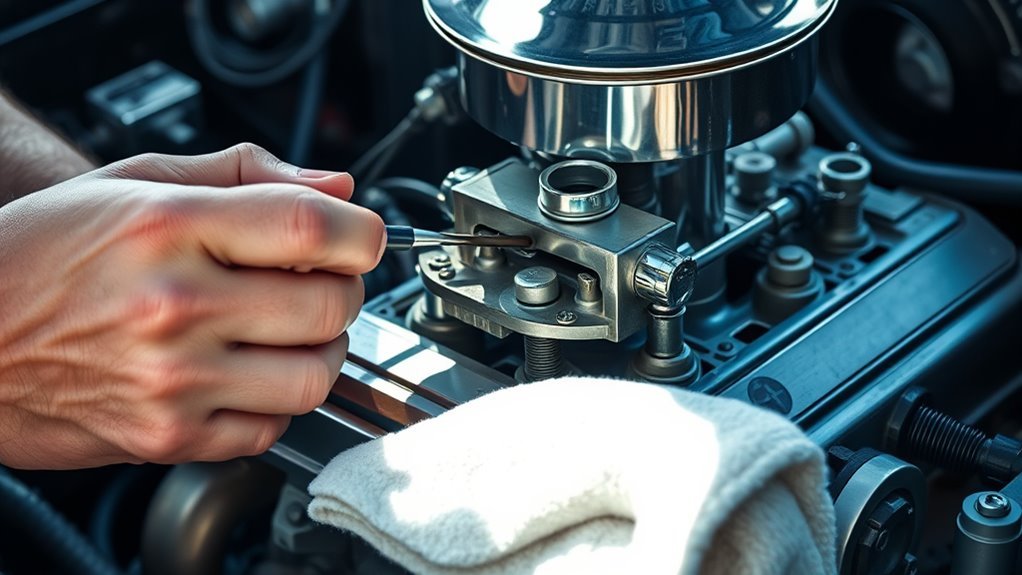

To tune your carburetor properly, start by adjusting the float level to control fuel flow accurately. This step is crucial for maintaining the correct fuel-to-air ratio. Next, fine-tune the idle speed screw to set your engine’s RPM and adjust the idle mixture screw for a smooth, stable idle.
Use tools like a screwdriver and vacuum gauge for precision during the tuning process. Ensure all components are clean and functioning well, as proper tuning improves performance and fuel efficiency. Exploring further will reveal how to address common issues and enhance overall engine response.
Key Takeaways
- Adjust the float level by measuring and bending the float tab to maintain proper fuel flow into the carburetor bowl.
- Set the idle speed screw to control throttle position and adjust RPM for smooth idling.
- Fine-tune the idle mixture screw in small increments to achieve the highest, smoothest idle without engine hesitation.
- Use tools like a vacuum gauge and tachometer to synchronize multiple carburetors and optimize air-fuel mixture.
- Regularly inspect and clean carburetor components, including the accelerator pump and jets, to prevent performance issues.
How a Carburetor Works
A carburetor mixes air and fuel in the correct ratio to power an engine efficiently. To understand this process, start by identifying key carburetor components: the throttle valve, fuel jet, venturi, and float chamber.
When you open the throttle valve, air flows through the venturi, creating a pressure drop. This drop draws fuel from the float chamber through the fuel jet, blending it with the air. The resulting air-fuel mixture then enters the engine’s combustion chamber.
You must guarantee each component functions properly to maintain the ideal mixture for combustion. The carburetor precisely meters fuel delivery based on airflow, preventing lean or rich conditions.
Understanding this mechanism allows you to diagnose issues and make accurate adjustments during tuning.
Why You Should Tune Your Carburetor
You should tune your carburetor to optimize engine performance by ensuring the correct air-fuel mixture.
Proper tuning also enhances fuel efficiency, reducing waste and cutting costs.
Regular adjustments keep your engine running smoothly and consistently.
Improve Engine Performance
Although modern engines have advanced fuel injection systems, tuning your carburetor remains essential for enhancing engine performance. When you perform engine modifications or install performance upgrades, your carburetor needs recalibration to match altered airflow and fuel demands.
Adjusting the idle mixture and main jet settings guarantees the engine receives the correct air-fuel ratio for efficient combustion. You should also verify throttle response and smooth acceleration by fine-tuning the needle valve and float level.
Proper carburetor tuning minimizes hesitation and power loss, enabling your engine to deliver maximum output. Neglecting this step can lead to rough idling, reduced power, and potential damage.
Enhance Fuel Efficiency
When your carburetor is properly tuned, it optimizes the air-fuel mixture to reduce fuel consumption without sacrificing engine power. Adjusting the fuel mixture and controlling air flow precisely guarantees that your engine runs efficiently, preventing wasted fuel and improving mileage.
You’ll notice smoother acceleration and less carbon buildup.
| Adjustment Area | Impact on Fuel Mixture | Effect on Air Flow |
|---|---|---|
| Idle Mixture | Balances fuel ratio | Maintains steady flow |
| Main Jet | Regulates fuel volume | Controls air intake |
| Air Screw | Fine-tunes air flow | Modifies mixture richness |
| Needle Position | Adjusts fuel delivery | Affects throttle response |
Tools Needed for Carburetor Tuning
To tune your carburetor effectively, you’ll need a specific set of tools including screwdrivers, wrenches, and a carburetor cleaner.
Accurate measuring instruments like a vacuum gauge and a tachometer are essential for precise adjustments.
Don’t forget safety gear such as gloves and eye protection to prevent injuries during the process.
Essential Carburetor Tools
A well-equipped toolkit is vital for effective carburetor tuning. To perform precise carburetor maintenance and tuning techniques, you’ll need specific tools.
Start with a set of screwdrivers, both flathead and Phillips, to adjust mixture and idle screws accurately. A socket wrench set is fundamental for removing and reinstalling the carburetor securely.
Needle-nose pliers help manipulate small components and springs. Always have a clean rag or shop towel handy to wipe off fuel residues and debris.
A small wire brush assists in cleaning jets and passages without causing damage. Finally, a fuel line clamp prevents fuel flow during adjustments.
Using these vital tools guarantees you execute carburetor tuning efficiently while maintaining component integrity and achieving peak engine performance.
Measuring Instruments Required
Although having the right tools is crucial, accurate measurements are equally critical for effective carburetor tuning. To perform precise carburetor diagnostics, you’ll need a vacuum gauge to assess manifold vacuum, a tachometer to monitor engine RPM, and a fuel pressure gauge to verify consistent fuel delivery.
A multimeter helps check electrical components, such as the choke or solenoid circuits. Additionally, a dial indicator or feeler gauge enables you to measure throttle plate position and clearances accurately.
These instruments are essential for applying tuning techniques that optimize air-fuel mixture and engine performance. Without accurate data from these measuring tools, adjustments risk being guesswork rather than informed corrections.
Confirm your instruments are calibrated and functional before starting any tuning session for reliable results.
Safety Equipment Checklist
Having accurate measurements is only part of the equation; protecting yourself and your workspace during carburetor tuning is equally important.
Before you start, equip yourself with essential safety gear. Always wear safety goggles to shield your eyes from fuel splashes, debris, or accidental sprays.
Use protective gloves made of chemical-resistant material to prevent skin contact with gasoline and solvents, which can cause irritation or burns.
Ensure your workspace is well-ventilated to avoid inhaling harmful fumes. Keep a fire extinguisher rated for flammable liquids nearby, as carburetor tuning involves working with combustible materials.
Finally, avoid loose clothing or jewelry that could catch on moving parts.
Adjusting the Float Level for Proper Fuel Flow
Since the float level directly controls the fuel entering the carburetor bowl, you must set it accurately to confirm proper fuel flow.
Begin by removing the carburetor bowl to access the float. Inspect the float for damage, then measure the fuel level against the manufacturer’s specifications.
Use a float gauge or ruler for precision. To perform the float adjustment, gently bend the float tab to raise or lower the float height. Lowering the float reduces the fuel level, preventing flooding; raising it increases fuel flow, avoiding lean conditions.
After adjusting, reinstall the bowl and check for leaks. Proper float adjustment confirms consistent fuel delivery, improving engine performance and preventing stalling or flooding.
Always refer to the carburetor manual for exact fuel level measurements and tolerances.
How to Adjust Carburetor Idle Speed and Mixture
With the float level properly set to secure steady fuel flow, you can now focus on adjusting the carburetor’s idle speed and mixture to optimize engine performance at low RPMs.
Start by locating the idle speed screw, which controls throttle plate position. Turn it clockwise to increase idle RPM or counterclockwise to decrease it.
Next, adjust the idle mixture screw, which regulates the air-fuel ratio at idle. Use tuning techniques such as slowly turning the idle mixture screw in small increments, listening for the highest, smoothest idle. If the engine stumbles or stalls, reverse the adjustment slightly.
Repeat these steps iteratively, balancing idle speed and idle mixture until the engine runs steadily without hesitation.
Proper adjustment improves fuel efficiency, reduces emissions, and secures smooth idle operation.
Fine-Tuning Your Carburetor for Best Performance
Three critical adjustments will help you fine-tune your carburetor for peak performance: enhancing the air-fuel mixture across the RPM range, calibrating the accelerator pump, and synchronizing multiple carburetors if applicable.
Begin with precise carburetor adjustments by:
- Adjusting main jets to guarantee correct fuel delivery at high RPMs.
- Setting the accelerator pump stroke to prevent hesitation during throttle changes.
- Balancing carburetor throttle plates for even airflow when multiple carburetors are present.
- Verifying choke operation to maintain ideal cold-start performance.
Each step directly impacts performance enhancement, improving throttle response, fuel efficiency, and engine smoothness.
Optimizing carburetor adjustments boosts throttle response, fuel efficiency, and overall engine smoothness.
Use a vacuum gauge and tachometer for accurate readings during tuning.
Common Carburetor Tuning Problems and Fixes
Many carburetor tuning issues stem from improper air-fuel mixture, faulty accelerator pump settings, or synchronization errors in multi-carb setups. To diagnose tuning symptoms effectively, watch for rough idling, hesitation, or excessive fuel smell indicating carburetor leaks or imbalance. Address these by adjusting mixture screws, checking accelerator pump strokes, and synchronizing carbs precisely.
| Problem | Fix |
|---|---|
| Rough idle | Adjust idle mixture screw |
| Hesitation on acceleration | Inspect and adjust accelerator pump |
| Carburetor leaks | Tighten fittings, replace gaskets |
| Poor fuel economy | Rebalance air-fuel ratio |
| Multi-carb sync issues | Use vacuum gauges to synchronize carbs |
Frequently Asked Questions
Can I Tune a Carburetor Myself Without Mechanical Experience?
You can try DIY tuning with beginner tips, but without mechanical experience, expect challenges. Start by learning basic adjustments, use a manual, and proceed cautiously.
Precision and patience are essential to avoid damage or poor performance.
How Often Should I Tune My Carburetor for Optimal Performance?
You should perform carburetor maintenance and adjust tuning frequency every 12,000 miles or annually, whichever comes first, to guarantee peak performance.
Regular checks prevent fuel inefficiency and engine issues, keeping your system finely calibrated.
Will Tuning My Carburetor Improve Fuel Efficiency Significantly?
Yes, carburetor tuning can improve fuel efficiency by optimizing air-fuel mixture delivery. You’ll notice smoother engine performance and reduced fuel consumption when you precisely adjust the carburetor to your engine’s specific requirements.
Can a Bad Carburetor Cause Engine Starting Problems?
Like a Victorian clock needing precise gears, a bad carburetor causes engine starting problems. You’ll spot carburetor symptoms through engine diagnostics: hesitation, flooding, or stalling.
Promptly check and adjust the fuel-air mixture for smooth starts.
Is It Necessary to Tune the Carburetor After Installing a New Air Filter?
Yes, you should perform carburetor adjustments after installing a new air filter, as different air filter types affect airflow. Proper tuning guarantees ideal fuel mixture, preventing engine performance issues and maintaining efficiency.
Conclusion
Tuning your carburetor is like tuning a fine instrument—precision is key. By carefully adjusting the float level, idle speed, and mixture, you’ll guarantee your engine runs smoothly and efficiently. Don’t overlook common issues; diagnosing and fixing them promptly keeps performance sharp.
With the right tools and attention to detail, you’ll master your carburetor’s settings, releasing ideal fuel flow and power. Take control, and your engine will thank you with reliable performance. Proper tuning ensures the best operation and longevity.
In conclusion, understanding how to tune a carburetor is essential for maintaining optimal engine performance and efficiency.