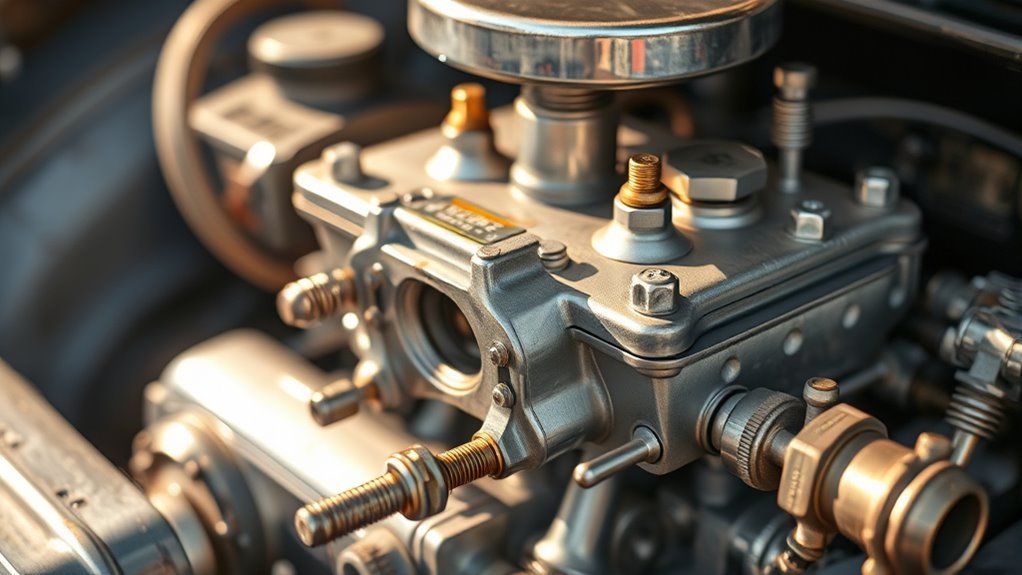

A carburetor is a device that mixes air and fuel precisely to guarantee your engine runs efficiently and smoothly. It plays a crucial role in ensuring the right fuel-to-air ratio for optimal combustion.
The carburetor uses components like the throttle valve, venturi, fuel jet, and float chamber to adjust fuel flow as your engine speed changes. These parts work together to deliver the correct mixture depending on the engine’s needs.
Common types include float and variable-jet carburetors, each suited to specific engine requirements. Regular maintenance is important to avoid issues like rough idling or stalling.
Understanding how a carburetor works helps you keep your engine performing at its best. Proper care and knowledge ensure reliable engine operation and longevity.
Key Takeaways
- A carburetor mixes air and fuel for internal combustion engines to ensure efficient engine performance.
- It uses components like throttle valves, venturi, fuel jets, and float chambers for precise air-fuel mixing.
- Common types include float-type, fixed-jet, variable-jet, and diaphragm carburetors based on engine needs.
- The venturi creates a pressure drop to draw fuel into the airflow, optimizing the air-fuel ratio.
- Regular cleaning and adjustment prevent issues like rough idling, stalling, and excessive fuel consumption.
What Is a Carburetor and Why It Matters
A carburetor is a mechanical device that mixes air and fuel in the correct ratio for internal combustion engines. Understanding its function is vital because it directly impacts engine performance and efficiency.
The carburetor history dates back to the late 19th century when early automotive engineers sought reliable fuel delivery systems. Over time, carburetor innovations improved fuel atomization and metering precision, enhancing engine responsiveness and fuel economy.
By grasping these developments, you can appreciate how carburetors shaped automotive technology before fuel injection became widespread. Knowing why a carburetor matters helps you diagnose engine issues and optimize tuning.
In practice, it guarantees your engine receives the right mixture under varying conditions, which is essential for power output and emissions control.
How a Carburetor Mixes Air and Fuel
Understanding how a carburetor mixes air and fuel lets you see how it delivers the precise combustion mixture your engine needs.
The mixing process begins as air enters the carburetor throat, where it passes through a narrowed section called the venturi. This design accelerates air, creating a pressure drop that draws fuel from the jet into the airstream.
Air speeds through the venturi, creating a vacuum that pulls fuel into the airstream for mixing.
You’ll notice that the carburetor continuously adjusts the air fuel ratio to match engine demands, optimizing combustion efficiency.
The fuel atomizes as it mixes with air, forming a uniform vapor essential for smooth engine operation.
Throughout this process, maintaining the correct air fuel ratio is critical; too rich or too lean a mixture affects performance and emissions.
Main Parts of a Carburetor and Their Functions
Now that you know how the carburetor blends air and fuel to achieve the correct mixture, it’s important to identify the main components that make this process possible.
The primary carburetor components include the throttle valve, which regulates airflow; the venturi, a narrowed section that increases air velocity and reduces pressure; and the fuel jet, responsible for precise fuel delivery into the airflow.
The float chamber maintains a constant fuel level, ensuring steady supply to the jet. Additionally, the choke valve restricts air to enrich the mixture during cold starts.
Each part works in concert to adjust the air-fuel ratio dynamically, optimizing combustion efficiency. Understanding these components enables you to diagnose issues and maintain effective fuel delivery within your carburetor system.
Common Types of Carburetors
Several common types of carburetors serve different engine requirements by varying in design and fuel delivery mechanisms.
In this types overview, you’ll encounter float-type, fixed-jet, variable-jet, and diaphragm carburetors.
The float-type uses a chamber to regulate fuel flow via a float valve, ensuring consistent fuel levels.
Fixed-jet carburetors provide a simple, fixed-size orifice for fuel delivery, suitable for steady-speed engines.
Variable-jet carburetors adjust fuel flow by changing jet size or needle position, offering better performance across varied speeds.
Diaphragm carburetors operate using pressure differences, ideal for small engines and portable equipment.
Understanding these common types helps you select and maintain the right carburetor, matching your engine’s operational demands precisely and efficiently.
Common Carburetor Problems to Watch For
While carburetors are essential for proper engine function, they can develop issues that compromise performance and efficiency. You might encounter carburetor leaks, which waste fuel and cause poor engine response. Idle issues often signal problems like clogged jets or incorrect air-fuel mixture adjustments. Addressing these promptly prevents further damage.
| Problem | Impact |
|---|---|
| Carburetor leaks | Fuel waste, poor mileage |
| Idle issues | Engine stalls, rough idling |
| Flooding | Hard starts, smoke |
| Hesitation | Power loss, throttle lag |
| Backfiring | Exhaust damage risk |
Understanding these common problems helps you maintain ideal engine performance and avoid costly repairs.
Signs Your Carburetor Needs Cleaning or Repair
Recognizing when your carburetor requires cleaning or repair is essential to maintaining engine efficiency and preventing more serious issues. Common carburetor symptoms include rough idling, engine stalling, poor acceleration, and black smoke from the exhaust. If you notice these signs, it’s vital to inspect and clean the carburetor promptly.
Watch for rough idling, stalling, or black smoke—these signal your carburetor needs cleaning or repair immediately.
Regular cleaning frequency depends on your vehicle’s usage and environment; typically, every 12,000 miles or annually works for most. However, dusty or humid conditions may necessitate more frequent attention.
Paying close attention to these symptoms allows you to address blockages, varnish buildup, or worn components early. Prompt maintenance restores proper fuel-air mixture flow, ensuring ideal combustion, fuel efficiency, and engine performance.
Ignoring these signs risks costly repairs or complete carburetor failure.
Carburetors vs. Fuel Injection Systems: What’s the Difference?
You’ll notice carburetors mix air and fuel mechanically, while fuel injection systems use electronic controls for precise delivery.
This difference directly impacts engine performance and fuel efficiency.
Understanding how each mechanism works helps you choose the right system for your needs.
Mechanism Comparison
Although both carburetors and fuel injection systems serve the same fundamental purpose of mixing fuel with air for combustion, they operate through distinct mechanisms that affect engine performance and efficiency.
Understanding their mechanical design and fuel atomization methods clarifies their differences.
- Carburetors rely on a venturi effect, drawing fuel into the airflow mechanically, resulting in less precise fuel atomization.
- Fuel injection systems use electronically controlled injectors that spray fuel directly, ensuring finer atomization and better mixture control.
- The mechanical design of carburetors involves fewer moving parts but depends heavily on physical adjustments, while fuel injection systems integrate sensors and computers for dynamic regulation.
Performance And Efficiency
When comparing performance and efficiency between carburetors and fuel injection systems, you’ll notice that fuel injection consistently delivers better fuel economy and power output.
Fuel injection precisely meters fuel and improves fuel atomization, ensuring a more complete and efficient combustion process.
In contrast, carburetor tuning requires manual adjustments to optimize the air-fuel mixture, which can be less consistent and less responsive to changing engine conditions.
Poor carburetor tuning often leads to inefficient fuel delivery, reducing power and increasing emissions.
Fuel injection systems adapt in real-time, optimizing performance across different loads and temperatures.
While carburetors offer simplicity and ease of repair, fuel injection’s superior fuel atomization and electronic control provide enhanced engine efficiency and performance, making it the preferred choice in modern engines.
Tips for Maintaining and Adjusting Your Carburetor
You’ll want to start by thoroughly cleaning the carburetor to remove any debris or buildup that can affect performance.
Next, focus on adjusting the idle speed and mixture screws to guarantee ideal fuel-air balance.
Following these procedures precisely will help maintain engine efficiency and prevent common carburetor issues.
Cleaning Techniques
Properly cleaning your carburetor guarantees peak engine performance and longevity.
Using the right cleaning supplies, such as carburetor cleaner spray, compressed air, and fine brushes, verifies you remove debris without damaging delicate components.
Pay attention to cleaning frequency; typically, every 12 months or 12,000 miles prevents buildup and clogging.
Follow these steps for effective cleaning:
- Disassemble the carburetor carefully, noting the placement of all parts.
- Soak metal components in carburetor cleaner, then use compressed air to clear jets and passages.
- Reassemble, inspecting gaskets and replacing worn parts to maintain airtight seals.
Stick to this routine to avoid performance issues and extend carburetor life without unnecessary adjustments or replacements.
Adjustment Procedures
Master adjusting your carburetor to optimize engine efficiency and fuel economy.
Begin with carburetor tuning by ensuring the throttle linkage moves freely.
Next, perform an idle adjustment: with the engine warm, slowly turn the idle screw to achieve a smooth, stable idle speed specified by the manufacturer. Use a tachometer for accuracy.
If the engine hesitates or stalls, fine-tune the mixture screw to balance fuel and air ratios. After each adjustment, monitor engine response and emissions.
Always recheck the idle speed after mixture adjustments, as they influence each other.
Remember, precise carburetor tuning prevents rough running and excessive fuel consumption.
Regular adjustment procedures extend carburetor life and maintain performance, so approach each step methodically and use proper tools to avoid damage or miscalibration.
Frequently Asked Questions
Can Carburetors Be Used With Alternative Fuels?
Yes, you can use carburetors with alternative fuels, but you’ll need carburetor adaptations to handle different fuel properties. Adjusting jets and materials guarantees proper fuel flow and combustion, maintaining engine performance and preventing damage.
How Do Altitude Changes Affect Carburetor Performance?
You’ll notice a 3% decrease in air density per 1,000 feet altitude rise, requiring altitude adjustment in your carburetor to maintain ideal fuel mixture. This prevents engine roughness and guarantees efficient combustion at varying elevations.
Are Carburetors Compatible With Electric Starter Engines?
Yes, carburetor compatibility with electric starter engines is common. You can integrate carburetors into electric start systems without issues, provided you guarantee proper fuel delivery and adjust the carburetor settings for smooth engine startup and operation.
What Is the Historical Development of Carburetor Technology?
You’ll witness carburetor evolution as a saga of relentless design innovations, from primitive fuel mixing to precision jets. These technical leaps refined air-fuel ratios, dramatically boosting engine performance and reliability throughout automotive history.
How Do Carburetors Impact Vehicle Emissions?
You’ll find carburetors impact vehicle emissions by controlling air-fuel mixture; improper adjustment lowers fuel efficiency and increases pollutants. This makes it harder to meet emission standards, so precise tuning is essential for cleaner combustion and compliance.
Conclusion
Just like a skilled conductor guarantees every instrument plays in harmony, your carburetor precisely balances air and fuel to keep your engine running smoothly. Ignoring its tune can lead to performance issues, much like a symphony falling out of sync.
By understanding, maintaining, and promptly addressing carburetor needs, you’re guaranteeing your vehicle performs reliably and efficiently. This attention turns the complex dance of combustion into seamless power you can trust every time you drive.
In essence, a well-maintained carburetor is key to unlocking your engine’s full potential and ensuring long-term performance.