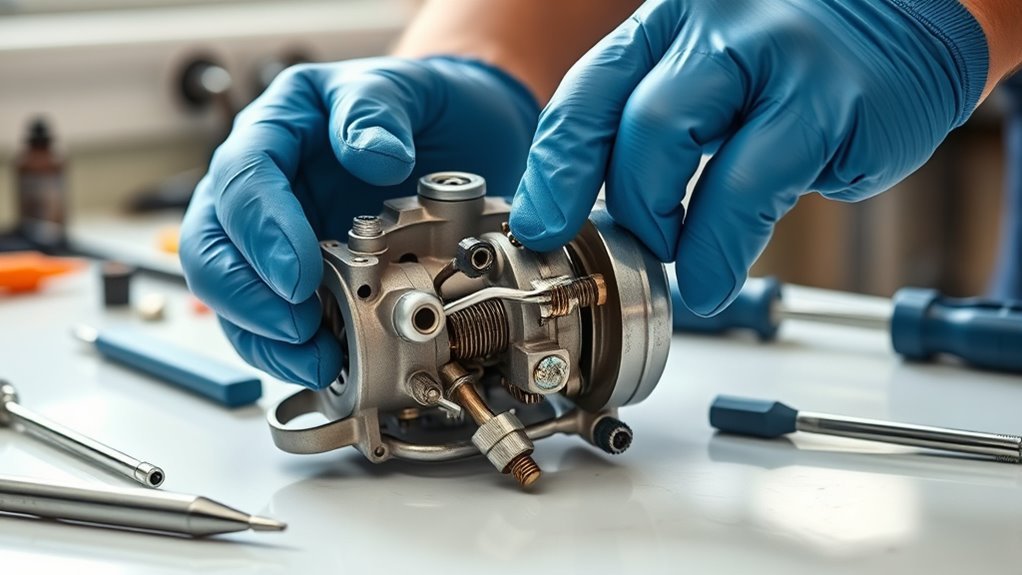

You service your carburetor by first identifying issues like rough idling or poor acceleration. Servicing the carburetor requires precision and attention to detail to restore optimal engine performance. Gather precision screwdrivers, wrenches, carb cleaner, and compressed air before starting the process.
Disassemble the carburetor carefully, labeling parts to avoid confusion. Soak components in cleaner and brush them gently to remove deposits. Clear the jets with compressed air to ensure unobstructed fuel flow.
Reassemble the carburetor, replacing gaskets as needed. Adjust the idle mixture and speed according to the manufacturer’s specifications. Check the choke and throttle linkages for proper operation.
Maintain regular cleaning and inspections to optimize performance. Understanding these steps prepares you for detailed tuning and troubleshooting, helping to keep your engine running smoothly.
Key Takeaways
- Diagnose carburetor issues by checking engine idling, starting difficulty, fuel efficiency, and exhaust smoke for performance clues.
- Disassemble carburetor safely in a clean area, label parts, and use carburetor cleaner with compressed air for thorough cleaning.
- Inspect jets, gaskets, and choke operation for wear or damage, replacing faulty parts to ensure proper function.
- Reassemble carefully following diagrams, replace gaskets, and fine-tune fuel-air mixture and idle speed according to manufacturer specs.
- Perform regular preventive maintenance: clean air filter every 3 months, inspect fuel lines monthly, and adjust mixture and idle speed biannually.
How to Identify When Your Carburetor Needs Servicing
Although carburetors are designed to function reliably over time, you’ll need to service yours if you notice irregular engine idling, difficulty starting, or decreased fuel efficiency.
These carburetor symptoms often indicate fuel-air mixture imbalances or internal blockages.
Performance issues like engine hesitation during acceleration, black smoke from the exhaust, or flooding are clear signs that the carburetor isn’t operating efficiently.
Engine hesitation, black exhaust smoke, or flooding signal an inefficiently operating carburetor needing service.
To identify when servicing is necessary, observe if the engine stalls at idle or displays a rough idle pattern.
Additionally, increased fuel consumption without changes in driving habits signals carburetor inefficiency.
Monitoring these symptoms systematically allows you to pinpoint carburetor faults early, ensuring better engine performance and preventing further damage.
Promptly addressing these performance issues will maintain your carburetor’s precision and extend its service life.
Tools and Materials Needed to Service a Carburetor
You’ll need specific tools like screwdrivers, wrenches, and a carburetor adjustment gauge to service your carburetor accurately.
Prepare cleaning materials such as carburetor cleaner spray, compressed air, and lint-free cloths to remove deposits effectively.
Having these essentials ready will guarantee a thorough and efficient servicing process.
Essential Tools Overview
Servicing a carburetor requires a specific set of tools to guarantee accurate disassembly, cleaning, and reassembly. You’ll need precision screwdrivers to handle various carburetor types, as screw sizes and head types differ.
A set of small wrenches or socket tools is essential for loosening nuts and bolts without damage. Needle-nose pliers allow you to manipulate springs and clips carefully. A carburetor adjustment tool helps fine-tune fuel-air mixtures, critical for maintaining peak performance based on maintenance frequency.
Additionally, a clean workspace with a magnetic parts tray prevents component loss. Having a magnifying glass or inspection mirror can aid in checking small passages and jets.
Equipping yourself with these tools guarantees you service the carburetor efficiently and effectively.
Required Cleaning Materials
After gathering the right tools for disassembly and adjustment, focus on the cleaning materials required to restore your carburetor’s performance.
Different carburetor types, whether single-barrel, two-barrel, or four-barrel, demand thorough cleaning solutions to remove varnish, deposits, and fuel residues effectively.
Use a carburetor-specific cleaning solution designed to dissolve gum and carbon without damaging metal components. Additionally, you’ll need a set of soft-bristle brushes and compressed air to clear jets, passages, and float bowls.
Make sure you have lint-free cloths to wipe surfaces without leaving fibers behind. Avoid harsh abrasives that can alter precision parts.
How to Safely Disassemble Your Carburetor
Before you start disassembling your carburetor, gather all essential tools to guarantee efficiency.
Set up a clean, well-lit workspace to prevent contamination and loss of small parts.
As you remove components, label each part carefully to maintain proper assembly order.
Gather Essential Tools
Although disassembling a carburetor can be complex, gathering the right tools simplifies the process and prevents damage. Different carburetor types demand specific tools for precise performance tuning. Before starting, verify you have these essentials ready to avoid interruptions and errors.
| Tool | Purpose |
|---|---|
| Screwdrivers (flat & Phillips) | Access screws on various carburetor types |
| Wrenches (metric & standard) | Loosen nuts without stripping |
| Carburetor cleaner spray | Remove deposits and varnish |
| Needle-nose pliers | Handle small parts delicately |
Having these tools at hand guarantees safety and efficiency, making your carburetor servicing smoother and more effective.
Work in Clean Area
Choose a clean, well-lit workspace to secure you don’t lose small parts or introduce contaminants during carburetor disassembly. A clean workspace helps you keep track of screws, jets, and springs, reducing the risk of misplacement.
Before starting, clear the area of dust, grease, and unrelated tools to minimize contamination. Use a lint-free mat or tray to catch falling components and prevent dirt intrusion.
Maintain organized tool placement to avoid accidental spills or damage to delicate parts. Handle the carburetor with clean hands or gloves to further reduce contamination risks.
Working in a controlled, clean environment secures the integrity of each component and facilitates a smooth, efficient disassembly process.
This preparation step is critical for successful carburetor servicing and accurate reassembly.
Label Parts Carefully
Labeling each part as you disassemble the carburetor guarantees you can accurately track their positions and avoid confusion during reassembly. Start by selecting a reliable labeling technique, such as using masking tape with fine-tip markers or small zip-lock bags with written tags.
Assign unique identifiers to parts, especially those that appear similar, to maintain precise part organization. Arrange labeled components systematically on a clean surface, grouping them by assembly sections or function.
This structured approach prevents mix-ups and accelerates the rebuild process. Avoid removing labels during cleaning or inspection by securing them firmly.
How to Thoroughly Clean Carburetor Parts
Before you begin reassembling the carburetor, you’ll need to clean each part meticulously to remove all deposits and debris. Use precise cleaning techniques like soaking parts in carburetor cleaner and brushing with a nylon brush. Avoid harsh abrasives that could damage surfaces.
After cleaning, perform thorough part inspection to check for cracks, warping, or corrosion.
| Cleaning Technique | Part Inspection Focus |
|---|---|
| Soak in carburetor cleaner | Check for cracks and corrosion |
| Use nylon brush | Inspect gasket and seals |
| Blow compressed air | Verify passageway clearance |
This method guarantees each part functions at its best, preventing future carburetor issues. Remember, thorough cleaning and inspection are critical for effective carburetor service.
How to Correctly Reassemble Your Carburetor
Start by organizing all cleaned and inspected carburetor parts on a clean, flat surface to streamline the reassembly process.
Follow these reassembly techniques to verify proper function:
- Inspect and perform gasket replacement to avoid leaks; never reuse old gaskets.
- Assemble the main body first, securing jets and needles precisely in their original positions.
- Reinstall small components such as springs and screws carefully, noting their orientation.
- Attach the float and needle valve mechanism, verifying smooth movement without binding.
Use a manual or diagram to confirm each part aligns correctly. Avoid forcing parts, which can cause damage.
Proper reassembly guarantees ideal carburetor performance and longevity.
Taking these steps methodically will help you avoid common errors, verifying your carburetor runs smoothly once installed.
How to Adjust Carburetor Settings for Best Performance
Once you’ve reassembled your carburetor correctly, you need to verify its settings to achieve ideal performance. Carburetor tuning involves adjusting the idle mixture, idle speed, and main jet to optimize fuel-air ratio and engine responsiveness. Begin with the idle mixture screw, then set idle speed, and finally test performance under load.
| Adjustment Parameter | Recommended Setting |
|---|---|
| Idle Mixture Screw | Turn clockwise until lean, then back 1/4 turn |
| Idle Speed Screw | Adjust to manufacturer’s RPM spec |
| Main Jet | Replace if engine hesitates or bogs |
| Choke Setting | Fully open at operating temperature |
| Throttle Linkage | Verify smooth, full range movement |
Follow these steps methodically for accurate carburetor tuning and performance optimization.
How to Troubleshoot Common Carburetor Problems
If your engine runs rough, stalls, or lacks power, you’ll need to diagnose common carburetor issues such as clogging, improper fuel mixture, or air leaks.
Identifying specific carburetor symptoms helps target the problem efficiently.
Follow these steps:
- Check for clogged jets by removing and inspecting them for debris restricting fuel flow.
- Inspect the fuel mixture settings; an overly rich or lean mixture causes poor engine performance.
- Look for vacuum leaks around gaskets and hoses that disrupt air-fuel balance.
- Examine the choke operation to verify it’s opening and closing correctly during startup.
Preventive Maintenance Tips for a Smooth-Running Carburetor
Although carburetors can be sensitive to wear and contamination, you can keep yours running smoothly by performing regular preventive maintenance. Focus on carburetor tuning to optimize the fuel mixture, ensuring efficient combustion and preventing engine performance issues.
Clean the air filter frequently, inspect the fuel lines for leaks, and check for deposits inside the carburetor body. Adjust the idle speed and mixture screws periodically to maintain proper settings.
| Task | Frequency | Purpose |
|---|---|---|
| Clean air filter | Every 3 months | Prevent dirt entering carburetor |
| Inspect fuel lines | Monthly | Detect leaks or cracks |
| Adjust fuel mixture | Every 6 months | Optimize combustion |
| Check idle speed | Every 6 months | Maintain smooth engine idle |
| Clean carburetor body | Annually | Remove deposits and buildup |
Following these steps lets you sustain effective carburetor performance.
Frequently Asked Questions
What Types of Fuel Work Best With Different Carburetors?
You should use low-ethanol blends or pure gasoline with older carburetors to avoid corrosion.
Modern carburetors handle up to 10% ethanol blends; always add fuel additives to protect components and maintain peak performance.
How Does Altitude Affect Carburetor Performance?
Altitude affects carburetor performance by reducing air density, decreasing fuel mixture, and lowering engine power.
You need precise carburetor tuning and altitude adjustments to maintain ideal air-fuel ratios and guarantee efficient combustion at higher elevations.
Can Carburetor Issues Cause Engine Flooding?
Yes, carburetor issues can cause engine flooding. If you notice flooding symptoms like fuel leaks or a strong smell, perform thorough carburetor maintenance.
This includes checking float levels and needle valves to prevent excess fuel entering the engine.
What Are the Environmental Impacts of a Malfunctioning Carburetor?
Like Pandora’s box, a malfunctioning carburetor releases excess emissions, violating emission regulations and reducing fuel efficiency. You’ll increase pollutants, harm air quality, and waste fuel, so precise adjustments are essential to minimize your environmental impact.
How Often Should a Carburetor Be Serviced for Vintage Engines?
You should perform carburetor maintenance tips on vintage engines every 6 to 12 months, depending on usage. Regular vintage engine care guarantees peak performance, prevents buildup, and extends engine life by keeping fuel flow consistent and clean.
Conclusion
Regular carburetor maintenance can improve engine efficiency by up to 15%, saving fuel and reducing emissions. By recognizing signs like rough idling or poor acceleration, you can confidently disassemble, clean, and reassemble your carburetor using the right tools and techniques.
Fine-tuning settings guarantees peak performance, while troubleshooting common issues keeps your engine running smoothly. Follow preventive maintenance tips consistently to extend your carburetor’s lifespan and maintain reliable engine function.
In conclusion, knowing how to service a carburetor is essential for keeping your engine running efficiently and reliably.