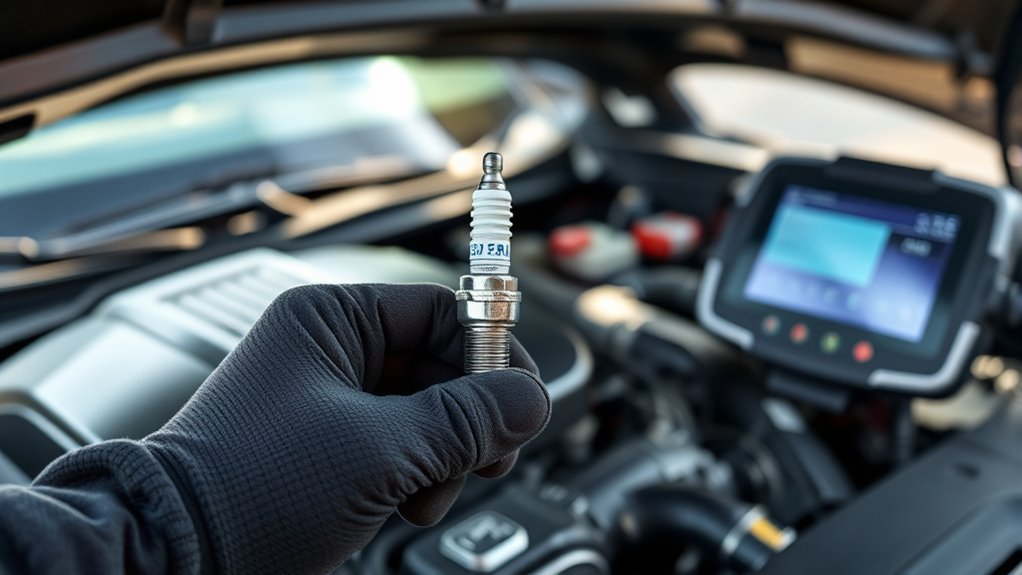

After changing spark plugs, resetting the check engine light is an important step to ensure your vehicle’s system recognizes the repair. You can reset the check engine light by connecting an OBD-II scanner to your vehicle’s port and selecting “Clear Codes.”
Alternatively, you can disconnect the battery’s negative terminal for about 15 minutes, then reconnect it securely. Some vehicles also allow resetting via the infotainment system’s diagnostics menu.
Make sure the new spark plugs are correctly installed and the engine runs smoothly. If the light stays on, precise troubleshooting is essential to fully resolve the issue and prevent future alerts.
Key Takeaways
- Use an OBD-II scanner to read and clear fault codes related to spark plugs via the vehicle’s diagnostic port.
- Disconnect the car battery’s negative terminal for 15 minutes to reset the ECU and turn off the check engine light.
- Access the vehicle’s infotainment system diagnostics menu to find and select the option to clear or reset the check engine light.
- Ensure spark plugs are properly installed with correct torque to avoid persistent error codes that keep the light on.
- Drive the car through several ignition cycles after replacement to allow the ECU to verify the new spark plugs before the light resets automatically.
Why Does the Check Engine Light Stay On After Changing Spark Plugs?
Although you’ve replaced the spark plugs, the check engine light may remain on because the engine control unit (ECU) hasn’t yet reset or detected the change. The ECU continuously monitors for spark plug malfunction and engine misfire through sensors.
If it recorded misfire codes before the replacement, the fault codes persist until the ECU confirms stable combustion across cylinders. Additionally, if the new spark plugs were improperly installed or the ignition system components are faulty, the ECU may still detect misfire signals.
This persistence prevents the check engine light from turning off automatically. To guarantee the ECU recognizes the resolved spark plug malfunction, you need to drive the vehicle through several complete drive cycles, allowing the system to verify consistent engine performance without misfire events.
How to Reset the Check Engine Light Using an OBD-II Scanner
When you want to clear the check engine light quickly and accurately, using an OBD-II scanner is the most effective method. First, verify your scanner has full OBD II functions and is compatible with your vehicle model. Connect the scanner to the OBD-II port, usually under the dashboard.
Power it on, access the diagnostic menu, and read the stored trouble codes. Once you confirm the spark plug-related codes, select “Clear Codes” to reset the light. This method avoids guesswork and guarantees precise error clearing.
| Step | Emotion Evoked |
|---|---|
| Connect scanner | Confidence |
| Read trouble codes | Clarity |
| Identify spark plug codes | Assurance |
| Clear codes | Relief |
How to Reset the Check Engine Light by Disconnecting the Battery
If you don’t have access to an OBD-II scanner, you can reset the check engine light by disconnecting the battery.
First, verify your vehicle is turned off. Locate the negative terminal of the battery, usually marked with a minus sign (-).
Use a wrench to carefully loosen the bolt securing the negative cable and perform a battery disconnect by removing the cable from the terminal.
Leave it disconnected for about 15 minutes to allow the vehicle’s computer to reset.
Reconnect the cable securely and tighten the bolt. This process clears temporary fault codes stored in the engine control unit, triggering an engine reset and turning off the check engine light.
Keep in mind, this method may erase radio presets and clock settings, so be prepared to reset them afterward.
How to Clear the Check Engine Light Using Your Car’s Infotainment System
Start by accessing your car’s infotainment diagnostics through the main menu.
Then, navigate to the engine settings section where you’ll find options related to system warnings.
Finally, select the option to reset or clear the check engine light to complete the process.
Accessing Infotainment Diagnostics
How do you access your car’s infotainment diagnostics to clear the check engine light? Start by powering on the infotainment system and maneuvering to the settings menu. Modern infotainment features often include built-in diagnostic tools accessible via touchscreen or physical controls.
Locate the diagnostics or vehicle status section to proceed.
Here’s a quick overview:
| Step | Action |
|---|---|
| 1. Open Settings | Access infotainment main menu |
| 2. Select Diagnostics | Find diagnostic tools or vehicle status |
| 3. Clear Codes | Use the option to reset check engine light |
Following these steps precisely lets you utilize integrated diagnostic tools to reset the light without external devices, streamlining the process after spark plug replacement.
Navigating to Engine Settings
Once you access the diagnostics menu through your infotainment system, the next step involves maneuvering to the engine settings to clear the check engine light.
Begin by selecting the “Engine” or “Powertrain” tab, which houses critical diagnostic tools for monitoring engine performance.
Use the touchscreen or control knob to traverse precisely, avoiding unintentional inputs. Within this section, locate options related to fault codes or system status.
These diagnostic tools provide a detailed overview of current issues affecting engine performance, including error codes triggered by the spark plug replacement.
Carefully review the displayed data to verify the source of the alert before proceeding.
Traversing accurately to this submenu guarantees you’re targeting the correct system parameters, setting the stage for an effective reset of the check engine light in the upcoming steps.
Resetting the Warning Light
To clear the check engine light using your car’s infotainment system, you’ll first need to access the diagnostics menu within the engine settings. From there, select the “Reset Warning Light” option.
This process employs built-in troubleshooting techniques that communicate with the vehicle’s onboard computer to clear fault codes triggering the warning light indicators. Make certain the ignition is on but the engine is off during this procedure.
| Step | Action | Expected Outcome |
|---|---|---|
| Access Diagnostics | Navigate to engine settings | Diagnostics menu appears |
| Select Reset | Choose “Reset Warning Light” | Fault codes cleared |
| Confirm Reset | Follow on-screen prompts | Check engine light resets |
Using this method guarantees a precise and system-approved reset without external tools.
How Long Does It Take for the Check Engine Light to Turn Off?
You’ll typically see the check engine light turn off after a few drive cycles once the issue is resolved.
Several factors affect this timing, including the severity of the fault and your vehicle’s onboard diagnostics system.
If the light remains on beyond expected periods, you may need to perform a manual reset using diagnostic tools.
Typical Reset Time
Several factors influence how long it takes for the check engine light to turn off after a reset. Understanding the typical reset time helps you manage your expectations following spark plug replacement.
Generally, the light duration depends on:
- Reset Procedures: Manual resets via OBD-II scanners typically turn the light off immediately, while battery disconnection may require driving cycles.
- Driving Patterns: The vehicle’s computer runs diagnostic checks during operation; consistent driving helps confirm the fix and clears the code.
- Vehicle Make and Model: Some vehicles require multiple drive cycles before the system recognizes the issue is resolved and turns off the light.
In most cases, expect the check engine light to turn off within a few drive cycles or up to a few days if relying on automatic reset procedures.
Factors Influencing Duration
Although the check engine light may turn off quickly after a reset, various factors influence how long it actually takes. The quality of your spark plugs directly impacts this duration; high-quality plugs guarantee consistent combustion, improving engine performance and reducing the likelihood of error codes reappearing.
Conversely, lower-quality plugs may cause misfires, keeping the light on longer. Additionally, your engine’s current performance level matters. If the engine runs smoothly after the change, the system typically confirms normal operation within a few drive cycles.
However, if performance issues persist, the onboard diagnostics system requires more cycles to verify the problem is resolved before turning the light off.
Understanding these variables helps you anticipate the check engine light’s behavior after replacing spark plugs.
When To Manually Reset
Since the check engine light can turn off automatically after multiple drive cycles, you should consider manually resetting it only if you’ve addressed the underlying issue and want to verify the fix immediately. A manual reset clears the warning light, allowing you to confirm that the spark plug replacement resolved the problem.
Here’s when to perform a manual reset:
- After replacing spark plugs and confirming no diagnostic trouble codes remain.
- When you need immediate feedback on whether the repair was successful.
- If the warning light persists despite repairs, to check if it was a temporary glitch.
Manual reset methods vary by vehicle but typically involve an OBD-II scanner or disconnecting the battery briefly. Use these techniques cautiously to avoid masking serious issues.
How to Confirm Your Spark Plugs Are Installed Correctly
To confirm your spark plugs are installed correctly, start by inspecting their seating and connection.
Verify each spark plug is properly aligned within the cylinder head to avoid cross-threading, which can damage the threads and cause poor engine performance.
Ensure spark plugs align correctly to prevent cross-threading and maintain optimal engine performance.
Use a torque wrench to tighten each plug to the manufacturer’s torque specifications. This prevents under-tightening that leads to misfires or over-tightening that risks thread stripping.
Check that each spark plug wire or coil pack firmly connects to the plug, verifying a secure electrical connection.
Finally, verify the gap on new plugs matches the vehicle’s required specification; improper gap affects ignition efficiency.
Common Mistakes That Keep the Check Engine Light On
If you keep experiencing a check engine light despite your efforts, you might be making common mistakes during diagnosis or repair. Proper spark plug installation is critical, but errors can still cause the light to persist. Avoid these pitfalls:
- Improper Torque on Spark Plugs: Over- or under-tightening can affect engine performance and trigger error codes detected during engine diagnostics.
- Neglecting to Clear Codes After Installation: Failing to reset stored codes in the vehicle’s computer means the check engine light won’t turn off.
- Ignoring Related Faults: Sometimes the issue lies beyond spark plugs. Worn ignition coils or damaged wiring can trigger the light despite correct spark plug installation.
Addressing these guarantees accurate engine diagnostics and successful check engine light reset.
What to Do If the Check Engine Light Won’t Reset
When your check engine light won’t reset after addressing the initial issue, you need to perform a thorough diagnostic to identify lingering faults or system malfunctions.
Begin by using an OBD-II scanner to read stored trouble codes; this tool provides precise data on unresolved issues.
Clear the codes after recording them, then monitor if the light returns. If it does, focus your check engine light troubleshooting on specific components indicated by the codes.
Inspect wiring, connectors, and sensors related to the spark plugs and ignition system for damage or poor connections.
Additionally, verify that the spark plugs are correctly installed and compatible.
If the light persists despite these steps, repeat diagnostics to confirm no secondary faults exist.
This methodical approach guarantees accurate identification and resolution of the problem.
When to See a Mechanic After Resetting the Check Engine Light
Although resetting the check engine light can temporarily clear warnings, you should consult a mechanic promptly if the light reappears shortly after or if your vehicle exhibits unusual performance issues.
Resetting the check engine light may mask issues—see a mechanic if it returns or performance declines.
A trained mechanic uses advanced diagnostic tools to identify underlying problems that simple resets can’t fix.
Pay attention to mechanic symptoms such as:
- Persistent or recurring check engine light illumination after reset.
- Noticeable drops in engine power, rough idling, or stalling.
- Unusual noises, exhaust smoke, or fuel efficiency decline.
Ignoring these signs can lead to further engine damage.
A professional diagnostic scan pinpoints fault codes accurately, enabling targeted repairs.
Don’t rely solely on resetting the light; timely mechanic intervention guarantees safety and prevents costly repairs down the line.
Frequently Asked Questions
Can Bad Spark Plugs Cause Engine Misfires Before Replacement?
Yes, bad spark plugs cause engine misfires before replacement. You’ll notice spark plug symptoms like rough idling and reduced engine performance.
Replacing them promptly restores ignition efficiency and smooth engine operation, preventing further damage.
How Often Should Spark Plugs Be Replaced in General?
You should replace spark plugs every 30,000 to 100,000 miles, depending on the spark plug lifespan specified by your vehicle manufacturer.
Follow replacement intervals precisely to maintain peak engine performance and fuel efficiency.
What Tools Are Needed to Change Spark Plugs?
You’ll need spark plug tools like a spark plug socket, ratchet wrench, extension bar, and a gap gauge for changing spark plugs. These guarantee precise removal, installation, and correct spark plug gap adjustment during changing spark.
Are All Spark Plugs Compatible With Every Car Model?
Only about 30% of spark plug types fit multiple vehicles. You shouldn’t assume compatibility; always check the manufacturer’s specs to avoid compatibility issues.
Using the wrong spark plug types can cause engine misfires or damage.
Can Faulty Spark Plug Wires Trigger the Check Engine Light?
Yes, faulty spark plug wires can trigger the check engine light. They cause misfires or poor engine performance, which the onboard diagnostics detect, illuminating the check engine indicator to alert you of ignition system issues.
Conclusion
Resetting your check engine light after changing spark plugs is often straightforward. Did you know that about 30% of check engine alerts are caused by ignition issues, such as faulty plugs? Using an OBD-II scanner or disconnecting the battery usually clears the code quickly.
However, if the light stays on after a few drive cycles, double-check your spark plug installation. In some cases, consulting a mechanic might be necessary to ensure everything is properly fixed.
An accurate diagnosis and reset are essential to keep your vehicle running efficiently and safely. Remember, knowing how to reset check engine light after changing spark plugs can save you time and help maintain your car’s performance.