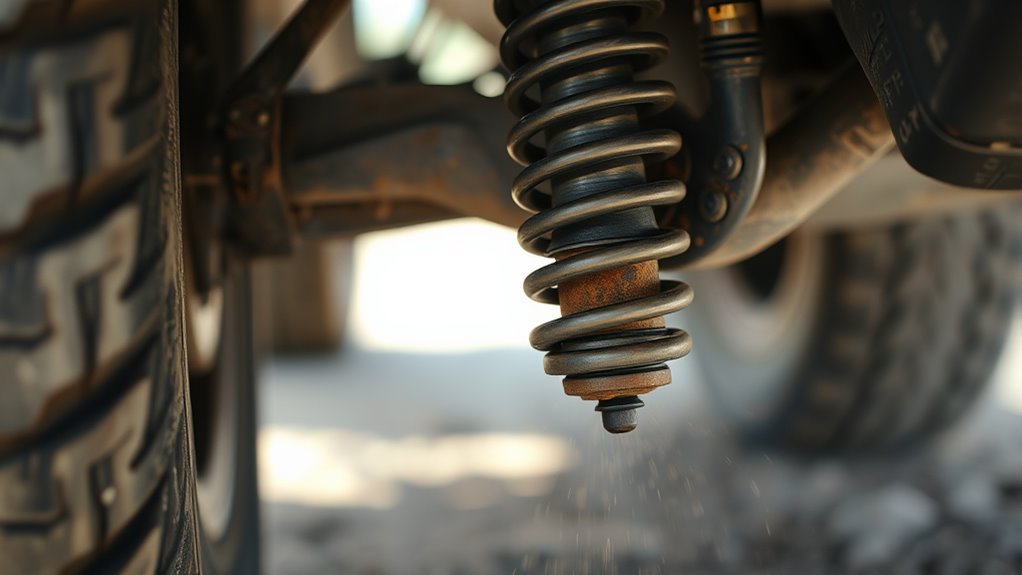

Can bad shocks cause vibration? Yes, they can definitely cause vibration by failing to dampen the oscillations from road irregularities. When your shocks lose fluid or have worn components, they allow uncontrolled bouncing that transmits motion to the vehicle frame and steering wheel, creating noticeable vibration.
This negatively affects handling, stability, and safety by amplifying dynamic loads. Understanding how these shock failures lead to vibration can help you better diagnose and address the issue for a smoother, safer ride.
Key Takeaways
- Bad shocks fail to dampen oscillations, causing uncontrolled vehicle movement and noticeable vibrations.
- Worn shocks produce uneven vertical motions and increased bounce frequency felt as vibration on rough roads.
- Defective shocks alter vibration frequency, amplifying oscillations and causing consistent vibration intervals matching shock rebound.
- Vibration from bad shocks often includes steering wheel shudder and decreased stability during cornering or braking.
- Regular shock maintenance prevents vibrations by ensuring proper absorption and vehicle stability, reducing safety risks.
Can Bad Shocks Cause Vibration? How Shocks Affect Vehicles and Machinery
How exactly do bad shocks cause vibration in vehicles and machinery? When shock absorption components deteriorate, they lose their ability to dampen oscillations effectively. This failure allows uncontrolled movement and resonance within the system, leading to noticeable vibration.
In vibration analysis, you’ll find that defective shocks alter the frequency response, amplifying unwanted oscillations. The shock absorber’s role is to convert kinetic energy into thermal energy, stabilizing the chassis or mechanical structure.
Defective shocks change frequency response, amplifying oscillations by failing to convert kinetic energy into thermal energy.
When this process is compromised, components experience increased dynamic loads, resulting in vibration that affects performance and safety.
So, bad shocks disrupt the controlled dissipation of energy, causing erratic vibrations that propagate through the vehicle or machinery’s framework.
Understanding this interplay is essential for diagnosing and mitigating vibration issues related to shock absorption failures.
Signs Your Shocks Are Causing Vibration
Why might you feel unusual vibrations while driving or operating machinery? One primary indicator is uneven or excessive vibration that correlates with road irregularities or load variations. If shock absorbers are worn or damaged, they fail to dampen oscillations effectively, resulting in persistent vibrations.
During vibration analysis, focus on irregular vertical motions, increased bounce frequency, or steering wheel shudder. Additionally, poor shock maintenance often leads to fluid leaks or visible damage, which are objective signs.
You may notice decreased stability during cornering or braking, further signaling shock-related issues. Identifying these signs promptly through systematic vibration analysis helps prevent secondary damage and guarantees operational safety.
Always integrate shock maintenance protocols to monitor shock absorber conditions regularly and address vibration symptoms early.
How to Tell Vibration From Bad Shocks Versus Other Causes
You need to identify specific vibration symptoms to determine if bad shocks are the source.
Focus on differentiating the impact of worn shocks from other common causes like tire imbalance or drivetrain issues.
Identifying Vibration Symptoms
Where exactly does the vibration originate when you experience bad shocks?
Typically, the vibration frequency correlates closely with the shock rebound cycle.
If your shocks are compromised, the suspension fails to absorb impact efficiently, causing a rapid, uneven rebound that transmits vibrations through the chassis.
You’ll notice these vibrations occurring at consistent intervals matching the shock’s oscillation rate.
To identify if bad shocks cause vibration, observe whether the vibrations intensify during uneven terrain or abrupt braking.
These are conditions that demand maximum shock absorption.
Unlike other causes, bad shocks produce a distinctive vibration pattern tied directly to shock rebound dynamics rather than wheel imbalance or drivetrain issues.
Monitoring this frequency and corresponding vehicle behavior helps you pinpoint vibration symptoms specifically linked to failing shocks.
Differentiating Shock Impact
Distinguishing vibration caused by bad shocks from other sources requires careful analysis of the vibration’s characteristics and conditions under which it occurs. You need to assess various shock types, such as sudden impacts, continuous jolts, or intermittent hits, and correlate them with the timing and frequency of the vibration.
Conducting a thorough impact analysis helps isolate whether the vibration stems from shock absorption failure or other mechanical issues. Focus on amplitude, duration, and waveform patterns during these shocks.
Bad shocks often produce irregular, high-amplitude spikes distinct from smoother, periodic vibrations caused by imbalances or misalignments.
Common Vibration Causes
Although vibrations can originate from numerous mechanical issues, identifying those caused specifically by bad shocks hinges on analyzing their unique signatures.
You need to evaluate various shock absorber types—hydraulic, gas-charged, or coil-over—since each exhibits distinct damping behaviors impacting vibration patterns.
Employ vibration testing techniques like frequency analysis and accelerometer data collection to isolate shock-induced oscillations from other sources such as tire imbalance, drivetrain issues, or wheel misalignment.
Focus on low-frequency vibrations typically linked to deteriorated shock absorbers, contrasting them against higher-frequency vibrations caused by engine or transmission faults.
What Happens When Bad Shocks Cause Vibration
When bad shocks cause vibration, you need to pinpoint the exact source to address the issue effectively.
This vibration directly affects your vehicle’s handling, reducing stability and control.
Identifying Vibration Sources
If bad shocks generate vibrations, you need to pinpoint their exact source to address the issue effectively. Conducting a thorough vibration analysis helps isolate whether shocks are the root cause or if other components contribute.
Focus on these key steps during shock maintenance and diagnostics:
- Inspect shock absorbers for leaks, wear, or damage affecting damping performance.
- Check mounting hardware and bushings for looseness or degradation causing vibration transmission.
- Perform vibration frequency analysis to correlate shock defects with vibration patterns.
- Evaluate suspension alignment and tire condition that may amplify or mimic shock-induced vibrations.
Impact on Vehicle Handling
After isolating bad shocks as a source of vibration, you can assess how these vibrations directly affect vehicle handling.
Faulty shocks compromise your vehicle stability by failing to adequately dampen road impacts, resulting in excessive body roll and reduced tire contact with the road surface.
This instability impairs steering response and braking efficiency, increasing the risk of loss of control during maneuvers.
Additionally, vibrations from worn shocks can mask subtle handling cues, making it harder for you to anticipate and react to road conditions.
Maintaining proper shock maintenance is critical; neglecting it allows shock degradation that progressively undermines handling performance.
Diagnosing Shock Absorber Issues
Although diagnosing shock absorber issues can be challenging, identifying vibration patterns and their sources provides clear indicators of worn or damaged shocks. You’ll want to start with a thorough shock inspection, checking for leaks, dents, or corrosion.
Next, conduct vibration analysis while driving to pinpoint irregular oscillations linked to faulty shocks. Pay close attention to:
- Uneven tire wear or cupping
- Excessive bouncing after bumps
- Steering wheel vibrations at certain speeds
- Abnormal noises during suspension compression
Combining these observations allows you to differentiate shock-related vibrations from other suspension or wheel problems.
Precise shock inspection paired with targeted vibration analysis guarantees accurate diagnosis, helping you address issues before they escalate into safety hazards or costly repairs.
How Bad Shocks Cause Unstable Rides and Vibration
When your shocks deteriorate, they can no longer effectively absorb and dampen road impacts, which directly compromises vehicle stability.
Poor shock absorption means your tires lose consistent contact with the road, causing erratic handling and increased body roll during turns.
Inadequate shock absorption disrupts tire-road contact, leading to unstable handling and excessive body roll.
This instability manifests as vibrations transmitted through the chassis, reducing ride comfort and driver control.
Additionally, worn shocks fail to control suspension rebound, resulting in oscillations that amplify vibration frequency and intensity.
The cumulative effect is an unstable ride where you feel every irregularity, increasing fatigue and risk during driving.
Understanding how shock degradation disrupts the suspension’s damping function helps you grasp why bad shocks lead to both unstable rides and vibration issues.
Maintaining effective shock absorption is essential for preserving vehicle stability and a smooth, controlled ride.
How to Diagnose Vibration Issues Linked to Faulty Shocks
Recognizing the connection between faulty shocks and vibration is just the beginning; accurately diagnosing these issues requires a systematic approach.
You need to perform detailed vibration analysis and thoroughly inspect shock maintenance records.
Start by:
- Visually examining shocks for leaks, dents, or damage.
- Conducting bounce tests to assess shock responsiveness.
- Using vibration analysis tools to detect irregular oscillation frequencies.
- Checking vehicle alignment and tire conditions to rule out other vibration sources.
Repair or Replace Bad Shocks Causing Vibration
If your inspection confirms that worn or damaged shocks are causing vibration, you’ll need to decide whether to repair or replace them. Generally, shock replacement offers a more reliable solution since shocks undergo significant wear and tear, reducing their effectiveness over time.
Repairing shocks often involves replacing seals or refilling fluid, but this may not fully restore performance, potentially leading to incomplete vibration repair.
When opting for shock replacement, make sure you select components compatible with your vehicle’s specifications to maintain peak ride stability.
Additionally, professional installation is critical to avoid alignment issues that could perpetuate vibration problems.
Prioritizing shock replacement over repair minimizes the risk of recurring vibration, guaranteeing a smoother, safer driving experience.
Why Maintaining Shocks Prevents Vibration Problems
Since shocks play a critical role in dampening road impact and maintaining tire contact, regular maintenance directly prevents vibration issues by preserving their ideal function.
When you prioritize shock maintenance, you guarantee consistent absorption of irregularities, reducing oscillations that cause vibration.
Neglecting this leads to uneven damping, creating resonance frequencies felt as vibrations.
Ignoring shock maintenance causes uneven damping and vibrations through resonance frequencies.
To maximize vibration prevention, focus on:
- Inspecting shocks for leaks and physical damage
- Checking shock mountings for tightness and wear
- Monitoring ride quality changes indicating shock degradation
- Replacing shocks at manufacturer-recommended intervals
Why Bad Shocks Threaten Safety and Equipment Life
Although bad shocks may seem like a minor issue, they directly compromise vehicle safety and accelerate equipment wear.
When shocks deteriorate, they fail to absorb impacts effectively, causing excessive vibration transmission through the chassis. This increased vibration undermines control and stability, elevating the risk of accidents.
Furthermore, poor shock performance leads to uneven tire wear and stresses suspension components beyond design limits, reducing overall equipment life.
Proper shock maintenance is crucial to restore damping efficiency and guarantee vibration prevention. Neglecting this maintenance allows vibration to propagate, damaging sensitive parts and increasing repair costs.
Frequently Asked Questions
Can Bad Shocks Affect Fuel Efficiency?
Yes, bad shocks reduce shock absorber efficiency, increasing rolling resistance and uneven tire wear. Your fuel consumption analysis will show higher fuel use as your vehicle works harder, lowering overall fuel efficiency considerably.
Do Bad Shocks Cause Uneven Tire Wear?
Yes, bad shocks can cause uneven tire wear by disrupting tire alignment and stressing suspension components. You’ll notice irregular tread patterns as the shocks fail to maintain consistent contact, leading to premature tire degradation and handling issues.
How Often Should Shocks Be Inspected or Replaced?
You should perform shock maintenance every 12,000 to 15,000 miles, with an inspection frequency of at least twice a year to detect wear or leaks. This ensures ideal vehicle stability and prevents premature suspension component failure.
Are Certain Vehicle Types More Prone to Shock-Related Vibration?
Yes, off road trucks and luxury vehicles are more prone to shock-related vibration due to their advanced suspension systems and heavier loads.
You’ll notice vibrations if shocks degrade, affecting ride quality and vehicle stability considerably.
Can Driving Habits Worsen Shock Absorber Damage?
Yes, your aggressive driving techniques, like sudden braking or sharp turns, accelerate shock absorber wear.
Consistent shock maintenance and adopting smoother driving habits help preserve shock performance, reduce vibration, and extend your vehicle’s suspension lifespan effectively.
Conclusion
So, if you’re into feeling every bump like a personal massage or prefer your ride to mimic a shaky carnival ride, by all means, ignore those bad shocks. But if you value stability, safety, and machinery that doesn’t vibrate itself to death, it’s time to diagnose and fix those faulty shocks.
Trust me, your vehicle and your nerves will thank you when you swap out those troublemakers for smooth, vibration-free rides. Remember, bad shocks can definitely cause vibration, so addressing them promptly ensures a safer and more comfortable driving experience.