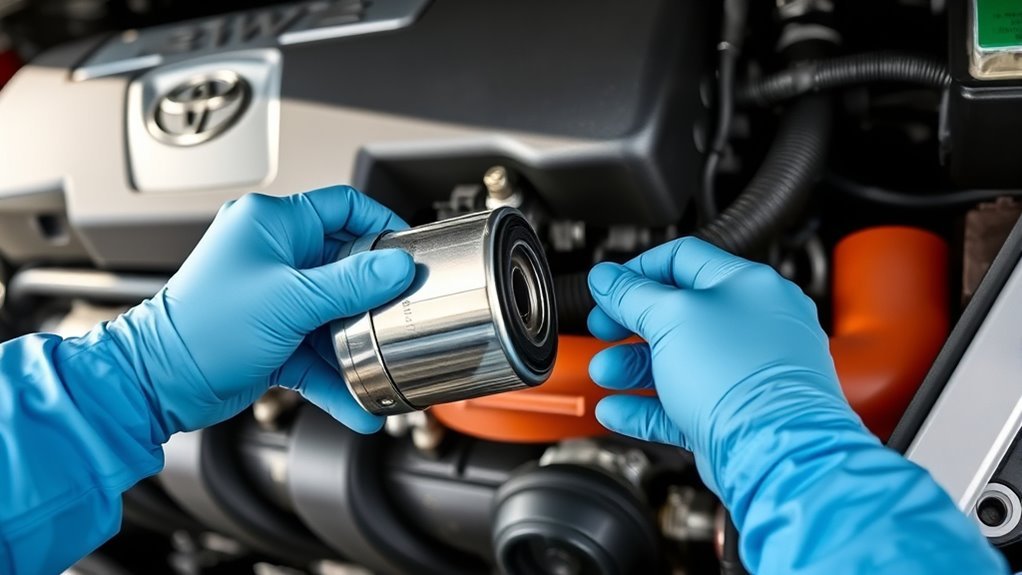

To change the oil filter on your 2016 Sienna XLE, start by securing the vehicle on a level surface. Engage the parking brake and make sure the engine is completely cooled down before you begin. This ensures safety and prevents burns.
Next, drain the old oil by removing the drain plug using a 14mm socket. Once the oil has drained, carefully remove the cartridge-style oil filter with a wrench.
Install a new OEM oil filter by first lightly oiling the O-ring. Hand-tighten the filter to avoid leaks and ensure a proper seal.
Finally, refill the engine with Toyota’s recommended 0W-20 synthetic oil. Check for any leaks after installation and make sure to properly dispose of the used oil and filter. Following these detailed steps will help you change the oil filter accurately and efficiently.
Key Takeaways
- Locate the spin-on oil filter on the engine block’s front right side using a flashlight for better visibility.
- Use an oil filter wrench to loosen the housing cap and remove the cartridge filter, noting the O-ring position.
- Coat the new filter’s rubber O-ring lightly with clean engine oil and hand-tighten it snugly without tools.
- Drain old engine oil by removing the 14mm drain plug and dispose of it responsibly at a recycling center.
- Refill with Toyota-recommended synthetic 0W-20 oil, check for leaks, and verify oil pressure before completing the job.
Gather Tools and Supplies
Before you begin changing the oil filter on your 2016 Sienna XLE, gather all necessary tools and supplies to streamline the process.
Start with a tools checklist: an oil filter wrench compatible with the Sienna’s filter size, a socket set including a 14mm socket for the drain plug, a torque wrench, and a drain pan.
Essential supplies include a new OEM oil filter, high-quality engine oil matching Toyota’s specifications, and a funnel to avoid spills.
Additionally, have clean rags to wipe any oil residue and nitrile gloves for protection.
Confirm you have a jack or ramps if you plan to elevate your van for better access, but only proceed after verifying safety measures.
Organizing these items beforehand reduces interruptions and guarantees a smooth, efficient oil filter replacement.
Prepare Your Van Safely
Before starting, park your 2016 Sienna XLE on a level surface to guarantee stability throughout the process.
Engage the parking brake firmly to prevent any movement.
Allow the engine to cool completely to avoid burns and guarantee safe handling of components.
Park On Level Ground
Finding a flat, stable surface is essential to guarantee your 2016 Sienna XLE stays secure throughout the oil filter change. Parking on level ground minimizes risks associated with vehicle movement, ensuring maximum parking safety.
Follow these steps to properly position your van:
- Locate a level ground area free of debris, gravel, or incline greater than 2 degrees.
- Align your van straight within the parking space to prevent any lateral shift.
- Confirm the surface’s firmness by pressing down with your foot; avoid soft or uneven terrain.
These measures maintain vehicle stability, prevent unintended rolling, and provide a safe working environment.
Engage Parking Brake
Engage the parking brake firmly to immobilize your 2016 Sienna XLE and prevent any unintended movement during the oil filter change. This step is vital for safety precautions, guaranteeing the vehicle stays stationary even if on a slight incline. Proper use of the parking brake underscores its importance in maintenance tasks, reducing accident risks.
| Step | Action | Reason |
|---|---|---|
| 1 | Locate parking brake | Guarantee accessibility |
| 2 | Pull brake lever firmly | Secure vehicle position |
| 3 | Confirm brake engaged | Verify immobilization |
| 4 | Double-check stability | Maintain safety precautions |
Always confirm the brake’s engagement before proceeding to protect yourself during the oil filter replacement.
Allow Engine To Cool
With the parking brake firmly set, you can move on to verifying the engine has cooled sufficiently.
Managing engine temperature is critical before starting the oil filter change to prevent burns and guarantee safe handling of components.
Follow these steps precisely:
- Turn off the engine and wait at least 30 minutes to allow oil cooling and engine temperature stabilization.
- Check the surface temperature of the engine block carefully; avoid contact with hot parts.
- Confirm the oil dipstick shows a safe temperature by lightly touching it or using an infrared thermometer.
This methodical approach guarantees your safety and protects the integrity of the oil system during maintenance.
Never rush the oil cooling phase to avoid injury or damage.
Locate the Oil Filter
You’ll find the oil filter located on the engine block, accessible under the hood near the front right side.
Open the hood and secure it, then scan the area for a cylindrical canister, which is the oil filter housing.
Identify whether your model uses a cartridge-style or spin-on type to prepare for removal.
Oil Filter Location Overview
Finding the oil filter on a 2016 Sienna XLE is essential before beginning the replacement process. Proper identification guarantees efficient maintenance and prevents damage. The oil filter is located on the engine block’s side, designed for easy removal and installation.
Follow these maintenance tips to locate it precisely:
- Position yourself at the front of the vehicle and look toward the engine’s lower section.
- Identify a cylindrical component, typically black or white, attached horizontally to the engine block.
- Confirm the oil filter’s location by cross-referencing with the vehicle’s service manual or a maintenance guide.
Knowing the exact oil filter location streamlines your oil change process, reduces errors, and promotes effective vehicle upkeep.
Accessing Under Hood
Before accessing the oil filter, open the hood and secure it using the prop rod to confirm safe and unobstructed work space. The 2016 Sienna XLE’s engine compartment layout is designed for straightforward maintenance, but you’ll need to familiarize yourself with it to optimize oil filter accessibility.
Locate the engine cover and remove it if necessary to improve visibility. The oil filter resides on the lower front side of the engine block, partially shielded by adjacent components. Use a flashlight to precisely identify its position in the tight engine compartment.
Clear any cables or hoses obstructing your reach carefully without forcing them.
Identifying Filter Type
Locating the oil filter on the 2016 Sienna XLE requires recognizing its specific type and placement within the engine bay. This model uses a cartridge-style oil filter housed in a black plastic canister, rather than a traditional spin-on filter.
To accurately identify and confirm filter compatibility, follow these steps:
- Refer to filter specifications in the owner’s manual or OEM parts catalog to confirm the exact cartridge model required.
- Locate the filter housing, typically positioned near the engine block’s front lower section, identifiable by a round cap secured with bolts.
- Verify filter compatibility with the vehicle’s engine code and oil type to prevent installation issues or damage.
This methodical approach guarantees you select and locate the correct filter for efficient oil maintenance.
Drain Old Engine Oil
Begin by positioning a suitable container beneath the oil drain plug to catch the draining fluid.
Using the correct size wrench, carefully loosen and remove the drain plug counterclockwise.
Allow all old engine oil to completely drain into the container; this guarantees effective engine maintenance by removing contaminants.
Avoid rushing, as residual oil can affect your new oil filter’s performance.
Once drained, inspect the drain plug for damage or worn washer and replace if necessary.
Clean the plug and reinstall it, tightening to the manufacturer’s specified torque to prevent leaks.
Proper oil disposal is critical.
Transfer the used oil to a sealed container and take it to a certified recycling center.
This methodical process safeguards the engine and supports environmental responsibility during oil changes.
Remove the Old Oil Filter
Turn your attention to the oil filter housing, which is typically found near the engine block.
Identifying the correct oil filter type is essential, as the 2016 Sienna XLE uses a cartridge-style filter within a housing rather than a spin-on type.
Follow these removal techniques precisely:
- Place a drain pan beneath the housing to catch residual oil.
- Use an appropriate oil filter wrench or socket to loosen the housing cap by turning it counterclockwise.
- Carefully lift out the cartridge filter, noting the orientation and condition of the rubber O-ring, which must be removed and replaced.
Adhering to these steps guarantees a clean, safe removal, preventing damage to the housing or engine components.
Install the New Oil Filter
Carefully insert the new cartridge-style oil filter into the housing, making sure the rubber O-ring is properly seated to prevent leaks.
Before installation, lightly coat the O-ring with clean engine oil to improve the seal and ease removal during the next oil change.
Align the filter carefully, then tighten it by hand until it’s snug; avoid using tools that might overtighten and damage the filter housing.
Since oil filter types vary, always select one that matches your 2016 Sienna XLE’s specifications.
Proper installation supports peak engine performance and longevity.
Remember, adhering to the recommended oil change frequency is critical, as it prevents contaminants from compromising the filter’s effectiveness and your engine’s health.
Verify the filter is secure but avoid excessive force to maintain system integrity.
Refill Engine Oil With Correct Type
To properly refill your 2016 Sienna XLE’s engine oil, use exactly the specified oil type to guarantee peak engine performance and protection.
Toyota recommends synthetic oil with the correct oil viscosity, typically SAE 0W-20, to assure ideal lubrication and temperature stability.
Follow these steps methodically:
- Remove the oil filler cap and pour in the new synthetic oil slowly, allowing it to settle.
- Add the precise quantity specified in the owner’s manual, usually around 4.6 quarts, to avoid overfilling.
- Replace the oil filler cap securely to prevent contamination and leaks.
Using the correct synthetic oil with proper oil viscosity maintains engine efficiency and prolongs component life.
Always double-check the manual for any updates to oil specifications before refilling.
Check for Oil Leaks and Pressure
After completing the oil refill, inspect all connections and seals for any signs of leaks.
Use a clean cloth to wipe around the oil filter housing and drain plug, then observe for fresh oil accumulation.
Engage the ignition without starting the engine to activate the oil pump, allowing initial oil pressure to build.
Monitor the oil pressure gauge on the dashboard to confirm it rises to the manufacturer’s specified range.
If the gauge remains low or fluctuates, shut off the engine immediately and recheck the filter and drain plug tightness.
Conduct thorough leak detection by visually inspecting the oil filter base and surrounding areas while the engine runs briefly.
Address any detected leaks promptly to prevent engine damage and maintain ideal oil pressure stability.
Dispose of Old Oil and Filter Safely
You’ll need to collect and store the used oil and filter immediately after removal to prevent contamination and environmental harm.
Follow these steps for proper oil disposal and to explore recycling options:
- Use a clean, leak-proof container to store the drained oil; avoid mixing with other fluids.
- Place the used oil filter in a sealed plastic bag or container to contain residual oil.
- Locate a certified recycling center or automotive store that accepts used oil and filters, ensuring compliant disposal.
Never pour oil down drains or onto soil. Proper oil disposal protects ecosystems and complies with regulations.
Avoid dumping oil into drains or soil to safeguard the environment and follow legal guidelines.
By selecting authorized recycling options, you contribute to resource conservation and pollution prevention.
Handle all materials with care, wear gloves, and clean spills promptly to maintain safety and environmental standards.
Frequently Asked Questions
How Often Should I Change the Oil Filter on a 2016 Sienna XLE?
You should change the oil filter every oil change frequency, typically every 5,000 to 7,500 miles. Follow the maintenance schedule in your 2016 Sienna XLE’s manual for ideal engine performance and longevity.
Can I Use a Generic Oil Filter Instead of the Toyota Brand?
You can use a generic oil filter if it meets oil filter compatibility standards for your 2016 Sienna XLE. However, perform a filter quality comparison to guarantee it matches Toyota brand durability and filtration efficiency requirements.
What Are Signs of a Clogged Oil Filter in My Van?
You’ll notice clog symptoms in your oil filter as reduced engine performance, increased oil pressure, unusual engine noises, or oil leaks.
Monitor these signs methodically to identify a clogged oil filter promptly and maintain peak engine function.
Is It Necessary to Reset the Oil Change Light After Replacement?
Think of your oil change light like a fitness tracker; it won’t reset itself after a workout. You must manually reset it to guarantee accurate maintenance tips and keep your van’s engine performance peak.
Can I Change the Oil Filter Myself Without Professional Help?
Yes, you can perform DIY maintenance to change the oil filter yourself, following precise steps. This approach guarantees cost savings and control over quality, but requires proper tools and careful adherence to manufacturer specifications for safety and effectiveness.
Conclusion
Changing your 2016 Sienna XLE’s oil filter is like tending to the heart of your engine—each step guarantees smooth, reliable life flow.
By carefully draining old oil, replacing the filter, and refilling with the right oil, you renew your van’s energy. This precise maintenance guards against wear and preserves performance, symbolizing your commitment to longevity and care.
Follow the method carefully, and your engine will thank you with every mile driven. Properly changing the oil filter on your 2016 Sienna XLE is essential to keep your vehicle running at its best.