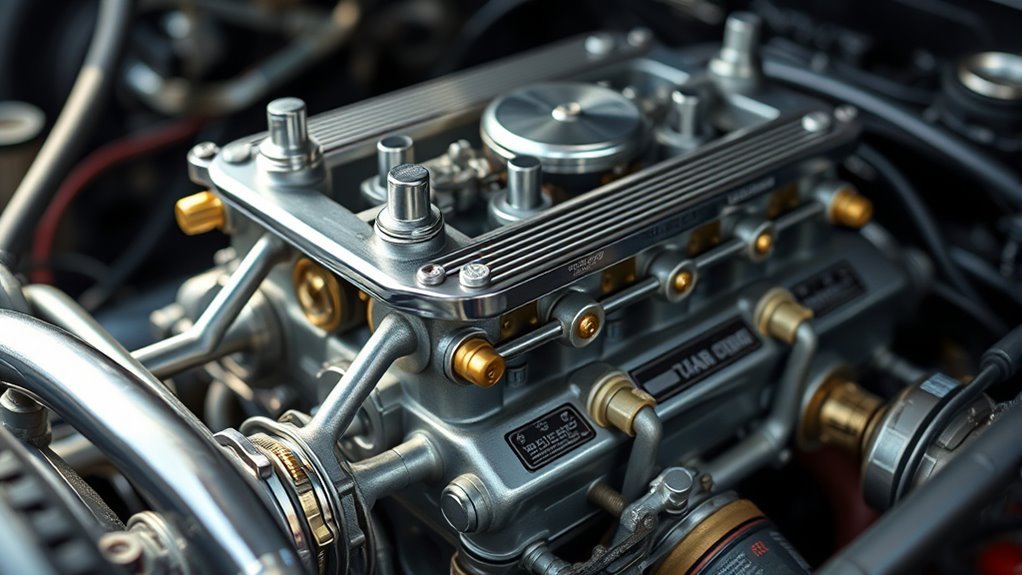

You rely on your car’s carburetor to mix air and fuel precisely for ideal combustion. The carburetor plays a crucial role in ensuring the right balance for your engine to run smoothly.
As air flows through the venturi, pressure drops and draws fuel from jets into the airstream, creating a fine spray. The float chamber maintains fuel levels, while the throttle and choke control airflow and engine speed.
Proper functioning guarantees efficiency and power, but issues like clogs or leaks can affect performance. Understanding these details helps you master carburetor operation and maintenance.
Key Takeaways
- A carburetor mixes air and fuel for combustion by drawing fuel through jets into a venturi-shaped airflow passage.
- The venturi creates a pressure drop that pulls fuel into the airstream, atomizing it for efficient engine combustion.
- The throttle valve controls airflow volume, regulating engine speed and power output.
- The float chamber maintains a consistent fuel level to supply the jets reliably.
- Proper carburetor tuning affects fuel efficiency, engine performance, and emissions control.
What a Carburetor Does and Why It’s Important
Although it may seem like a simple component, the carburetor plays an integral role in your engine’s performance by precisely mixing air and fuel in the correct ratio for combustion.
Understanding carburetor history reveals its evolution from rudimentary fuel delivery systems to sophisticated mechanical devices, vital before fuel injection became widespread.
The carburetor evolved from simple fuel delivery to complex mechanical systems before fuel injection dominated.
You’ll appreciate how proper tuning techniques directly impact efficiency, power output, and emissions control. By adjusting idle mixture screws, float levels, and jet sizes, you guarantee ideal air-fuel ratios under varying engine loads and speeds.
Without accurate tuning, the carburetor can cause poor fuel economy, rough idling, or engine stalling.
How a Carburetor Mixes Air and Fuel to Power Your Engine
You control the airflow through a venturi-shaped passage that precisely regulates the volume entering the carburetor.
As air speeds up, it creates a pressure drop that draws fuel through jets, atomizing it into fine droplets.
This controlled mixture of air and fuel then flows into the engine for efficient combustion.
Airflow Regulation Mechanism
When air flows through the carburetor’s venturi, it creates a pressure drop that draws fuel from the jet into the airstream, precisely regulating the air-fuel mixture needed to power your engine effectively.
This process hinges on airflow dynamics, where the venturi’s narrowing accelerates air, lowering pressure according to Bernoulli’s principle.
The pressure regulation guarantees fuel is metered correctly, preventing rich or lean mixtures that could impair performance. As you adjust the throttle, you alter the venturi’s airflow, which directly influences the pressure differential and consequently the fuel flow.
This delicate balance between air velocity and pressure drop allows the carburetor to maintain ideal combustion conditions under varying engine loads and speeds, delivering consistent power and responsiveness.
Fuel Atomization Process
The precise regulation of airflow and fuel delivery sets the stage for the fuel atomization process, where liquid fuel breaks into fine droplets and mixes thoroughly with incoming air.
As air passes through the carburetor’s venturi, it creates a low-pressure zone that draws fuel through the jet, initiating fuel droplet formation.
These droplets disperse into a mist, optimizing the surface area for better vaporization. You rely on this finely atomized mixture to guarantee uniform combustion within the engine cylinders.
Proper fuel droplet size directly influences combustion efficiency by promoting complete burning and reducing unburned hydrocarbons.
If droplets are too large, incomplete combustion occurs, wasting fuel and increasing emissions.
Consequently, the carburetor’s design carefully balances airflow and fuel atomization to maximize engine performance, fuel economy, and emission control.
The Main Parts of a Carburetor and What They Do
Understanding a carburetor’s main parts is essential for diagnosing and optimizing engine performance. You’ll find key components like the float chamber, which regulates fuel level, and the venturi, where air velocity increases to draw fuel into the airstream.
Different carburetor types may vary in design, but these parts are fundamental to precise fuel delivery. The throttle valve controls airflow volume, directly influencing engine speed, while the fuel jets meter the exact amount of fuel entering the venturi.
Additionally, the fuel inlet allows gasoline into the float chamber, maintaining a consistent supply.
How the Carburetor Throttle and Choke Control Engine Performance
You control engine power by adjusting the throttle valve, which regulates airflow into the carburetor.
The choke mechanism restricts air intake during cold starts, enriching the fuel mixture for smoother ignition.
Both components directly influence combustion efficiency and overall engine performance.
Throttle Valve Functionality
Although it might seem complex at first, mastering how the throttle valve regulates airflow and fuel mixture is essential for controlling engine speed and power output.
The throttle valve, a butterfly valve located in the carburetor’s venturi, adjusts its position based on your throttle input.
When you open the throttle valve, it increases airflow, reducing pressure in the venturi, which draws more fuel into the mixture. This precise control of the throttle position directly impacts throttle response, allowing the engine to accelerate smoothly and efficiently.
By modulating the valve angle, you control the volume of the air-fuel mixture entering the combustion chamber, optimizing combustion and power delivery.
Understanding this mechanism helps you diagnose performance issues and tune your carburetor for ideal throttle response and engine behavior.
Choke Mechanism Operation
Since cold engines require a richer fuel mixture to start and run smoothly, the choke mechanism plays a critical role by restricting airflow into the carburetor’s venturi.
You’ll find various choke types, such as manual, thermostatic, and electric chokes, each designed to modulate airflow differently based on engine temperature.
When you engage the choke, it partially closes the choke valve, reducing air intake and increasing fuel concentration.
Precise choke adjustments are vital; improper settings either flood the engine or cause lean running.
You adjust the choke by calibrating the choke plate position and timing its opening relative to engine temperature.
This control guarantees ideal air-fuel ratios during warm-up.
Impact on Engine Efficiency
When the throttle and choke work in harmony, they directly influence engine efficiency by regulating the air-fuel mixture entering the combustion chamber. You control the throttle to adjust airflow, while the choke enriches the mixture during startup.
Proper carburetor tuning guarantees this balance, optimizing combustion and maximizing fuel efficiency. If the choke remains partially engaged too long, it causes a rich mixture, wasting fuel and reducing performance. Conversely, insufficient choke use leads to a lean mixture, risking engine stalls and damage.
Fine-tuning the throttle response and choke timing helps maintain ideal air-fuel ratios under varying conditions, improving power output and minimizing emissions.
Common Types of Carburetors and Their Differences
Carburetors come in several distinct types, each designed to enhance fuel-air mixture delivery under different operating conditions.
You’ll commonly encounter suction type carburetors, which use engine vacuum to draw fuel through jets, efficiently metering it based on airflow demand. These are prevalent in older vehicle models where simplicity and reliability are key.
Alternatively, diaphragm type carburetors employ a flexible diaphragm to regulate fuel flow, responding to pressure changes rather than relying solely on suction. This design excels in applications with variable orientations or where gravity feed is impractical, such as in motorcycles or small engines.
Understanding these differences helps you select or maintain the appropriate carburetor, ensuring precise fuel delivery and efficient engine performance across varying loads and speeds.
Common Carburetor Problems and How to Identify Them
Although fuel delivery systems are designed for reliability, you may encounter issues that disrupt peak performance. Identifying common carburetor problems quickly can save you from extensive damage.
Watch for symptoms like rough idling, stalling, or poor acceleration, which often indicate underlying issues.
- Carburetor leaks causing fuel odors or puddles beneath your vehicle.
- Fuel contamination leading to clogging in jets or passages.
- Improper air-fuel mixture resulting in black smoke or engine hesitation.
- Float problems causing flooding or fuel starvation.
- Vacuum leaks producing inconsistent engine speeds or surging.
How to Maintain and Clean Your Carburetor for Best Results
To guarantee peak performance and longevity, you should regularly maintain and clean your carburetor following a systematic procedure.
Regular maintenance and cleaning of your carburetor ensure optimal performance and extend its lifespan.
Begin carburetor cleaning by removing it from the engine, then disassemble key components like the float bowl, jets, and throttle body.
Use a carburetor cleaner spray to dissolve varnish and deposits inside passages and orifices. Inspect gaskets and diaphragms for wear, replacing any damaged parts to prevent air leaks.
Reassemble carefully, making sure all screws and linkages are secure.
For maintenance tips, routinely check fuel filters and use high-quality fuel to minimize residue buildup.
Additionally, adjust the idle mixture and throttle settings as specified in your vehicle’s manual.
Following these steps guarantees precise fuel delivery, improving engine efficiency and reducing emissions.
Tips for Troubleshooting Carburetor Issues
Identifying the root cause of carburetor problems often involves checking several key components systematically.
Start with basic troubleshooting techniques to isolate issues efficiently. Focus on carburetor adjustments to optimize fuel-air mixture and idle speed.
Here’s what you should inspect:
Examine the choke for proper operation; a stuck choke affects startup.
Check the float level to guarantee correct fuel delivery; a misadjusted float causes flooding or starvation.
Inspect jets and passages for clogs; debris restricts fuel flow.
Verify throttle linkage movement; binding affects responsiveness.
Test for vacuum leaks around gaskets and hoses; leaks cause erratic idling.
When to Repair or Replace Your Carburetor
When your carburetor consistently exhibits performance issues despite thorough troubleshooting and adjustments, it’s crucial to determine whether a repair will suffice or a full replacement is necessary.
Understanding the carburetor lifespan and recognizing specific repair signs will guide your decision.
| Repair Signs | Replacement Indicators |
|---|---|
| Minor fuel leaks | Severe corrosion or metal fatigue |
| Clogged jets or passages | Persistent poor engine performance |
| Sticking throttle or choke | Cracked or damaged carburetor body |
If you notice repair signs such as minor leaks or clogged jets, a rebuild or cleaning often restores functionality.
However, if the carburetor shows severe corrosion, cracks, or continuous performance failure, replacement is the most reliable option to guarantee ideal engine operation and longevity.
Frequently Asked Questions
Can Modern Cars Use Carburetors Instead of Fuel Injection Systems?
You can’t easily use carburetors in modern cars due to fuel injection drawbacks like precise fuel control and emissions compliance. Although carburetor advantages include simplicity, modern engines demand injection systems for efficiency, performance, and stricter regulations.
How Did Carburetors Evolve Historically in Automotive Design?
You’ll find the carburetor history shows an evolution timeline from early float-type designs to more precise, multi-barrel models. These improvements enhanced fuel-air mixing and efficiency before fuel injection systems gradually replaced carburetors in automotive design.
Are Carburetors Environmentally Friendly Compared to Fuel Injection?
You won’t find carburetors environmentally friendly compared to fuel injection because carburetor emissions are higher and fuel efficiency is lower due to less precise air-fuel mixture control. This leads to increased pollutants and wasted fuel.
What Tools Are Essential for Rebuilding a Carburetor?
Like a surgeon’s scalpel, your rebuilding tools must be precise: screwdrivers, wrenches, and carburetor kits including gaskets and jets. These essential tools let you carefully disassemble, clean, and reassemble the carburetor for peak performance.
Can Carburetor Tuning Improve Fuel Economy Significantly?
Yes, tuning your carburetor can greatly enhance carburetor efficiency by optimizing the fuel mixture. Precise adjustments guarantee the engine runs leaner or richer as needed, improving fuel economy while maintaining performance and reducing emissions.
Conclusion
Understanding how your carburetor works is like mastering the conductor of an engine’s orchestra—it precisely blends air and fuel to keep your vehicle running smoothly. By knowing its parts, functions, and common issues, you can spot problems early and maintain peak performance.
Regular cleaning and timely repairs guarantee your carburetor doesn’t miss a beat, keeping your engine efficient and reliable. Stay proactive, and your carburetor will reward you with consistent power and longevity.
In conclusion, understanding how car carburetor works is essential to ensure your engine runs at its best and lasts longer.