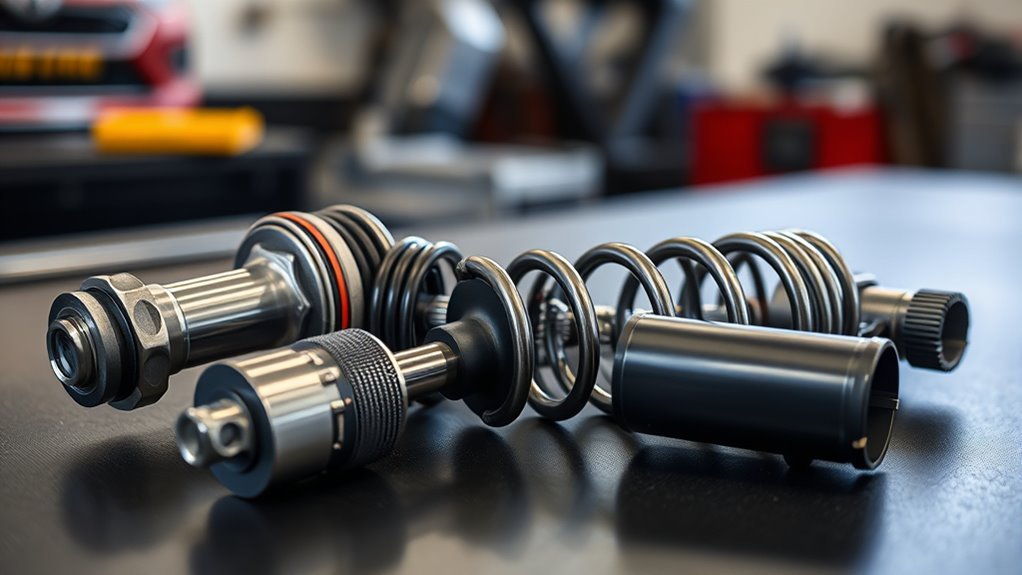

Eibach shocks are primarily designed for replacement rather than rebuild, meaning Eibach shocks are not typically rebuildable. While some shocks on the market feature rebuildable designs, Eibach focuses on ensuring consistent performance through new units instead of servicing worn internal components.
This approach simplifies maintenance and guarantees compatibility with your suspension system. You’ll want to watch for signs like fluid leaks or poor handling that indicate the need for replacement.
If you’re interested in understanding the differences, costs, and maintenance tips surrounding Eibach shocks, there’s more detail ahead to explore.
Key Takeaways
- Eibach shocks are designed primarily for replacement, not for user rebuilding or disassembly.
- Their rebuildable design is limited to professional servicing with specialized tools and expertise.
- Rebuilding Eibach shocks can save costs but may compromise durability and performance consistency.
- New Eibach shocks come with warranties and guaranteed performance, unlike rebuilt units.
- Regular maintenance focuses on inspecting seals, bushings, and damping performance rather than rebuilding.
What Makes Eibach Shocks Different From Standard Shocks?
Eibach shocks stand out from standard shocks primarily due to their rebuildable design, which allows you to maintain and customize damping characteristics over time.
Unlike conventional shocks that require full replacement when worn, Eibach shock technology incorporates modular components, enabling you to disassemble and service internal parts.
This design extends service life and lets you adjust rebound and compression rates precisely.
Additionally, Eibach shock materials feature high-grade alloys and advanced coatings that resist corrosion and wear, ensuring durability under demanding conditions.
Their proprietary valving system, combined with these materials, delivers consistent performance and improved ride quality.
How Do Eibach Shocks Work in Your Suspension System?
You rely on Eibach shocks to control your suspension’s movement by damping the energy from road impacts.
They regulate suspension dynamics, ensuring your tires maintain ideal contact with the road surface.
This precise control directly enhances your ride quality by balancing comfort and handling performance.
Shock Absorber Functionality
Shock absorbers play a critical role in controlling the motion and stability of your vehicle’s suspension system. They manage energy transfer by converting kinetic energy from suspension movement into heat, which dissipates through hydraulic fluid.
Different shock absorber types, such as twin-tube, monotube, and coilover, offer distinct damping characteristics tailored to various driving conditions and performance upgrades.
When you install Eibach shocks, you benefit from precise valving designed to optimize rebound and compression rates, enhancing ride quality and handling responsiveness.
These shocks adjust fluid flow through internal valves, controlling suspension oscillations and reducing body roll.
Role In Suspension Dynamics
Although suspension components work together to absorb impacts and maintain tire contact, the damping effect provided by Eibach shocks is crucial for controlling oscillations and stabilizing vehicle dynamics.
You rely on these shocks to convert kinetic energy from suspension movement into heat, regulating the rate of compression and rebound.
This precise shock absorption is significant for effective suspension tuning, allowing your vehicle to respond predictably over varying road surfaces.
By modulating fluid flow inside the shock, Eibach shocks reduce excessive bouncing and minimize body roll, directly influencing handling and traction.
Understanding their role in suspension dynamics helps you appreciate how they balance comfort and control, ensuring your suspension system performs efficiently under different driving conditions.
This makes Eibach shocks a critical component in maintaining consistent vehicle stability and responsiveness.
Impact On Ride Quality
When your vehicle encounters uneven terrain, Eibach shocks actively manage suspension travel to smooth out the ride. By controlling the rate at which the suspension compresses and rebounds, these shocks minimize abrupt movements, enhancing ride comfort.
You’ll notice reduced vibrations and jolts as the shocks dissipate kinetic energy efficiently. Additionally, Eibach shocks contribute considerably to handling stability by maintaining consistent tire contact with the road surface.
This control prevents excessive body roll and improves traction during cornering and braking. Their precise valving design guarantees that you maintain a balanced ride without sacrificing responsiveness.
Ultimately, Eibach shocks optimize your suspension system’s performance, delivering a refined balance between comfort and control tailored to dynamic driving conditions.
Are Eibach Shocks Designed to Be Rebuildable or Replaceable?
How do Eibach shocks handle maintenance and longevity?
Eibach shocks primarily feature a replaceable design rather than a rebuildable design. This means you won’t find them intended for disassembly and internal component replacement.
Instead, when wear or performance degradation occurs, you replace the entire shock unit. This design choice guarantees consistent shock compatibility with your vehicle’s suspension system and maintains ideal damping characteristics without the risk of improper rebuilds.
While rebuildable shocks allow parts replacement, Eibach prioritizes engineering precision and durability over serviceability.
So, if you want to maintain peak performance, plan on swapping out worn Eibach shocks rather than rebuilding them.
This approach simplifies maintenance but requires purchasing full units for continued ride quality and safety.
Signs Your Eibach Shocks Need Rebuilding or Replacement
You’ll notice your Eibach shocks need rebuilding or replacement if you observe leaking fluid around the shock body, which indicates compromised seals.
Additionally, if your vehicle experiences reduced damping performance, such as increased bounce or poor handling, the shocks are likely failing.
Monitoring these signs early helps maintain ideal suspension function and safety.
Leaking Fluid Indicators
What signs indicate that your Eibach shocks are leaking fluid and require rebuilding or replacement?
Fluid leakage is the most definitive indicator. Inspect the shock body regularly for oily residue or wetness around seals and mounting points.
Visible fluid on the exterior confirms internal seal failure, compromising damping efficiency. You might also notice fluid dripping onto suspension components or the ground. This leakage reduces shock performance and accelerates wear.
For effective maintenance, clean the shocks periodically to detect early leakage and prevent debris from damaging seals.
If you observe consistent fluid loss, don’t delay rebuilding or replacing the shocks, as continued use risks suspension damage and unsafe handling.
Adhering to these maintenance tips helps maintain your Eibach shocks perform at their best and last longer.
Reduced Damping Performance
When your Eibach shocks lose their ability to control suspension movement effectively, reduced damping performance is likely the cause.
This performance degradation results from worn internal components that alter the shock’s damping characteristics, leading to less effective energy absorption and rebound control.
You’ll notice increased body roll, longer braking distances, and a generally harsher ride.
The shock may respond inconsistently over bumps, indicating a loss of precision in its damping function.
Reduced damping performance not only compromises handling but also accelerates wear on other suspension parts.
If you observe these symptoms, it’s essential to evaluate whether rebuilding the shocks can restore the original damping characteristics or if replacement is necessary to maintain ideal vehicle dynamics and safety.
Comparing Costs: Rebuilding vs. Replacing Eibach Shocks
Although rebuilding Eibach shocks can extend their lifespan, understanding the cost implications compared to outright replacement is essential for informed decision-making.
Shock maintenance through rebuilding typically involves disassembly, inspection, seal replacement, and fluid refilling, which can lower rebuild costs relative to purchasing new units.
Rebuilding shocks includes disassembly, inspection, seal replacement, and fluid refilling to reduce costs versus new units.
However, rebuild costs vary based on labor rates and parts availability, sometimes approaching 50-70% of new shock prices. Replacement shocks eliminate concerns about hidden wear and often come with full warranties, offering long-term value.
Conversely, rebuilding can be more economical if performed by experienced technicians using quality components, especially for shocks with otherwise good structural integrity.
Weigh these factors carefully, as your choice impacts both vehicle performance and maintenance budget efficiency.
How to Choose Between Rebuilding and Buying New Eibach Shocks
When deciding between rebuilding and buying new Eibach shocks, you should carefully analyze the cost implications alongside expected performance and longevity.
Rebuilding can save money upfront but may affect durability compared to brand-new units.
Evaluating these factors based on your specific usage will help you make an informed choice.
Cost Comparison Analysis
Deciding whether to rebuild or purchase new Eibach shocks hinges primarily on a detailed cost comparison.
When evaluating cost factors, consider parts, labor, and potential downtime.
Rebuilding techniques often require replacement seals, fluid, and sometimes piston or valve components, which can be less expensive than buying new units.
However, labor costs vary based on expertise and equipment needed for precise disassembly and reassembly.
Additionally, rebuilt shocks may require frequent maintenance, influencing long-term expenses.
New Eibach shocks come with warranties and guaranteed performance but involve higher upfront costs.
By quantifying these cost factors, you can determine the most economical option for your application.
Weigh rebuilding techniques’ initial savings against potential recurring expenses and the value of new shocks’ reliability to make an informed decision.
Performance and Longevity
Since performance and longevity directly impact your vehicle’s handling and safety, choosing between rebuilding and buying new Eibach shocks requires careful evaluation of wear, material integrity, and expected service life.
Eibach shock technology integrates advanced damping systems designed for ideal performance enhancements, which can degrade if critical components wear beyond tolerance. When considering rebuilding, you must assess if internal seals, valves, and pistons maintain precision engineering standards.
New shocks guarantee factory-spec performance and longevity, often exceeding rebuilt units in durability.
Key considerations include:
- Extent of internal wear affecting damping consistency
- Material fatigue and corrosion resistance in shock components
- Availability of genuine replacement parts preserving original performance enhancements
Ultimately, purchasing new Eibach shocks guarantees sustained handling precision and extended service life, while rebuilding suits only minor wear scenarios.
What Tools and Skills You Need to Rebuild Eibach Shocks
Although rebuilding Eibach shocks requires specialized tools and knowledge, you can successfully complete the process with proper preparation.
To start, you’ll need a shock spring compressor, precision wrenches, and a torque wrench for accurate assembly. A shock valve tool and seal driver are vital for accessing internal components without damage.
Additionally, having a clean workspace and quality replacement parts guarantees effective shock maintenance. Your rebuild techniques must include careful disassembly, inspection, and precise reassembly to maintain performance integrity.
Skills in fluid handling and measuring damping characteristics also help achieve ideal results. Familiarity with technical manuals or manufacturer guidelines is essential because Eibach shocks have unique specifications.
How to Rebuild Eibach Shocks Step-by-Step
Before you begin rebuilding your Eibach shocks, make sure you have thoroughly cleaned your workspace and organized all necessary tools and replacement parts.
Start by carefully disassembling the shock absorber, noting the position of each component to guarantee proper reassembly.
Drain the old hydraulic fluid completely to prevent contamination during Eibach shock maintenance.
Inspect all seals, valves, and pistons for wear or damage; replace any compromised parts to maintain peak performance.
Refill the shock with the manufacturer-recommended fluid and reassemble with precision.
Key steps include:
- Complete disassembly and inspection
- Replacement of worn seals and components
- Accurate refilling and reassembly
Following these steps guarantees your Eibach performance upgrades operate reliably and extend shock lifespan.
Troubleshooting Eibach Shock Rebuilds
Once you’ve carefully reassembled your Eibach shocks, you might encounter performance issues that indicate a problem with the rebuild process.
Start troubleshooting by inspecting for common errors such as incorrect piston alignment, improper seal installation, or contaminated oil.
Verify that shock rebuild techniques, including torque specifications and component orientation, were strictly followed.
Check for fluid leaks or inconsistent damping, which often signal faulty seals or damaged internal components.
Employ precise measurements to assess shaft straightness and spring preload.
If vibration or noise persists, reassess the mounting hardware and bushings for wear.
Accurate diagnosis during Eibach shock maintenance is vital to guarantee reliability.
Addressing these issues promptly will restore peak shock function and prolong service life without unnecessary part replacement.
Tips for Maintaining Eibach Shocks to Extend Their Lifespan
To maximize the lifespan of your Eibach shocks, you should perform regular inspections and maintenance routines tailored to their specific design.
Effective shock maintenance requires attention to detail and timely interventions. Here are essential longevity tips to keep your shocks functioning at their best:
Inspect seals and bushings for wear or leaks to prevent contamination and fluid loss.
Clean shock surfaces regularly to avoid dirt buildup that can cause premature wear.
Monitor damping performance periodically; inconsistent behavior signals the need for servicing or rebuild.
Frequently Asked Questions
How Do Eibach Shocks Affect Vehicle Handling and Performance?
Eibach shocks enhance your vehicle’s handling dynamics by providing consistent shock performance, improving stability and responsiveness. They reduce body roll and absorb road irregularities, allowing you to maintain better control and achieve smoother, more precise driving.
What Warranty Options Are Available for Eibach Shocks?
You’ll find Eibach shocks come with specific warranty details covering defects, typically lasting several years to guarantee shock longevity. Always check the exact terms to confirm coverage duration and conditions for your vehicle’s application.
Can Eibach Shocks Be Used on Off-Road Vehicles?
Like a knight upgrading his armor, you can use Eibach shock absorbers for off-road performance. Their advanced suspension tuning enhances terrain adaptability, ensuring your vehicle handles rough trails with precision and reliability.
Are Eibach Shocks Compatible With Other Suspension Brands?
You’ll find Eibach shocks generally offer good shock compatibility with many suspension brands, but you should verify specific models for suspension upgrades to guarantee proper fitment, performance, and avoid any potential issues or premature wear.
How Long Do Eibach Shocks Typically Last Under Normal Driving Conditions?
You can expect Eibach shocks to have a shock lifespan of roughly 50,000 miles under typical driving conditions. This estimate varies with terrain and driving style, so regular inspections guarantee peak performance and safety.
Conclusion
If you think Eibach shocks are indestructible, think again—they can wear out and demand attention like any high-performance gear. While rebuilding them isn’t a walk in the park, with the right tools and know-how, you can bring them back to life and save a fortune.
Ignoring maintenance? That’s like asking your suspension to survive a rollercoaster nonstop. So, stay sharp and rebuild smart.
In conclusion, Eibach shocks are rebuildable, and with proper care, you can keep your ride performing at its peak.