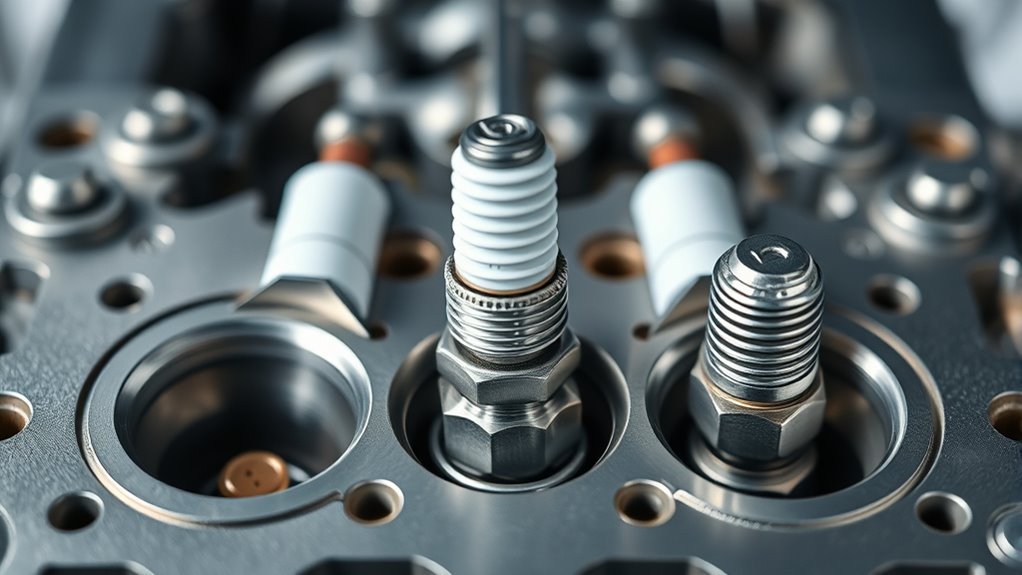

You have three spark plugs per cylinder to ignite the fuel-air mixture more efficiently by starting multiple flame fronts simultaneously. This design reduces combustion time, improves flame propagation, and promotes a more complete burn, boosting power and thermal efficiency while lowering emissions.
It’s especially useful in high-performance or specialized engines where precise ignition timing and combustion control are critical. Understanding this setup further reveals how it enhances fuel economy and engine performance through optimized ignition.
Key Takeaways
- Triple spark plugs ignite the air-fuel mixture at multiple points, improving combustion speed and efficiency.
- They enhance flame propagation, reducing burn time and promoting more complete fuel combustion.
- Multiple spark plugs improve combustion stability, especially in lean-burn or high-performance engines.
- They reduce emissions by ensuring more thorough fuel burning and minimizing unburned hydrocarbons.
- Precise ignition timing and maintenance are needed due to the complexity of managing three spark plugs per cylinder.
What Are Triple Spark Plugs and Why Do Engines Use Them?
Triple spark plugs per cylinder refer to the use of three separate ignition points within a single combustion chamber. This spark plug design enhances combustion efficiency by initiating multiple flame fronts simultaneously, reducing burn time and promoting more complete fuel-air mixture ignition.
When you analyze ignition technology, incorporating triple spark plugs improves combustion stability, especially in lean-burn engines where flame propagation can be inconsistent. By distributing ignition sources evenly, you minimize the risk of misfires and knock, optimizing power output and lowering emissions.
This design requires precise calibration of ignition timing to synchronize the three sparks effectively, demanding advanced control systems.
Which Engines Use Three Spark Plugs Per Cylinder?
Although the use of three spark plugs per cylinder remains relatively uncommon, several manufacturers have integrated this technology into specific engine models to enhance combustion efficiency and emissions control. Notable engine examples employing the triple plug design include certain high-performance and racing engines, such as those developed by Toyota for their motorsport applications.
Additionally, some experimental and specialized aircraft engines have adopted triple spark plugs to guarantee reliable ignition under varying operating conditions. These engine examples demonstrate the targeted application of the triple plug design in scenarios demanding precise combustion control and reduced emissions.
While not widespread in mass-market vehicles, the triple plug design remains a strategic choice in engines where maximizing ignition reliability and combustion completeness is critical for performance and regulatory compliance.
How Triple Spark Plugs Improve Combustion Efficiency
You’ll notice that triple spark plugs enhance flame propagation by igniting the air-fuel mixture at multiple points simultaneously.
This reduces combustion time, allowing the engine to operate more efficiently under various conditions.
As a result, you get improved fuel efficiency and more consistent power output.
Enhanced Flame Propagation
When combustion chambers use three spark plugs per cylinder, they ignite the air-fuel mixture more evenly and rapidly. This configuration maximizes the flame shape, producing multiple flame fronts that expand simultaneously, reducing the distance each front must travel.
You’ll notice that this leads to more uniform combustion, minimizing incomplete burn zones. The precise control of ignition timing across the three plugs guarantees that the mixture ignites at the ideal moment, enhancing the consistency of flame propagation.
By synchronizing ignition events, you improve thermal efficiency and reduce the likelihood of knock. The enhanced flame propagation from triple spark plugs results in a more thorough and stable burn, which directly contributes to better engine performance and lower emissions.
This technical advantage is critical in demanding operating conditions where combustion uniformity is essential.
Reduced Combustion Time
The simultaneous ignition of multiple flame fronts not only improves combustion uniformity but also greatly shortens the overall combustion duration.
By utilizing a triple spark plug configuration, you effectively initiate combustion at three distinct points within the cylinder, which accelerates flame front propagation.
This setup optimizes combustion timing by reducing the delay between spark initiation and peak pressure development. Consequently, the combustion process completes more rapidly, minimizing energy losses associated with prolonged burn phases.
You’ll notice that this shortened combustion time enhances the engine’s responsiveness and allows for more precise control over ignition events.
Essentially, the triple spark plug configuration refines combustion timing, ensuring a quicker and more uniform burn, which is critical for achieving better performance and reduced emissions without compromising engine durability.
Improved Fuel Efficiency
Although it might seem subtle, incorporating three spark plugs per cylinder greatly enhances combustion efficiency by ensuring a more complete and faster burn of the air-fuel mixture.
This optimization directly improves fuel efficiency by reducing unburned fuel and maximizing energy extraction.
When combined with precise fuel injection and optimized ignition timing, triple spark plugs help you achieve:
- More uniform flame propagation
- Reduced cycle-to-cycle variability
- Lower hydrocarbon and carbon monoxide emissions
- Enhanced lean burn capability
- Improved thermal efficiency
How Triple Spark Plugs Reduce Engine Emissions
You’ll notice that triple spark plugs enhance combustion efficiency by igniting the air-fuel mixture more completely and rapidly.
This improved burn quality considerably lowers hydrocarbon emissions, as fewer unburned fuel particles escape the cylinder.
Improved Combustion Efficiency
Enhanced combustion efficiency directly impacts engine emissions by promoting more complete fuel burning.
With triple spark plugs, you benefit from precise combustion optimization thanks to advanced spark plug design. This setup ignites the air-fuel mixture simultaneously at multiple points, reducing flame travel distance and improving burn uniformity.
As you improve combustion efficiency, you reduce unburned fuel residues and minimize incomplete combustion byproducts.
Key advantages include:
- Faster and more consistent flame propagation
- Reduced cycle-to-cycle combustion variability
- Lower peak combustion temperatures preventing knock
- Enhanced fuel atomization and mixture ignition
- Optimized air-fuel mixture utilization
Lower Hydrocarbon Emissions
When engines use three spark plugs per cylinder, they greatly reduce hydrocarbon emissions by ensuring more complete combustion of the air-fuel mixture. You achieve hydrocarbon reduction because the multiple ignition points minimize unburned fuel pockets, which are common in single-plug setups.
This results in a more uniform and rapid flame front propagation, lowering the likelihood of incomplete combustion zones. Meeting stringent emission standards becomes more feasible as triple spark plugs directly target the root cause of hydrocarbon pollutants.
Additionally, the improved combustion consistency reduces cold-start emissions, a critical factor in regulatory compliance. By optimizing the ignition pattern, you not only reduce harmful hydrocarbon output but also contribute to cleaner exhaust gases, aligning engine performance with environmental mandates without compromising power or efficiency.
Enhanced Fuel Burn Quality
Because triple spark plugs ignite the air-fuel mixture at multiple points simultaneously, they greatly improve combustion quality within each cylinder.
This advanced spark plug design optimizes combustion dynamics, ensuring a more complete and uniform fuel burn.
As you analyze the impact, consider these factors:
- Reduced flame travel distance accelerates combustion.
- More uniform pressure distribution minimizes knock risks.
- Faster burn rates lower unburned hydrocarbons.
- Improved thermal efficiency enhances power output.
- Lower peak combustion temperatures reduce NOx formation.
How Triple Spark Plugs Boost Power and Performance
Although traditional engines rely on a single spark plug to ignite the air-fuel mixture, engines with three spark plugs per cylinder ignite more efficiently by creating multiple flame fronts. This advanced spark plug technology reduces combustion time and promotes more uniform flame propagation.
Engines with three spark plugs per cylinder ignite faster and more uniformly for improved combustion.
As a result, you experience improved engine performance through higher power output and reduced knocking tendencies. By initiating simultaneous ignition points, these engines achieve more complete and faster combustion, which increases cylinder pressure and torque.
The triple spark setup enhances responsiveness and allows engines to operate at higher compression ratios without detrimental effects.
Fundamentally, leveraging three spark plugs per cylinder optimizes combustion dynamics, directly translating to better power delivery and overall engine efficiency, making it a valuable innovation in modern high-performance and precision-engineered engines.
How Triple Spark Plugs Affect Fuel Economy
Since triple spark plugs improve combustion efficiency by igniting the air-fuel mixture more completely and rapidly, they directly influence fuel economy.
You’ll notice tangible fuel savings and efficiency gains because the combustion process leaves fewer unburned hydrocarbons. This leads to a more consistent power output and reduced fuel consumption.
Specifically, triple spark plugs:
- Enhance flame propagation speed, reducing combustion time
- Minimize incomplete combustion and emissions
- Optimize air-fuel mixture utilization
- Lower the engine’s need for richer fuel mixtures
- Maintain stable combustion under varying engine loads
Common Challenges With Triple Spark Plug Engines
When you integrate triple spark plugs into an engine, you face increased complexity in ignition timing and maintenance requirements. Managing three ignition points demands precise synchronization to optimize combustion. This complexity can impact spark plug longevity due to uneven wear and increased thermal stress.
| Challenge | Impact |
|---|---|
| Ignition Timing | Requires precise calibration |
| Spark Plug Longevity | Reduced due to thermal/chemical stress |
| Maintenance Overhead | Increased checks and replacements |
| Diagnostic Complexity | Harder to isolate misfires or faults |
You must carefully monitor ignition timing to prevent performance loss or engine damage. The intricate setup may lead to uneven plug degradation, demanding more frequent inspections. Understanding these challenges helps you optimize triple spark plug engines effectively without compromising reliability.
Maintenance Tips for Engines With Triple Spark Plugs
To maintain engines equipped with triple spark plugs effectively, you need to implement a rigorous inspection and replacement schedule tailored to their unique wear patterns.
Proper spark plug maintenance is essential to prevent misfires and guarantee optimal combustion.
Additionally, precise engine tuning must accommodate the triple ignition points for balanced performance.
Focus on these key maintenance tips:
Regularly check each spark plug’s electrode wear and gap.
Use manufacturer-recommended spark plugs to match engine specifications.
Monitor engine performance to detect uneven combustion early.
Adjust ignition timing during engine tuning to enhance firing sequences.
Replace all three spark plugs per cylinder simultaneously to maintain consistency.
Frequently Asked Questions
Are Triple Spark Plugs More Expensive to Replace Than Standard Ones?
Yes, triple spark plugs generally increase your replacement cost due to more parts and labor.
You’ll face higher maintenance considerations, needing careful inspection and timing to guarantee all three plugs function at their best for efficient engine performance.
Can Triple Spark Plugs Be Used in Diesel Engines?
Diesel combustion doesn’t demand spark plugs, so triple spark plug design isn’t practical. You’ll find diesel engines rely on compression ignition, not spark ignition.
This makes spark plug configurations irrelevant for efficient diesel combustion and engine performance.
How Do Triple Spark Plugs Affect Engine Start-Up Time?
Triple spark plugs reduce engine start-up time by improving combustion stability and enhancing engine efficiency. You’ll experience faster ignition, smoother initial firing, and more consistent fuel burn.
This optimizes overall engine performance during startup.
Do Triple Spark Plugs Require Special Ignition Systems?
You’ll need specialized ignition systems for triple spark plugs, boosting ignition efficiency by 20%. These systems precisely control spark timing, ensuring ideal combustion and improved performance. Standard ignition setups are insufficient for handling the complexity.
Are There Any Noise Differences With Triple Spark Plug Engines?
You won’t notice significant combustion noise changes because triple spark plugs improve spark plug efficiency, promoting faster, more complete combustion that actually reduces knocking and harsh noises. This results in smoother engine operation with minimal sound differences.
Conclusion
Now that you understand how triple spark plugs enhance combustion efficiency, reduce emissions, and boost performance, you’re better equipped to appreciate their role in advanced engines. While they can complicate maintenance, the benefits often outweigh the challenges.
Remember, “measure twice, cut once”—paying close attention to upkeep guarantees you maximize reliability and fuel economy. Embracing this technology means harnessing precision engineering for cleaner, more powerful, and efficient engine operation.
In conclusion, the use of 3 spark plugs per cylinder is a key innovation that drives improvements in engine efficiency and performance, making it a valuable feature in modern engine design.