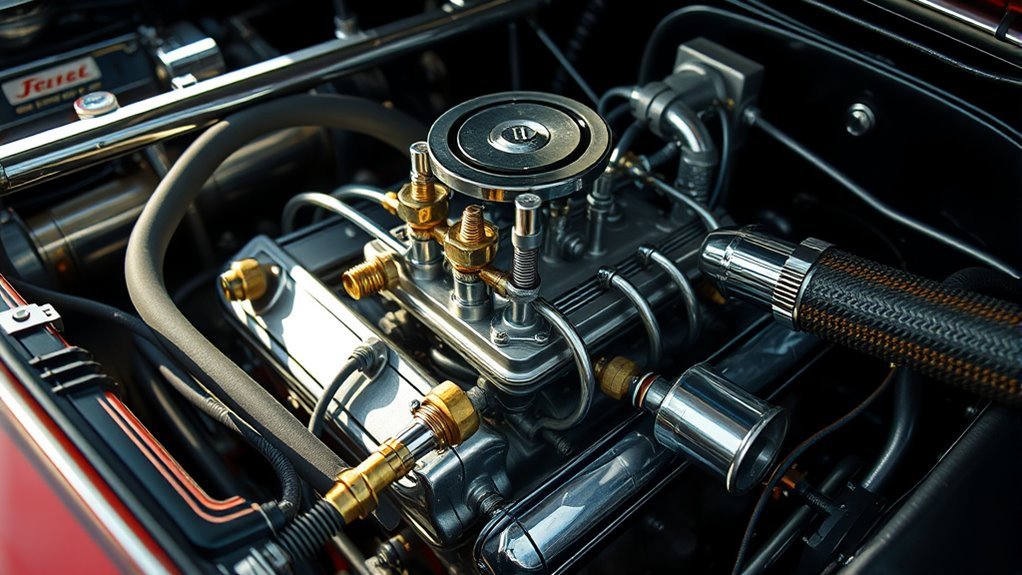

You’ll find the carburetor mounted directly on top of the intake manifold, nestled between the air filter and engine block. It’s a metallic component with fuel lines and throttle linkages, often topped by a round air filter housing. Its exact placement varies by engine type—centered on inline engines or between cylinder banks on V-type engines.
Knowing its location helps you spot issues quickly and handle maintenance effectively. Understanding these details can streamline your engine care.
Key Takeaways
- The carburetor is mounted directly on top of the intake manifold between the air filter and the engine block.
- In inline engines, the carburetor is centrally located on the intake manifold.
- For V-type engines, it sits between the two cylinder banks for compact placement.
- It is identifiable by a metallic body with fuel lines, throttle linkage, and often a round air filter housing above.
- The carburetor connects mechanically without wiring, positioned near the center of the engine bay under the air filter.
Where Is the Carburetor in a Gasoline Engine?
Where exactly is the carburetor located in a gasoline engine?
You’ll find the carburetor mounted directly on top of the intake manifold, between the air filter and the engine block.
This position is critical because the carburetor design focuses on mixing air and fuel efficiently before delivering it to the combustion chambers.
The carburetor controls fuel delivery by regulating the flow of gasoline through jets and venturis, guaranteeing the right air-fuel ratio.
The carburetor ensures the correct air-fuel mix by precisely controlling gasoline flow through jets and venturis.
Its placement guarantees that the air entering the engine passes through the carburetor, where fuel is atomized and combined with air.
This precise location optimizes fuel delivery, promoting efficient combustion.
Understanding this setup helps you grasp why the carburetor is integral to engine performance and fuel management.
How to Identify the Carburetor Under the Hood
You’ll find the carburetor mounted directly on top of the engine’s intake manifold, usually near the center of the engine bay.
Look for a metallic component with fuel lines and a throttle linkage attached, often featuring a round air filter housing on top.
Checking the engine type can also help confirm the presence of a carburetor, as they’re typically used in older or classic gasoline engines.
Carburetor Location Basics
How can you quickly spot the carburetor under the hood? First, understand that carburetors, rooted in a long carburetor history, are typically mounted atop the engine’s intake manifold.
Regardless of carburetor types—be it single-barrel, two-barrel, or four-barrel—they remain centrally located to mix air and fuel before entering the engine.
Look for a component connected to the throttle linkage and fuel line, positioned between the air filter and intake manifold. Since carburetors sit above the engine block, identifying the carburetor involves locating this elevated assembly directly beneath the air cleaner housing.
Knowing these basics lets you bypass guesswork and accurately find the carburetor, essential for maintenance or troubleshooting in vehicles that still use these classic fuel delivery systems.
Visual Carburetor Features
Although carburetors vary in design, you can identify them by key visual features under the hood. Look for a metal component mounted atop the intake manifold, usually featuring a round or rectangular air horn.
Familiarize yourself with common carburetor parts: the throttle linkage, fuel inlet, and choke mechanism. These parts often protrude and connect to other engine components. The presence of a float bowl on the side or bottom is another distinctive marker.
Visual diagrams can help you recognize these elements quickly, especially the air horn’s characteristic shape and placement. Unlike fuel injectors, carburetors have no wiring harness but include mechanical linkages.
Engine Compatibility Indicators
Where can you find clues about the carburetor’s compatibility with your engine? Start by examining the mounting flange and linkage setup under the hood.
Different engine types require specific carburetor designs; for example, V6 and V8 engines often use carburetors with distinct mounting patterns and throttle linkages.
Check for stamped part numbers or manufacturer codes on the carburetor body. These often correlate directly with engine types and indicate precise carburetor compatibility.
Additionally, review the fuel inlet position and choke mechanism, as incorrect alignment can signal incompatibility.
Understanding these engine compatibility indicators guarantees you select or identify a carburetor that matches your engine’s requirements, avoiding performance issues.
Always cross-reference these physical clues with your engine’s specifications for accurate identification and maximum function.
How Carburetor Location Changes by Engine Type
When working with an inline engine, you’ll typically find the carburetor mounted directly on top of the intake manifold, centered for straightforward fuel delivery.
In contrast, V-type engines position the carburetor between the two cylinder banks, requiring a more compact and elevated setup.
Understanding these differences helps you locate the carburetor quickly based on the engine configuration.
Inline Engine Placement
Since inline engines arrange their cylinders in a straight line, the carburetor’s placement differs considerably from other engine types.
In this engine orientation, the carburetor is typically mounted directly on top of the intake manifold, positioned centrally to guarantee even fuel delivery to all cylinders.
This placement optimizes air-fuel mixture distribution by minimizing the length and complexity of intake runners.
When you work on an inline engine, you’ll notice the carburetor’s accessibility is straightforward, aiding maintenance and tuning.
The linear layout also allows for simpler linkage connections between the throttle and carburetor.
Understanding how the engine orientation influences carburetor location helps you diagnose performance issues related to uneven fuel distribution or improper carburetor adjustment in inline engines efficiently.
V-Type Engine Positioning
Inline engines place the carburetor centrally atop the intake manifold for balanced fuel delivery, but V-type engines require a different approach due to their cylinder arrangement. In a v type configuration, the carburetor often sits between the two cylinder banks.
This positioning optimizes engine dynamics by ensuring equal fuel-air mixture distribution to both sides, minimizing flow resistance, and maintaining consistent performance. You’ll find that this layout demands precise carburetor placement to address the wider intake manifold geometry characteristic of V engines.
Here’s a practical comparison:
| Engine Type | Carburetor Position | Impact on Engine Dynamics |
|---|---|---|
| Inline | Centered atop manifold | Balanced mixture flow |
| V-Type (small V) | Between cylinder banks | Equal fuel distribution |
| V-Type (large V) | Dual carburetors possible | Improved throttle response |
| Flat Engine | Above intake runners | Low center of gravity |
| Rotary | Side-mounted or direct fuel | Different air-fuel delivery needs |
How the Carburetor Connects to the Intake Manifold and Air Filter
The carburetor serves as the critical junction between the intake manifold and the air filter, regulating the air-fuel mixture entering the engine.
When you inspect carburetor mounting, you’ll notice it’s securely fastened atop the intake manifold, ensuring airtight contact for efficient air intake.
The air filter attaches directly above the carburetor, cleaning incoming air before it mixes with fuel.
Key connection points include:
- Carburetor base gasket sealing the manifold joint
- Mounting bolts securing the carburetor to the manifold
- Air filter housing clamped or bolted to the carburetor’s air horn
- Air intake duct routing filtered air into the carburetor
These components work together precisely to maintain proper engine breathing and optimize combustion performance.
Signs Your Carburetor Needs Repair or Replacement
How can you tell when your carburetor needs repair or replacement? Key carburetor symptoms include rough idling, stalling, poor acceleration, and black smoke from the exhaust.
If your engine floods frequently or the fuel economy drops noticeably, these are also clear indicators.
Additionally, a hard start or hesitation during throttle response signals potential carburetor issues. Diagnosing these symptoms promptly helps avoid extensive engine damage.
Repair costs vary depending on the problem’s severity; minor cleaning or adjustment might cost less, while full replacement or rebuilds can be more expensive.
Monitoring these signs allows you to address carburetor problems early, ensuring peak engine performance and preventing costly repairs down the line.
Always consult a professional to accurately assess the carburetor’s condition.
Why Knowing Where Your Carburetor Is Makes Maintenance Easier
Recognizing symptoms of carburetor trouble is only part of effective maintenance; knowing exactly where the carburetor is located on your engine makes diagnosing and fixing issues much more straightforward.
When you understand its placement, you can quickly apply targeted troubleshooting tips and perform routine carburetor maintenance without guesswork. This precision saves time and prevents unnecessary disassembly. You’ll also reduce the risk of damaging nearby components.
Keep these points in mind:
- Locate the carburetor relative to the intake manifold and air filter housing
- Identify fuel and throttle linkages connected to it
- Understand access points for cleaning jets and adjusting screws
- Recognize common obstructions impacting performance
Mastering these aspects helps you maintain peak engine function with confidence and efficiency.
Frequently Asked Questions
What Is the Main Function of a Carburetor in an Engine?
You rely on the carburetor design to mix air and fuel precisely, ensuring ideal engine performance. It controls the ratio for efficient combustion, directly affecting power output, fuel efficiency, and smooth engine operation.
How Does a Carburetor Affect Fuel Efficiency?
Like a maestro directing an orchestra, your carburetor tuning finely balances the fuel mixture, ensuring ideal combustion. When adjusted precisely, it maximizes fuel efficiency by preventing wastage and enhancing engine performance under varying conditions.
Can a Carburetor Be Converted to Fuel Injection?
Yes, you can perform a carburetor conversion to fuel injection. Doing so improves fuel injection benefits like better fuel efficiency, precise air-fuel mixture control, and enhanced engine performance.
This makes your vehicle more reliable and environmentally friendly.
What Tools Are Needed to Clean a Carburetor?
To tackle carburetor cleaning, you’ll need essential tools like screwdrivers, a carburetor cleaner spray, compressed air, and a small wire brush. These tools cut through grime, restoring fuel flow with surgical precision and efficiency.
How Often Should a Carburetor Be Serviced?
You should perform carburetor maintenance every 12,000 to 15,000 miles or annually, depending on usage. Regular service intervals guarantee peak performance, prevent buildup, and extend the carburetor’s lifespan effectively and reliably.
Conclusion
Think of your carburetor like the heart of your engine’s fuel system—it precisely mixes air and fuel, keeping everything running smoothly. Just like a clockmaker relies on knowing each gear’s place, you need to understand where your carburetor sits under the hood to maintain peak performance.
Remember, a study found that 70% of engine problems trace back to fuel delivery issues.
So, knowing where the carburetor is located isn’t just helpful—it’s essential for timely, effective maintenance.