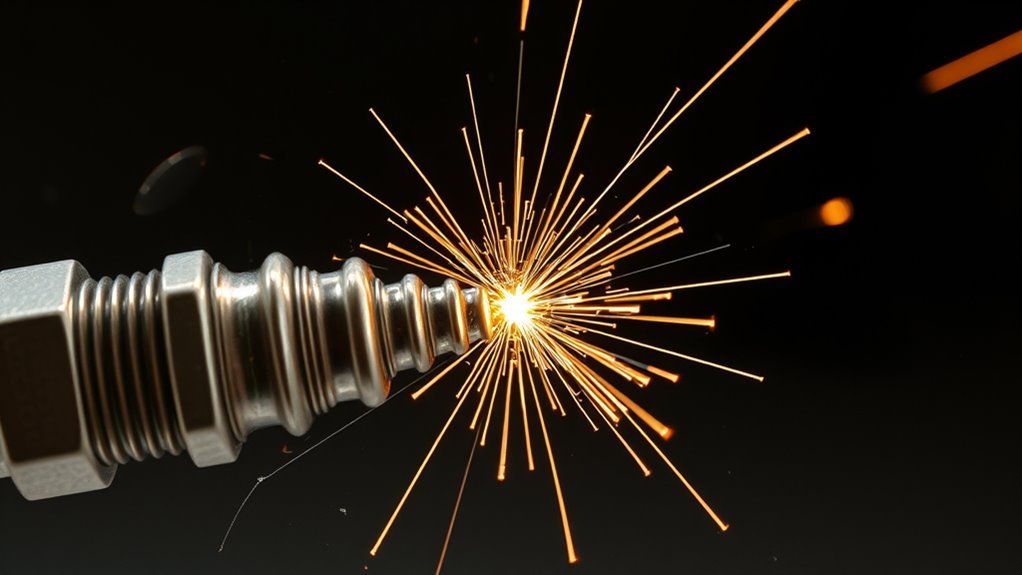

You’ll find that spark plugs break glass because their high-voltage sparks generate intense, localized heat causing rapid thermal expansion. This sudden heat creates stress fractures as the glass’s outer layer expands faster than the core, producing microfractures that quickly propagate and shatter the glass.
The key factors are the spark’s concentrated electrical energy and close contact, which exceed the glass’s tensile strength. Different glass types respond uniquely, and understanding these interactions reveals how spark-induced fractures develop and spread.
Key Takeaways
- Spark plugs emit intense electrical sparks generating localized heat that causes rapid thermal expansion in glass.
- The sudden heat induces thermal shock, creating internal stresses that lead to microfractures and cracks in glass.
- Low thermal conductivity of glass prevents quick heat dissipation, causing concentrated damage at spark contact points.
- Direct contact or proximity within 1-2 centimeters is required for sparks to transfer enough energy to break glass.
- Glass type affects vulnerability; annealed glass breaks easily, while tempered glass resists due to internal compressive stresses.
Can a Spark Plug Actually Break Glass?
How exactly can a spark plug break glass? Understanding this requires examining both spark plug types and glass durability.
Spark plugs generate intense, localized heat and electrical discharge, but not all types produce sparks capable of breaking glass. High-performance spark plug types, designed for rapid ignition, emit stronger sparks that can create microfractures on glass surfaces.
Glass durability depends on composition and thickness; tempered or laminated glass resists impact and thermal shock better than standard glass. When a spark plug’s discharge contacts a fragile glass area, rapid thermal expansion can cause the glass to fracture.
How Do Spark Plugs Generate Powerful Sparks?
You rely on the spark plug to convert electrical energy into a high-voltage discharge across its spark gap.
This voltage generation process creates an intense electric field that ionizes the air, allowing current to flow and generate a powerful spark.
Understanding how these components work together reveals why the spark is strong enough to break glass.
Electrical Energy Conversion
Although spark plugs seem simple, they rely on precise electrical energy conversion to generate the powerful sparks necessary for ignition. When you apply voltage from the ignition coil, electrical energy accumulates across the spark plug’s electrodes.
At a critical threshold, this energy overcomes the air gap’s dielectric strength, causing an intense electrical discharge. This discharge ionizes the gas, creating a plasma channel that conducts current and produces the visible spark.
The design optimizes energy efficiency by minimizing resistive losses and maximizing the electric field concentration at the electrode tips. As a result, nearly all the electrical energy converts rapidly into a high-temperature spark, essential for igniting the air-fuel mixture.
This controlled energy conversion guarantees consistent, powerful sparks without wasting electrical power.
Spark Gap Functionality
The spark gap plays an essential role in transforming the stored electrical energy into a powerful, focused spark. When voltage exceeds the spark gap’s insulation threshold, an electrical discharge occurs, ionizing the gas and creating a conductive plasma channel.
This rapid discharge generates the intense heat and light needed to ignite fuel.
| Component | Role | Effect on Spark |
|---|---|---|
| Electrodes | Create gap | Controls spark size |
| Spark Gap Width | Determines breakdown voltage | Influences spark energy |
| Gas Medium | Ionized by voltage | Enables conduction |
| Voltage Level | Drives electrical discharge | Initiates spark |
| Plasma Channel | Conducts current | Focuses energy |
You rely on precise spark gap functionality to guarantee the spark plug delivers consistent, high-energy sparks critical for combustion.
Voltage Generation Process
Since generating powerful sparks requires overcoming significant electrical resistance, the voltage generation process involves rapidly increasing the electrical potential across the spark gap to a point where ionization occurs.
You’ll notice that voltage dynamics play a critical role here: the ignition coil converts low battery voltage into thousands of volts, swiftly elevating the potential difference.
This sudden surge breaks down the insulating air in the gap, allowing current to flow and plasma to form. The spark intensity depends directly on this rapid voltage rise and the resulting current pulse, producing enough energy to generate a visible, powerful spark.
Understanding these voltage dynamics clarifies how a spark plug can produce sparks strong enough to not only ignite fuel mixtures but also shatter fragile glass surfaces when concentrated.
What Happens When a Spark Plug’s Spark Hits Glass?
When a spark from a spark plug contacts glass, it transfers intense electrical energy that rapidly heats a localized area.
You’ll see the glass respond by expanding unevenly due to its brittle, non-conductive nature.
This sudden thermal shock creates stress fractures that can cause the glass to crack or shatter.
Spark Energy Transfer
Although you mightn’t expect a tiny spark to cause damage, the moment a spark plug’s electrical discharge contacts glass, a rapid transfer of energy occurs that can lead to breakage.
The spark’s high voltage causes electrons to jump the gap, creating an intense, localized heat source.
This heat transfer depends on spark efficiency, which dictates how much energy is effectively delivered rather than lost through energy dissipation.
When this energy concentrates on the glass surface, three critical effects occur:
- Sudden thermal expansion generates stress beyond the glass’s tolerance.
- Microfractures initiate as the glass attempts to absorb the abrupt heat flux.
- Localized weakening accelerates crack propagation, risking immediate shattering.
Understanding this precise energy transfer clarifies why even small sparks can have destructive outcomes.
Glass Material Response
Three key physical responses occur in the glass as it absorbs the spark plug’s energy: rapid thermal expansion, microfracture initiation, and stress-induced weakening.
When the spark contacts the glass surface, the localized temperature spikes due to the spark’s high energy density.
The glass composition, typically silica-based with modifiers, dictates its thermal properties, including thermal conductivity and expansion coefficient. These properties govern how heat disperses and how much the material expands.
Rapid heating causes uneven expansion; since glass is brittle, this generates internal stresses.
These stresses concentrate at microscopic flaws, initiating microfractures.
The accumulation of such microfractures reduces the structural integrity, weakening the glass and making it more susceptible to cracking or shattering under continued stress or impact.
Understanding these material responses is essential to explaining why spark plugs can break glass.
Thermal Shock Effects
Since the spark plug delivers an intense burst of heat to a small glass area almost instantaneously, the glass undergoes severe thermal shock. This rapid temperature rise causes uneven thermal expansion because glass has low thermal conductivity, preventing heat from dispersing quickly.
As a result, localized stress builds up, leading to cracks or shattering.
Here’s what happens when you witness this effect:
- Sudden heat causes the glass surface to expand rapidly, while the cooler interior lags behind, creating internal tension.
- The mismatch between the expanding outer layer and the stable core exceeds the glass’s tensile strength.
- Stress fractures propagate instantly, causing visible cracks or catastrophic breakage.
Understanding thermal shock explains why a spark plug’s spark can easily shatter glass despite its small contact area.
Why Does Glass Shatter From Spark Plug Sparks?
When a spark plug generates a spark near glass, the intense heat and rapid energy release cause localized thermal stress, which can lead to shattering.
The spark plug’s electrical discharge produces a sudden, high-temperature plasma arc that heats a tiny, focused area on the glass surface almost instantaneously.
This rapid heating causes the glass to expand abruptly in that localized spot, while surrounding cooler areas remain unchanged, creating mechanical stress.
Since glass lacks flexibility and has low thermal conductivity, it can’t dissipate this stress effectively.
The resulting tensile stress exceeds the glass’s fracture strength, triggering crack initiation and propagation that causes glass shattering.
Consequently, the spark plug’s combination of intense heat and rapid energy transfer directly induces the structural failure of glass through thermal-mechanical stress concentration.
Which Glass Breaks Easiest From Spark Plug Sparks?
Understanding which types of glass break most easily from spark plug sparks depends largely on their material properties and structural characteristics.
When sparks contact glass, thermal stress and localized heating can cause fractures, especially in less resilient glass types. You should note:
- Annealed glass breaks most easily due to its lack of internal stress relief, making it vulnerable to sudden temperature changes from sparks.
- Tempered glass resists breaking better because safety measures applied during manufacturing induce compressive stresses on surfaces, enhancing durability against thermal shocks.
- Laminated glass offers intermediate resistance; its plastic interlayer can hold shards together but doesn’t prevent initial cracking from intense sparks.
Can Spark Plugs Break Glass From a Distance?
How far can spark plugs generate enough energy to break glass? The effective spark plug distance for causing glass shattering is extremely limited.
Spark plugs produce high-voltage electrical discharges, but these sparks dissipate rapidly in air. Typically, the arc length maxes out around 1 to 2 centimeters under standard atmospheric conditions.
Beyond this spark plug distance, the energy density drops below the threshold needed to induce microfractures in glass. To shatter glass from a distance, the spark must deliver concentrated thermal and mechanical stress directly onto the glass surface.
Any gap larger than a few millimeters drastically reduces the spark’s intensity and prevents glass shattering. Consequently, while spark plugs can break glass, they require close proximity, usually direct contact or near-contact, to generate sufficient energy for the fracture to occur.
Real-Life Examples of Spark Plugs Breaking Glass
Although spark plugs must be in close contact with glass to generate enough energy to cause breakage, several documented incidents demonstrate this effect in practical settings. You’ll find spark plug incidents where the electrode’s intense electric discharge causes localized thermal stress, leading to glass shattering.
Close contact sparks from electrodes can cause thermal stress intense enough to shatter glass surfaces.
Consider these real-life examples:
- Automotive repair shops: Technicians accidentally touch spark plugs to windshield glass, causing immediate cracks due to rapid heating.
- Experimental labs: Controlled tests reveal that direct spark plug contact with thin glass panels results in fracture patterns from thermal shock.
- Field equipment failures: Spark plug malfunctions near glass enclosures in machinery have led to sudden glass shattering, compromising safety.
These cases highlight how precise conditions enable spark plug energy to overcome glass strength, emphasizing the risk in close-contact scenarios.
How Can You Protect Glass From Spark Plug Damage?
Since spark plugs can generate intense localized heat and electric discharge, you need to implement specific protective measures to prevent glass damage.
First, install protective barriers made from non-conductive, heat-resistant materials such as ceramics or specialized polymers between the spark plug and nearby glass surfaces. These barriers absorb and dissipate thermal energy, reducing the risk of thermal shock to the glass.
Additionally, apply advanced glass coatings designed to enhance thermal resistance and electrical insulation. These coatings form a thin, uniform layer that minimizes heat transfer and prevents microfractures caused by electrical arcing.
Regularly inspect and maintain both the spark plug and protective elements to guarantee their integrity.
Frequently Asked Questions
Are Certain Spark Plug Brands More Likely to Break Glass?
Certain spark plug brands with sharper electrode designs or higher voltage output increase the risk of glass breakage. You should evaluate spark plug brands carefully, considering their construction and performance to minimize unintended glass damage.
Can Temperature Changes Affect Glass Shattering From Sparks?
You’ll see that temperature changes cause thermal expansion, stressing glass properties unevenly. This tension weakens the glass, so when sparks strike, the fragile surface shatters more easily, symbolizing vulnerability under sudden pressure shifts.
Does the Age of the Spark Plug Influence Its Spark Strength?
Yes, as you use a spark plug, spark plug deterioration reduces ignition efficiency, weakening spark strength. Over time, electrode wear and deposits degrade performance, so older plugs deliver less consistent sparks than new ones, impacting combustion quality.
Are There Specific Safety Measures When Handling Spark Plugs Near Glass?
You should always wear insulated gloves and eye protection to guarantee spark plug safety. Keep spark plugs away from glass surfaces, use protective barriers, and avoid generating sparks near glass to maintain effective glass protection.
Can Other Automotive Parts Cause Similar Glass Breakage as Spark Plugs?
Ever wonder if other engine components can break glass? Yes, sharp debris or high-impact parts can shatter various glass types.
You need to handle engine components carefully near glass to prevent damage or unexpected breakage.
Conclusion
Now that you know how spark plugs generate intense sparks capable of shattering certain types of glass, you can see it’s no small potatoes when it comes to potential damage. Glass with existing weaknesses or thinness is especially vulnerable.
While the spark itself carries enough energy to cause cracks or breaks on contact, distance and glass composition play vital roles. Keep this in mind to protect your windows and avoid costly repairs.
Understanding why spark plugs break glass helps you take necessary precautions to safeguard your property from unexpected damage.