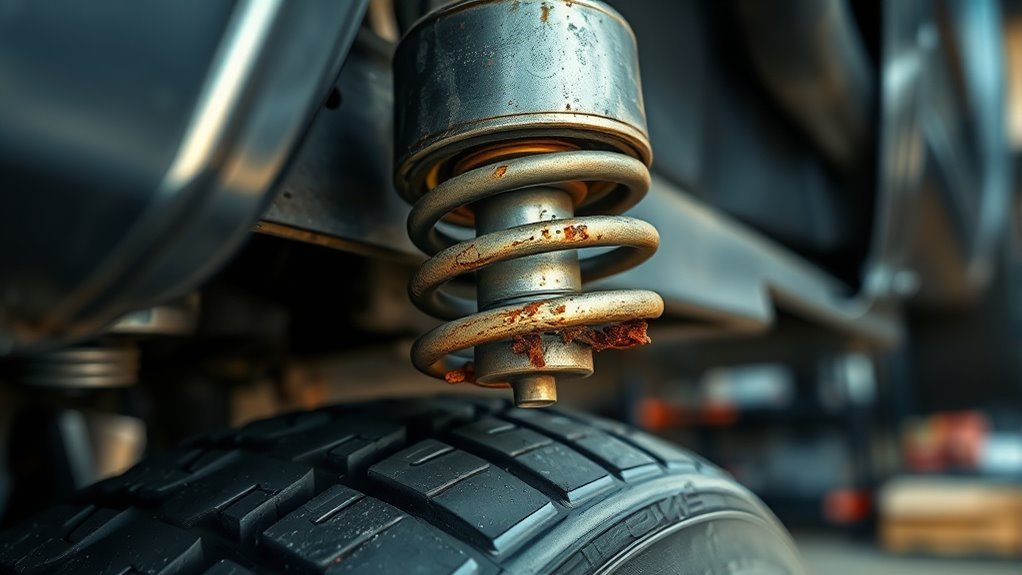
You can tell if shocks are bad by checking for excessive bouncing after bumps, nose-diving when braking, and uneven tire wear.
Listen for squeaks or clunks from suspension movement, and watch for oily fluid leaks on the shock body.
Performing a simple bounce test by pushing down on the car corners can also reveal worn shocks if the vehicle continues to bounce.
These signs indicate a need for inspection and possible replacement. Keep exploring to understand how worn shocks impact handling and costs involved.
Key Takeaways
- Notice excessive bouncing or swaying after driving over bumps or rough roads.
- Observe nose diving or instability when braking sharply.
- Check for uneven or unusual tire wear patterns.
- Look for fluid leaks or oily residue on the shock absorbers.
- Listen for squeaking or clunking noises during suspension movement.
What Are Shock Absorbers and What Do They Do?
Shock absorbers play an essential role in your vehicle’s suspension system by controlling the impact and rebound movement of your car’s springs and suspension.
Shock absorbers control your vehicle’s spring movement, ensuring a smooth and stable ride.
They stabilize your ride, ensuring consistent tire contact with the road and improving handling.
There are several shock absorber types, including hydraulic, gas-charged, and coilover shocks, each designed for specific performance needs.
Proper shock absorber maintenance involves regular inspections for leaks, damage, and wear, as well as timely replacement to preserve ride quality and safety.
Ignoring maintenance can lead to degraded damping ability, uneven tire wear, and compromised vehicle control.
Understanding the function and types of shock absorbers helps you appreciate why keeping them in ideal condition is vital for your car’s performance and your safety.
Common Signs Your Car’s Shocks Are Worn Out
When your vehicle’s suspension no longer absorbs bumps effectively, it’s a clear indicator that the shocks may be worn out. Declining shock performance directly impacts ride comfort and vehicle control.
Here are common signs indicating your car’s shocks need attention:
- Excessive bouncing after hitting a bump
- Nose diving during braking
- Uneven tire wear patterns
- Fluid leaks around the shock absorber
- Reduced stability when cornering or driving on uneven surfaces
These symptoms reflect compromised shock absorbers unable to dampen suspension movement properly. Ignoring them can degrade ride comfort and increase wear on other suspension components.
Regularly inspecting for these signs helps maintain peak shock performance and guarantees a safer, more comfortable driving experience.
What Noises Indicate Failing Shocks?
If you hear unusual noises while driving over bumps or rough roads, it could indicate that your shocks are failing. A common symptom is a persistent squeaking noise, which often results from worn or dried-out bushings within the shock absorber assembly.
This noise typically occurs during suspension travel as metal components rub against each other without sufficient lubrication. Additionally, a noticeable clunking sound may emerge when hitting potholes or abrupt bumps. This clunking often signals loose or damaged shock mounts or internal shock components failing to dampen impacts properly.
Both sounds suggest that your shocks are no longer effectively controlling suspension movement, compromising ride quality and vehicle stability.
If you detect these noises, it’s essential to have your shocks inspected and replaced promptly to maintain safe handling and prevent further suspension damage.
How to Spot Shock Fluid Leaks and What They Mean
Unusual noises can signal internal issues, but visible signs like fluid leaks provide direct evidence of shock absorber problems.
During your fluid assessment, inspect the shock body closely for oily residue. Leak identification is essential because any loss of hydraulic fluid impairs shock performance and safety.
Inspect shocks carefully for oily residue; fluid leaks compromise performance and safety.
Look for these indicators:
- Wetness or dripping fluid on the shock absorber’s shaft or casing
- Accumulated dirt clinging to oily surfaces
- Corrosion or rust near suspected leak points
- Uneven tire wear from compromised damping
- Reduced ride quality signaling fluid loss
Spotting these signs early helps you address shock failure before it worsens.
Regular fluid assessment and leak identification are key to maintaining your vehicle’s suspension integrity.
How to Perform a Bounce Test to Check Your Shocks
Performing a bounce test requires applying firm pressure to each corner of your vehicle and then releasing it quickly.
Use consistent bounce techniques by pressing down with enough force to compress the suspension and allow it to rebound freely.
Observe how your vehicle responds: if it bounces more than once or twice before settling, this indicates reduced shock performance. Properly functioning shocks will absorb the energy quickly, preventing excessive oscillation.
Test all four corners individually to identify any uneven wear or damage. This method provides a straightforward, mechanical assessment of your shocks’ ability to dampen motion.
Remember, while the bounce test is effective for detecting obvious shock issues, it doesn’t replace a thorough inspection for internal shock damage or fluid leaks.
Use it as an initial diagnostic tool to evaluate shock performance.
How Worn Shocks Affect Your Car’s Handling and Safety
When shocks wear out, they compromise your vehicle’s stability by reducing its ability to absorb road impacts and maintain tire contact.
This degradation directly affects your car’s handling stability and safety performance, making driving unpredictable and hazardous.
Worn shocks cause:
- Increased body roll during cornering, reducing control
- Extended braking distances due to less tire grip
- Uneven tire wear, impairing traction and stability
- Amplified impact from bumps, stressing suspension components
- Reduced responsiveness to steering inputs
When Should You Replace Your Shocks : and What Will It Cost?
How can you determine the right time to replace your shocks to maintain ideal vehicle performance? Generally, the replacement frequency for shocks ranges between 50,000 to 100,000 miles, depending on driving conditions and shock types.
Gas-charged shocks tend to last longer than traditional hydraulic ones, but both degrade over time. You should replace shocks if you notice excessive bouncing, uneven tire wear, or decreased stability.
Gas-charged shocks last longer, but replace them if you experience bouncing, uneven tires, or reduced stability.
As for costs, prices vary by shock types and vehicle models. Standard shocks typically cost $100 to $200 each, while premium or specialized shocks can exceed $300. Labor can add $150 to $300 for a full replacement.
Staying within recommended replacement frequency and monitoring performance symptoms guarantees safety and peak handling without incurring premature expenses.
How to Choose the Right Replacement Shocks for Your Car
Why does choosing the right replacement shocks matter for your vehicle’s performance and safety?
Selecting shocks that match your car’s specifications guarantees excellent handling, ride comfort, and braking efficiency.
To pick the right shocks, focus on shock compatibility and performance ratings.
Here’s what to take into account:
- Verify shock compatibility with your vehicle’s make, model, and year to assure proper fitment.
- Review performance ratings to understand shock durability and responsiveness under different driving conditions.
- Choose shocks designed for your typical driving style, whether daily commuting, off-roading, or sport driving.
- Evaluate OEM (Original Equipment Manufacturer) versus aftermarket options based on quality and warranty.
- Inspect shock material and technology, such as gas-charged or twin-tube designs, for performance needs.
Following these criteria helps you maintain safety and vehicle control effectively.
Frequently Asked Questions
Can Bad Shocks Cause Uneven Tire Wear?
Yes, bad shocks can cause uneven tire wear by disrupting proper tire alignment and stressing suspension components. You’ll notice irregular tread patterns because worn shocks fail to absorb impacts, affecting overall vehicle stability and tire contact with the road.
How Do Temperature Changes Affect Shock Performance?
You’ll notice temperature effects on shock performance as colder conditions thicken the fluid, reducing damping efficiency. Heat thins it, potentially causing leaks or diminished control. These changes directly impact ride quality and handling responsiveness.
Are Shock Absorbers Covered Under Vehicle Warranties?
Warranty coverage for shock absorbers varies by manufacturer and vehicle. You should review your specific warranty terms to confirm if shock replacement is included, as some cover it under suspension components while others exclude wear items.
Can Aftermarket Shocks Improve Fuel Efficiency?
Yes, aftermarket benefits include improved fuel efficiency by optimizing shock installation for better suspension performance. You’ll experience reduced rolling resistance and enhanced vehicle stability, which collectively contribute to more efficient fuel consumption during your drives.
Do All Vehicles Use the Same Type of Shocks?
No, you won’t find all vehicles using the same shock types. You must check shock compatibility since variations depend on vehicle weight, suspension design, and intended performance.
Always match shocks precisely to your vehicle specs.
Conclusion
Now that you know how to identify worn shocks—from unusual noises to fluid leaks and handling issues—you can debunk the myth that shocks only affect comfort.
In reality, bad shocks directly impact your vehicle’s safety and control. Performing simple tests like the bounce test can give you quick insights.
Don’t wait for complete failure; timely replacement not only preserves ride quality but also guarantees your car handles precisely when it matters most. Recognizing how to tell if shocks are bad is essential for maintaining both safety and performance.