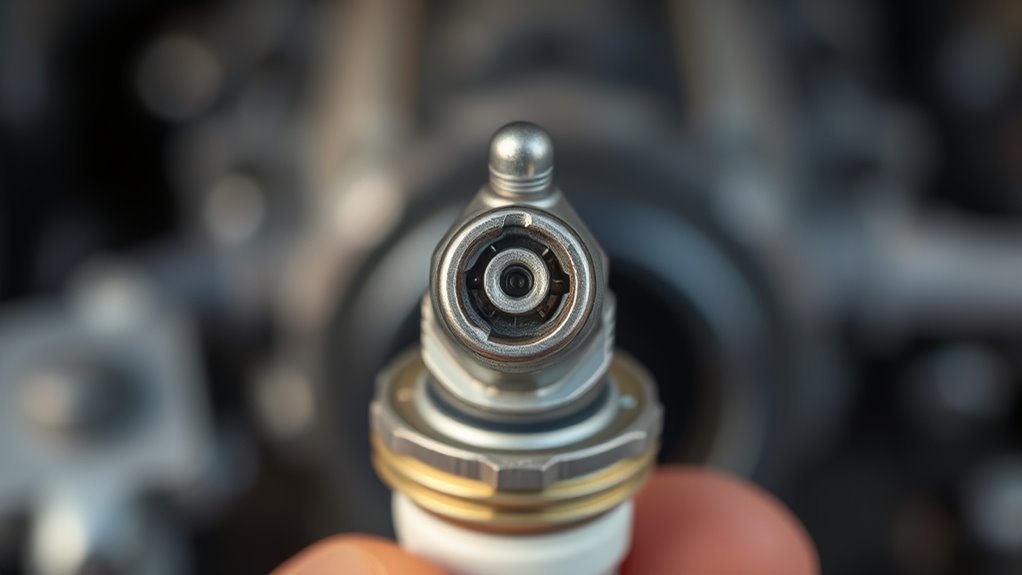
The gap on spark plugs is the space between the center and ground electrodes, which is crucial for creating a strong spark to ignite the engine’s air-fuel mixture. This gap must be set precisely according to your vehicle’s specifications to ensure optimal performance.
An incorrect gap can lead to misfires, poor fuel efficiency, and rough engine running. To measure and adjust this gap safely, using a feeler gauge is recommended.
Understanding the role of the spark plug gap can help you maintain peak engine performance and enhance the longevity of your vehicle. Proper maintenance of this gap is a simple yet effective way to keep your engine running smoothly.
Key Takeaways
- The spark plug gap is the space between the center and ground electrodes.
- It controls the spark needed to ignite the engine’s air-fuel mixture.
- Gap size varies by engine type and manufacturer specifications.
- Proper gap ensures efficient combustion and prevents misfires.
- Measuring and adjusting the gap requires precise tools like feeler gauges.
What Is the Spark Plug Gap and Why Does It Matter?
Although it may seem like a small detail, the spark plug gap plays an important role in your engine’s performance. The gap is the precise distance between the center and ground electrodes, critical for generating a consistent spark to ignite the air-fuel mixture.
Different spark plug materials, such as copper, platinum, or iridium, influence durability and conductivity, affecting how the spark forms across the gap.
To guarantee peak function, you need accurate gap measurement tools like feeler gauges or gap gauges, which help verify the electrode spacing meets manufacturer specifications.
Incorrect gaps can cause misfires, reduced fuel efficiency, and engine hesitation.
Thus, understanding and maintaining the correct spark plug gap is crucial for reliable ignition and overall engine efficiency.
What Is the Correct Spark Plug Gap Size?
You need to set your spark plug gap according to the manufacturer’s specifications, as this varies by engine type.
Using an incorrect gap can lead to misfires, poor fuel efficiency, and engine performance issues.
Let’s examine how to identify the precise gap size for your engine and the consequences of improper adjustments.
Manufacturer Recommendations
When setting your spark plug gap, following the manufacturer’s specifications guarantees superior engine performance and longevity. Each engine model requires specific gap specifications based on its design, combustion chamber, and ignition system.
Manufacturers provide precise gap values tailored to different spark plug types, such as copper, platinum, or iridium, accounting for their unique electrode wear rates and conductivity. Ignoring these recommendations can cause misfires, reduced fuel efficiency, and increased emissions.
To guarantee accuracy, always consult your vehicle’s service manual or the spark plug packaging for the exact gap size. Use a feeler gauge or gap tool to adjust the electrode spacing carefully without damaging the plug.
Adhering to manufacturer gap specifications preserves prime ignition timing and combustion, maintaining engine reliability and performance over time.
Engine Type Variations
Since engine designs vary widely, the correct spark plug gap size depends heavily on the specific engine type and its operating conditions.
For vintage engines, which typically operate at lower compression ratios and use simpler ignition systems, you’ll often find larger gap sizes, commonly between 0.035 to 0.045 inches. This accommodates the weaker ignition sparks characteristic of older systems.
In contrast, modern engines utilize advanced ignition technologies like coil-on-plug systems and higher compression ratios, enabling smaller gaps, usually around 0.028 to 0.032 inches. These smaller gaps guarantee reliable spark energy and efficient combustion under higher pressures and faster engine speeds.
When setting your spark plug gap, always consider whether you’re working with vintage engines or modern engines, as this distinction directly influences the ideal gap size for performance and durability.
Effects of Incorrect Gap
Although determining the correct spark plug gap size might seem straightforward, an incorrect gap can greatly impact engine performance and efficiency. If the gap measurement is too wide, the spark may become weak or inconsistent, causing misfires and rough idling.
Conversely, a gap that’s too narrow can produce a weak spark, leading to incomplete combustion and reduced power output. Both situations negatively affect spark plug performance, increasing fuel consumption and emissions.
You must carefully check and adjust the gap to your engine manufacturer’s specifications using a precise gap tool. Proper gap measurement guarantees ideal ignition timing and combustion quality, which promotes smoother engine operation and longevity.
Neglecting this critical adjustment can result in poor acceleration, decreased fuel economy, and potential engine damage over time.
How to Tell if Your Spark Plug Gap Needs Fixing
If your engine shows signs such as misfiring, rough idling, or decreased fuel efficiency, you might need to check your spark plug gap.
Symptom identification is essential because these issues often indicate improper spark plug function linked to an incorrect gap.
To determine if the gap needs fixing, observe these symptoms alongside performance irregularities. While visual inspection alone isn’t definitive, it helps identify obvious wear or damage.
The key step involves gap measurement using a precise tool to compare the existing gap to manufacturer specifications. If the measured gap deviates beyond acceptable limits, it requires adjustment.
Measure the spark plug gap precisely and adjust if it falls outside manufacturer specifications for optimal engine performance.
Addressing the gap promptly prevents further engine performance decline and guarantees ideal combustion efficiency.
Recognizing symptoms and confirming with accurate gap measurement guides effective spark plug maintenance.
How to Check the Spark Plug Gap at Home
Checking the spark plug gap at home requires just a few specialized tools and careful attention to detail.
You’ll need proper spark plug tools designed for gap measuring to guarantee accuracy. Follow these steps:
- Remove the spark plug using a socket wrench, avoiding damage to the electrode.
- Use a gap measuring tool, either a feeler gauge or a wire gauge, to measure the distance between the center and ground electrodes.
- Insert the gauge into the gap, noting if it fits snugly without forcing it.
- Compare the measurement to your vehicle’s manufacturer specifications to determine if the gap falls within the recommended range.
Accurate gap measuring is essential for peak engine performance and fuel efficiency.
Using the correct spark plug tools guarantees precise results without harming the plug.
How to Adjust the Spark Plug Gap Safely
When you find the spark plug gap outside the recommended range, you need to adjust it carefully to avoid damaging the electrodes.
Start by selecting the right spark plug tools, such as a gap gauge or feeler gauge, specifically designed for gap measuring.
Begin by choosing the appropriate gap or feeler gauge designed for precise spark plug measurement.
Place the gauge between the center and ground electrodes to check clearance.
To widen the gap, gently bend the ground electrode outward using a spark plug gap tool, applying minimal force to prevent distortion.
To narrow the gap, carefully tap the ground electrode on a hard surface or use the tool’s bending end, ensuring gradual adjustment.
After each modification, re-measure the gap precisely.
Repeat this process until the gap matches the manufacturer’s specifications.
Avoid excessive bending or using inappropriate tools, as this can compromise spark plug performance and durability.
How the Spark Plug Gap Affects Engine Performance
Adjusting the spark plug gap precisely guarantees ideal ignition conditions, but understanding how this gap influences engine performance provides deeper insight into why accuracy matters.
The gap affects the spark’s strength and consistency, which directly impacts combustion efficiency. Here’s how:
- Ignition timing precision: A correct gap guarantees the spark fires at the perfect moment, vital for peak engine power.
- Spark plug materials compatibility: Different materials require specific gaps to maintain longevity and consistent spark delivery.
- Combustion completeness: An improper gap can cause misfires or incomplete combustion, reducing fuel efficiency.
- Engine responsiveness: Correct gaps improve throttle response by stabilizing flame propagation within the cylinder.
Frequently Asked Questions
Can Spark Plug Gaps Vary Between Different Car Models?
Yes, spark plug variation exists between car models, impacting engine performance. You should follow manufacturer specs for the correct gap to guarantee ideal combustion, efficiency, and engine longevity, avoiding misfires or reduced power.
Does Fuel Type Affect the Ideal Spark Plug Gap?
Yes, fuel type affects the ideal spark plug gap because different fuel combustion properties require specific spark plug materials and gap sizes to optimize ignition efficiency. This ensures proper combustion and prevents misfires in your engine.
How Often Should Spark Plug Gaps Be Checked or Replaced?
You probably love surprises, so check your spark plug gaps every 30,000 miles to avoid them. Regular spark plug maintenance prevents spark plug wear, ensuring peak engine performance and avoiding costly repairs down the road.
Are There Specific Tools Recommended for Professional Gap Adjustments?
You should use precise gap measurement tools like a spark plug feeler gauge for professional gap adjustments. These tools guarantee accurate spacing, preventing misfires and optimizing engine performance by maintaining the correct spark plug gap consistently.
Can Improper Spark Plug Gaps Cause Emissions Test Failure?
You know, “a stitch in time saves nine.” Improper spark plug gap effects can cause incomplete combustion, increasing emissions. This often leads to an emissions test failure, so you’ve got to guarantee precise gap settings.
Conclusion
Think of the spark plug gap as the tiny, precise bridge where combustion sparks ignite. If it’s too wide or too narrow, your engine’s performance stumbles like a misfiring dancer.
By checking and adjusting this gap carefully, you guarantee a clean, consistent spark that powers your engine efficiently. Keep this small space in perfect tune, and your vehicle will run smoothly.
This not only saves fuel but also extends engine life with every controlled burst of energy. Understanding the gap on spark plugs is key to maintaining optimal engine performance.