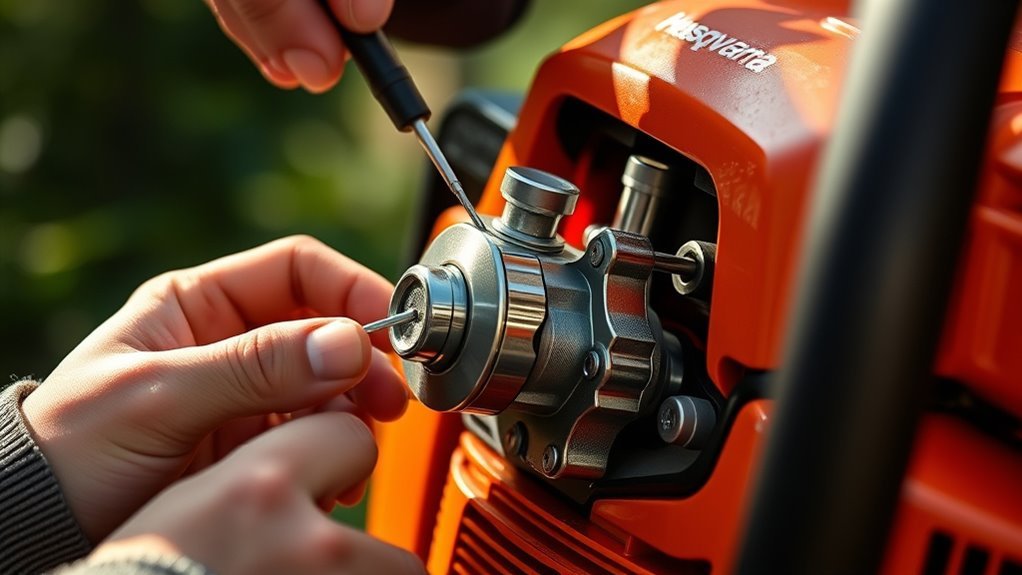
To adjust your Husqvarna chainsaw carburetor, first identify the L (low speed), H (high speed), and T (idle speed) screws. These screws control the fuel and air mixture at different engine speeds, which is crucial for optimal performance.
Start the engine and let it warm up. Turn the L and H screws clockwise until the engine sputters, then back off slightly to achieve the best fuel mixture. This helps ensure your chainsaw runs smoothly.
Next, adjust the T screw to set the idle speed so the chain does not move. For precise RPM adjustments, use a tachometer. Continue refining these settings to improve performance and prevent stalling.
Following these steps carefully will help you master the process of adjusting your Husqvarna chainsaw carburetor efficiently. More detailed tips can further enhance your results.
Key Takeaways
- Locate the L (low speed), H (high speed), and T (idle speed) screws on the carburetor for precise adjustment.
- Start the chainsaw, warm it up, then turn L and H screws clockwise until sputtering, and back off slightly for optimal mixture.
- Adjust the T screw to set idle speed, ensuring the chain does not move while the engine runs smoothly.
- Use a tachometer to maintain engine RPM within Husqvarna’s recommended specifications during adjustments.
- Always perform adjustments with the chain brake engaged, on a stable surface, and wear protective gear for safety.
When Your Husqvarna Chainsaw Needs Carburetor Adjustment
If your Husqvarna chainsaw struggles to start, idles erratically, or lacks power under load, it’s likely time to adjust the carburetor.
These carburetor symptoms indicate improper fuel-air mixture, which compromises performance and increases wear. You’ll notice issues like stalling, uneven acceleration, or excessive smoke.
Regular adjustment frequency depends on usage intensity; heavy use demands more frequent tuning, typically every 20-30 hours of operation, while occasional users can extend intervals.
Adjust your Husqvarna carburetor every 20-30 hours with heavy use; less often for occasional users.
Keep in mind that environmental factors like altitude and temperature also affect carburetor settings.
Addressing these symptoms promptly prevents engine damage and guarantees peak efficiency.
Monitoring your saw’s behavior and adhering to a consistent adjustment schedule maintains reliable performance and fuel economy.
Recognizing carburetor symptoms early lets you act before problems escalate.
Tools Needed to Adjust Your Husqvarna Chainsaw Carburetor
You’ll need a few essential tools like a flathead screwdriver and a tachometer to adjust your Husqvarna chainsaw carburetor accurately.
Don’t forget safety gear such as gloves and eye protection to prevent injury during the process.
Optional diagnostic instruments can help fine-tune performance but aren’t always necessary for basic adjustments.
Essential Adjustment Tools
Adjusting your Husqvarna chainsaw carburetor requires specific tools to guarantee accuracy and safety. Using the right equipment assures precise carburetor tuning and effective adjustment techniques.
Here are the essential tools you’ll need:
| Tool | Purpose | Tip |
|---|---|---|
| Flathead screwdriver | Adjust carburetor screws | Use correct size to avoid damage |
| Tachometer | Measure engine RPM | Assures precise idle speed setting |
| Carburetor cleaner | Clean carburetor components | Remove debris before adjustments |
These tools help you perform precise adjustments, improving engine performance and lifespan. Confirm you have them ready before starting your tuning procedure to avoid interruptions and errors.
Safety Equipment Requirements
Three essential pieces of safety equipment protect you during carburetor adjustments on your Husqvarna chainsaw.
First, always wear proper eye protection to shield against fuel splashes and debris.
Second, use gloves made from durable material to protect your hands from sharp components and chemical exposure.
Third, guarantee you have sturdy protective gear, such as long sleeves and pants, to guard your skin. These items minimize injury risks while working with fuel and moving parts.
Before starting, check that your workspace is well-ventilated to avoid inhaling harmful fumes.
By consistently using this protective gear, you maintain safety and focus during adjustments, reducing accidents and guaranteeing precise carburetor tuning.
Never compromise on safety equipment; it’s critical for effective and safe chainsaw maintenance.
Optional Diagnostic Instruments
Although basic carburetor adjustments can be made with minimal tools, using optional diagnostic instruments greatly enhances accuracy and efficiency.
For precise carburetor diagnostics, you should consider employing performance gauges such as a vacuum gauge or a digital tachometer.
A vacuum gauge measures manifold vacuum, helping you identify air leaks or fuel delivery issues affecting engine performance. A digital tachometer provides accurate RPM readings, essential for setting the high and low-speed screws correctly.
Additionally, a fuel pressure gauge can verify consistent fuel flow to the carburetor. These instruments allow you to diagnose underlying problems rather than relying solely on audible or visual cues.
Investing in these diagnostic tools streamlines the adjustment process, ensuring your Husqvarna chainsaw runs smoothly and performs at peak efficiency.
Understanding and Adjusting the Carburetor Screws (L, H, T)
Anyone working with a chainsaw carburetor needs to understand the function of the L, H, and T screws. The L screw controls the low-speed fuel mixture, affecting idle performance and acceleration.
The L screw manages low-speed fuel mixture, crucial for smooth idle and responsive acceleration.
The H screw adjusts the high-speed fuel mixture, influencing maximum engine power and efficiency. The T screw, or idle speed screw, sets the throttle position at idle, ensuring the chain doesn’t move when the saw is idling.
Proper carburetor tuning balances these screws to optimize engine performance and fuel efficiency. Incorrect adjustments can cause stalling, poor acceleration, or excessive fuel consumption.
Before making changes, identify each screw clearly and note their original positions. Understanding their roles lets you fine-tune your Husqvarna chainsaw for smooth operation and reliable power output.
Step-by-Step Guide to Adjusting Your Husqvarna Chainsaw Carburetor
Before adjusting your Husqvarna chainsaw carburetor, make sure the saw is clean, fuel is fresh, and the air filter is in good condition.
You’ll start by locating the L, H, and T screws for precise tuning.
Follow each adjustment step carefully to optimize engine performance and prevent damage.
Preparing The Chainsaw
To prepare your Husqvarna chainsaw for carburetor adjustment, start by making sure the engine is off and cool to prevent accidents. Understanding carburetor basics will help you perform effective chainsaw maintenance.
Begin by cleaning the exterior, especially around the carburetor, to avoid debris entering internal parts during adjustment.
Next, inspect the air filter; a dirty filter can affect fuel-air mixture and carburetor performance.
Finally, check the spark plug for wear or carbon buildup, as this influences engine response.
- Remove the spark plug cover and clean the area
- Inspect and clean or replace the air filter
- Make sure the chain brake is engaged for safety
Proper preparation sets the stage for precise carburetor tuning and best chainsaw operation.
Carburetor Adjustment Steps
Although adjusting the carburetor may seem complex, following the correct steps will guarantee your Husqvarna chainsaw runs smoothly and efficiently.
First, locate the three adjustment screws: Low (L), High (H), and Idle (T).
Start the engine and let it warm up. Turn the L and H screws slowly clockwise until the engine begins to sputter, then back off slightly to achieve the best fuel mixture.
Next, adjust the idle screw (T) to set the chain speed. The chain shouldn’t move at idle, but the engine must run steadily.
Throughout carburetor tuning, make small, incremental adjustments, allowing the engine to stabilize between each.
Finally, test the chainsaw under load to confirm proper response and smooth acceleration. Proper carburetor tuning improves performance and prolongs engine life.
Troubleshooting Common Issues After Husqvarna Chainsaw Carburetor Adjustment
Even after carefully adjusting your Husqvarna chainsaw carburetor, you might encounter issues such as rough idling, stalling, or poor acceleration.
These problems often stem from carburetor flooding or incorrect tuning.
To troubleshoot effectively, focus on these areas:
To troubleshoot effectively, concentrate on carburetor flooding, tuning screws, and air filter and spark plug condition.
Carburetor flooding: Check for excessive fuel entering the carburetor, which can cause stalling or difficulty starting. Inspect the float needle and fuel lines for leaks or blockages.
Incorrect tuning: Revisit the high-speed (H), low-speed (L), and idle (T) screws to verify proper fuel-air mixture and engine speed.
Air filter and spark plug condition: Dirty filters or fouled plugs can mimic carburetor issues; clean or replace as needed.
Address these points systematically to restore peak chainsaw performance after adjustment.
Tips for Maintaining Your Husqvarna Chainsaw Carburetor
Addressing post-adjustment issues like stalling or rough idling often points to maintenance gaps in your Husqvarna chainsaw carburetor. Regular carburetor cleaning is critical to prevent residue buildup that impedes fuel flow.
Also, always use fresh, high-quality fuel to avoid clogging and engine inefficiency. Store fuel properly and avoid fuel mixtures older than 30 days.
Inspect the air filter and replace it when dirty to maintain ideal air-fuel mixture.
| Maintenance Task | Frequency | Key Benefit |
|---|---|---|
| Carburetor cleaning | Every 25 hours | Prevents clogging |
| Fuel quality check | Before each use | Guarantees consistent engine performance |
| Air filter inspection | Weekly | Maintains air-fuel balance |
| Fuel storage | As needed | Prevents fuel degradation |
| Spark plug check | Monthly | Guarantees proper ignition |
How to Improve Chainsaw Idling and Prevent Stalling
If your chainsaw idles roughly or stalls frequently, fine-tuning the carburetor settings can often resolve these issues.
Proper idle tuning guarantees the engine runs smoothly at low RPM, reducing fuel wastage and preventing stalling. Start by adjusting the idle speed screw to achieve a steady chain stop without the engine dying.
Use the low-speed mixture screw to enrich or lean the fuel mixture, improving stability during idle.
For effective stalling solutions, verify the carburetor is clean and the air filter is unobstructed.
- Adjust idle speed screw for stable RPM
- Fine-tune low-speed mixture screw for ideal fuel-air ratio
- Clean carburetor and check air filter for blockages
Implement these steps to enhance idling performance and minimize stalling issues.
Maximizing Power and Performance From Your Husqvarna Chainsaw Carburetor
Once you’ve stabilized your chainsaw’s idle and reduced stalling, you can focus on tuning the carburetor to release maximum power and performance.
Start by adjusting the high-speed (H) screw incrementally, turning it clockwise to enrich the fuel mixture or counterclockwise to lean it.
Monitor engine response and avoid a lean setting that causes overheating or knocking.
Next, fine-tune the low-speed (L) screw to optimize throttle response during acceleration.
Adjust the low-speed (L) screw carefully to enhance throttle responsiveness and smooth acceleration.
Precise carburetor tuning balances air-fuel ratio, enabling peak combustion efficiency.
This targeted adjustment results in notable performance enhancement, improving cutting power and fuel economy.
Use a tachometer if possible to maintain RPM within manufacturer specifications.
Safety Precautions When Adjusting Your Husqvarna Chainsaw Carburetor
Before adjusting your Husqvarna chainsaw carburetor, you need to confirm the saw is on a stable surface with the chain brake engaged to prevent accidental movement.
Prioritizing safety during carburetor maintenance is vital to avoid injury and guarantee accurate adjustments that enhance engine performance.
Keep these precautions in mind:
- Wear protective gloves and eye protection to shield against fuel splashes and debris.
- Work in a well-ventilated area to prevent inhaling harmful fumes from gasoline and exhaust.
- Disconnect the spark plug before making adjustments to eliminate the risk of accidental engine start.
Following these steps protects you and supports precise tuning, ultimately optimizing your chainsaw’s engine performance and longevity.
Frequently Asked Questions
How Often Should I Clean the Carburetor on My Husqvarna Chainsaw?
You should perform carburetor maintenance and cleaning frequency every 25 hours of use or at least once a season. Regular cleaning guarantees peak performance and prevents buildup that could cause engine issues or poor fuel efficiency.
Can I Use Aftermarket Carburetor Parts on My Husqvarna Chainsaw?
You can use aftermarket parts, but check aftermarket compatibility carefully; improper parts may cause performance impact, reduce efficiency, or damage your chainsaw.
Always choose quality components designed for Husqvarna to maintain ideal function and longevity.
What Fuel Mixture Is Best for Husqvarna Chainsaw Engines?
You should use a 50:1 fuel mixture ratio with high-quality two-stroke oil and unleaded gasoline. This guarantees peak engine performance and longevity, matching Husqvarna’s recommended fuel types and mixture ratios precisely.
How Do Altitude Changes Affect Carburetor Settings?
Altitude effects cause thinner air, making your carburetor run rich; you’ll need carburetor tuning to lean the mixture for peak performance.
Don’t worry, adjustments are straightforward and essential to prevent engine bogging or stalling.
Is It Necessary to Replace the Air Filter When Adjusting the Carburetor?
You don’t always need to replace the air filter when adjusting the carburetor, but maintaining a clean air filter is essential for peak carburetor performance.
A dirty filter can impair airflow and reduce engine efficiency.
Conclusion
Adjusting your Husqvarna chainsaw carburetor is like fine-tuning a precision instrument—small tweaks can make a big difference. By carefully following the steps and understanding the L, H, and T screws, you’ll improve performance, prevent stalling, and extend your saw’s life. Always use proper tools and prioritize safety.
With regular maintenance and adjustments, your chainsaw will run smoothly and powerfully. This will keep it ready to tackle any job efficiently. Properly adjusting a Husqvarna chainsaw carburetor ensures optimal operation and longevity.