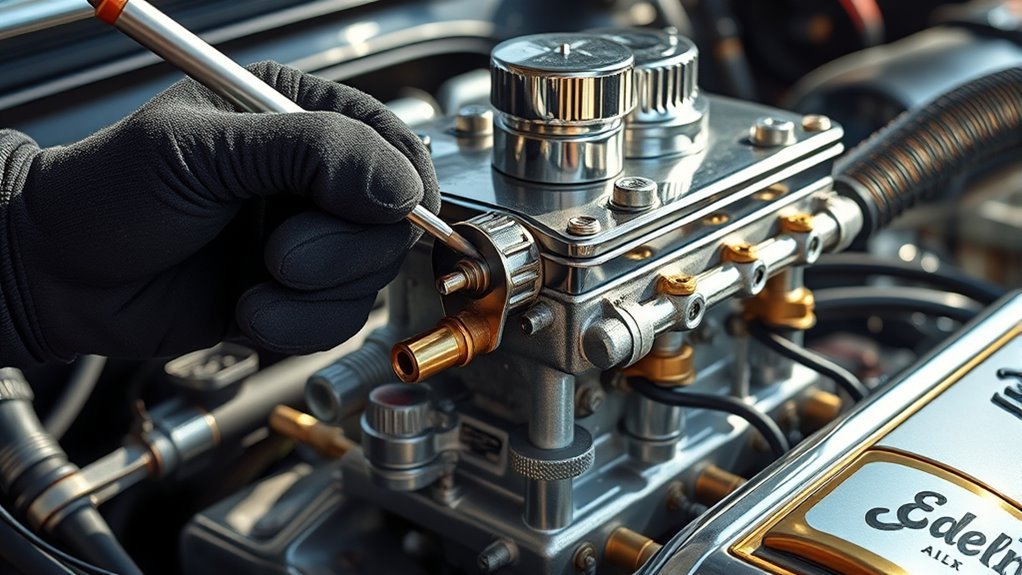
To adjust your Edelbrock carburetor properly, start with the engine warmed to operating temperature. This ensures all components are functioning under normal conditions. Locate the idle speed screw near the throttle linkage and set the RPM to the manufacturer’s specifications using a tachometer.
Next, find the mixture screws at the carburetor base. Gently turn them clockwise until the engine stumbles, then slowly turn counterclockwise until you achieve a smooth idle. This balances the air-fuel mixture for optimal performance.
After that, adjust the choke to ensure proper cold starts. Finally, fine-tune the accelerator pump stroke to improve throttle response. Understanding these essentials helps optimize your carburetor’s performance and reliability.
Key Takeaways
- Warm the engine to operating temperature before making any adjustments for accurate tuning of the Edelbrock carburetor.
- Locate and adjust the idle speed screw to set the engine RPM to the manufacturer’s recommended idle.
- Adjust the mixture screws by turning them clockwise until the engine stumbles, then counterclockwise to achieve the smoothest idle.
- Check and fine-tune the accelerator pump stroke length between 0.100 to 0.140 inches for optimal throttle response.
- Inspect for fuel leaks, clean jets, and verify float settings if engine hesitation or poor performance persists after adjustments.
Preparing Your Engine for Edelbrock Carburetor Adjustment
Before adjusting your Edelbrock carburetor, you need to verify the engine is properly warmed up and running at normal operating temperature. This guarantees accurate tuning, as cold engines can cause inconsistent readings.
Start by idling the engine for at least 10 minutes, allowing all components to reach thermal equilibrium. Check that the ignition timing and spark plugs are in ideal condition, as these affect engine performance. Confirm the air filter is clean to maintain proper airflow.
Ensure the choke is fully open once warm, preventing a rich mixture that hinders fuel efficiency.
Tools Needed to Adjust an Edelbrock Carburetor
Once your engine is properly warmed up and running smoothly, gathering the right tools will guarantee you can adjust your Edelbrock carburetor accurately and efficiently.
Proper carburetor tools enable precise manipulation, essential to effective adjustment techniques.
Having the right tools ensures precise control, crucial for successful carburetor adjustments.
Here are the must-have carburetor tools for the job:
- Flathead screwdriver for turning the idle and mixture screws with control.
- Tachometer to monitor engine RPM during adjustments for precise tuning.
- Vacuum gauge to measure manifold vacuum, aiding in fine-tuning the air-fuel mixture.
- Carburetor cleaner to make certain components are clean and function smoothly prior to adjustment.
With these tools, you’ll implement adjustment techniques confidently, optimizing your carburetor’s performance.
Find the Idle and Mixture Screws on an Edelbrock Carburetor
You’ll start by visually inspecting the Edelbrock carburetor to locate the idle and mixture screws.
The idle screw typically adjusts the throttle plate position, while the mixture screw controls the fuel-to-air ratio at idle.
Identifying these screws accurately is essential for making precise adjustments.
Identifying Idle Screw
Locating the idle and mixture screws on an Edelbrock carburetor is essential for precise tuning.
To identify the idle screw location specifically, follow these steps:
- Examine the carburetor’s throttle linkage area; the idle screw is usually near the throttle lever.
- Look for a small, knurled screw that contacts the throttle shaft or lever directly. This controls the idle speed.
- Verify the screw’s function by gently turning it; adjusting idle speed should change as you turn it.
- Note that the idle screw is typically accessible without removing any carburetor components, simplifying adjustments.
Locating Mixture Screw
Two key screws control the fuel-air mixture in an Edelbrock carburetor, and identifying the mixture screw is vital for fine-tuning performance.
You’ll find the mixture screw typically located near the base of the carburetor, adjacent to the throttle linkage, distinguishable from the idle screw by its smaller size and unique threading.
Carefully locating this screw allows you to apply precise mixture adjustment techniques, essential for achieving peak tuning practices.
Before making any adjustments, ascertain the engine is at operating temperature. Turning the mixture screw clockwise generally leans the mixture, while counterclockwise enriches it.
Proper identification and adjustment of the mixture screw directly impact engine efficiency and emissions.
Mastering this step forms the foundation for effective carburetor tuning and improved overall performance.
Visual Carburetor Inspection
A thorough visual inspection of your Edelbrock carburetor is essential to accurately identify the idle and mixture screws before making any adjustments.
Follow these steps to guarantee proper identification and check for issues like carburetor leaks or disrupted fuel flow:
- Locate the throttle linkage near the base; the idle screw is typically adjacent to this mechanism.
- Identify the mixture screw on the side of the carburetor bowl, often covered by a plug or cap.
- Inspect the screws for signs of wear, damage, or corrosion that could affect adjustment accuracy.
- Check the carburetor body and fuel lines for leaks that might alter fuel flow and skew your tuning results.
Completing this inspection guarantees you adjust the correct screws and maintain peak carburetor performance.
How to Set the Idle Speed on an Edelbrock Carburetor
To set the idle speed on an Edelbrock carburetor, you’ll first need to warm up the engine to its normal operating temperature.
Once warm, locate the idle speed screw, usually found on the throttle linkage.
With a tachometer connected, turn the screw slowly to adjust the idle speed. Increase or decrease the RPM until the engine achieves the manufacturer’s specified idle speed, guaranteeing smooth and stable operation.
Proper idle speed adjustment is critical for peak engine performance, preventing stalling and reducing rough idling.
Avoid excessive RPMs, which can cause unnecessary wear.
After setting, let the engine stabilize and verify the idle speed remains steady under normal conditions.
This precision guarantees your Edelbrock carburetor maintains efficient engine performance and reliable start-up behavior.
How to Adjust the Air-Fuel Mixture on an Edelbrock Carburetor
Although adjusting the idle speed guarantees stable engine operation, fine-tuning the air-fuel mixture is essential for maximizing combustion efficiency and overall performance.
To adjust the air-fuel balance on your Edelbrock carburetor, follow these tuning techniques:
- Locate the idle mixture screws, usually on the carburetor’s side, and start with them gently seated, then back out 1.5 turns.
- Warm up the engine to operating temperature for accurate adjustments.
- Turn each mixture screw slowly clockwise until the engine stumbles, then counterclockwise to the highest smooth idle. This finds the ideal air-fuel ratio.
- Repeat the process on both screws to maintain balance, ensuring no lean or rich conditions that could cause inefficiency or emissions issues.
This precise method guarantees your carburetor performs at peak efficiency.
How to Adjust the Choke for Easy Cold and Warm Starts
Fine-tuning the air-fuel mixture sets the stage for consistent engine performance, but adjusting the choke guarantees your Edelbrock carburetor handles cold and warm starts smoothly.
Begin by identifying the choke plate and linkage. Use choke adjustment techniques such as loosening the choke housing screws to set the initial choke plate position.
For cold start issues, make sure the choke is fully closed when the engine is cold, allowing a richer mixture. Gradually open the choke plate as the engine warms, preventing flooding or stalling.
Adjust the choke thermostat or bimetal spring tension to control the choke’s opening rate.
Test by starting the engine cold and observing idle quality; fine-tune the choke position until the engine runs smoothly without hesitation or stalling during warm-up phases.
Adjust the Accelerator Pump for Better Throttle Response
First, locate the accelerator pump on your Edelbrock carburetor to access the adjustment screw.
Then, carefully adjust the pump stroke length to control the fuel squirt during throttle changes.
Finally, test the throttle response to guarantee smoother acceleration and eliminate hesitation.
Locate The Accelerator Pump
The accelerator pump plays an essential role in delivering the extra fuel needed for quick throttle response during sudden acceleration.
To locate the accelerator pump on your Edelbrock carburetor, follow these steps precisely:
- Identify the carburetor’s side where the throttle linkage attaches; the accelerator pump is typically situated nearby.
- Look for a small rectangular or circular diaphragm housing protruding from the carburetor body. This houses the accelerator pump.
- Trace the pump function linkage connected to the throttle shaft; it actuates the accelerator pump when you press the gas pedal.
- Confirm by spotting the fuel discharge nozzle near the base of the pump housing, which sprays fuel into the carburetor throat during acceleration.
Locating the accelerator pump accurately guarantees you can make effective adjustments to optimize pump function.
Adjust Pump Stroke Length
Two key adjustments affect your Edelbrock carburetor’s accelerator pump performance: stroke length and pump rod position.
To adjust the pump stroke length, first identify the pump arm connected to the accelerator pump.
Using precise pump adjustment techniques, you’ll alter the stroke by bending the pump rod or adjusting the pump lever’s position. Increasing stroke length delivers more fuel during throttle changes, improving response, but excessive stroke can cause flooding.
Ideal stroke settings typically range from 0.100 to 0.140 inches of pump plunger travel. Use a dial indicator or a ruler for accurate measurement.
Make incremental adjustments, then recheck the stroke length to verify consistency.
Properly setting the stroke length balances fuel delivery, preventing hesitation or bogging during acceleration. This precision adjustment is vital for maximizing your carburetor’s performance.
Test Throttle Response
After setting the pump stroke length, you’ll need to evaluate how the accelerator pump responds during throttle changes. Testing throttle response is essential for effective carburetor tuning and optimizing throttle sensitivity.
Follow these steps:
- Start the engine and let it idle at operating temperature.
- Rapidly open and close the throttle to observe immediate fuel delivery and engine reaction.
- Note any hesitation, bogging, or lag, which indicates the accelerator pump may need adjustment.
- Adjust the pump cam or linkage to increase or decrease stroke length, then retest until throttle sensitivity improves.
This process guarantees the accelerator pump delivers the correct fuel volume precisely when you demand power, preventing lean conditions or bogging.
Proper throttle response tuning enhances drivability and performance in your Edelbrock carburetor.
Troubleshooting Common Issues After Adjusting Your Edelbrock Carburetor
Although fine-tuning your Edelbrock carburetor can optimize engine performance, you might encounter issues such as rough idling, hesitation, or flooding.
Start by inspecting for fuel leaks, which can cause poor performance issues and pose safety risks. Check all gaskets, seals, and fuel lines for cracks or looseness.
If you notice hesitation or stalling, re-examine the idle mixture screws and adjust them incrementally.
Flooding often results from a stuck float or incorrect float height; verify the float setting against manufacturer specifications.
Performance issues may also arise from clogged jets. Clean or replace them as needed.
Finally, guarantee the throttle linkage moves freely without binding.
Systematic troubleshooting following these steps will help you quickly resolve common problems after adjusting your Edelbrock carburetor.
Frequently Asked Questions
What Type of Edelbrock Carburetor Is Best for My Engine?
You’ll want an Edelbrock carburetor that matches your engine compatibility and supports performance tuning. Consider models like the AVS or Performer series, designed for specific horsepower ranges and fuel delivery needs to optimize your setup.
How Often Should I Clean My Edelbrock Carburetor?
Like clockwork, you should perform carburetor maintenance every 12,000 miles or annually, whichever comes first. This cleaning frequency guarantees your Edelbrock carburetor runs smoothly, preventing buildup that impairs fuel delivery and engine performance.
Can I Convert My Edelbrock Carburetor to Run on Ethanol Fuel?
Yes, you can convert your Edelbrock carburetor for ethanol compatibility by performing specific carburetor modifications, including upgrading seals, adjusting jetting, and ensuring materials resist ethanol’s corrosive properties. These changes help maintain peak fuel delivery and performance.
What Are the Signs of a Failing Edelbrock Carburetor?
You’ll notice carburetor symptoms like rough idling, poor fuel economy, and hesitation during acceleration. You’ll spot performance issues through engine stalling, black smoke, and difficulty starting. These signs indicate your Edelbrock carburetor needs attention.
How Do I Store My Edelbrock Carburetor During Winter?
For proper carburetor storage during winter, drain all fuel, spray carburetor cleaner inside, and seal openings to prevent moisture.
Store it in a dry, temperature-controlled environment to guarantee effective winter preparation and prevent corrosion or damage.
Conclusion
Adjusting your Edelbrock carburetor isn’t just a task—it’s a tune-up for performance, precision, and power. As you tweak the idle, mixture, choke, and accelerator pump, remember each small turn makes a big difference. With patience and the right tools, you’ll transform hesitation into harmony, rough idles into smooth rides.
Keep troubleshooting in mind, because perfection is a process, not a product. Now, go ahead—fine-tune your engine’s heartbeat with confidence. Mastering how to adjust a Edelbrock carburetor ensures your engine runs at its best.