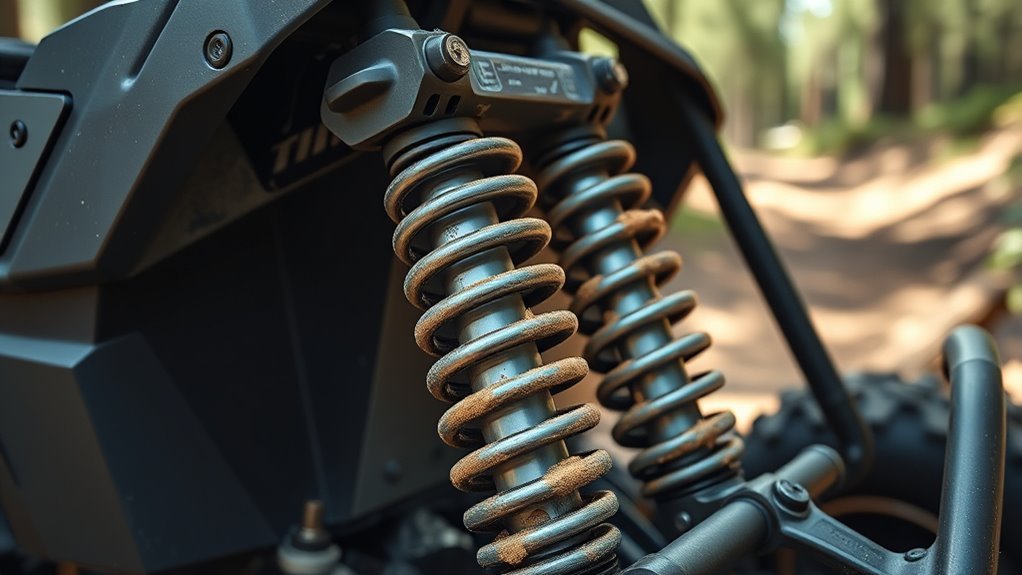

Can-Am Defender shocks are essential for smoothly absorbing rough terrain and maintaining vehicle stability. These shocks utilize advanced damping technology, including hydraulic or gas-charged designs, to precisely control compression and rebound forces.
Choosing the right shocks depends on your specific Can-Am Defender model, the terrain you frequently encounter, and whether you require adjustable performance features. Regular inspection and maintenance help prevent leaks and wear, ensuring consistent ride quality and control.
Understanding proper installation techniques and upgrade options can further enhance your Defender’s suspension performance. This knowledge allows you to maximize the effectiveness of your shocks and improve overall vehicle handling.
Key Takeaways
- Can-Am Defender shocks improve ride comfort by absorbing terrain impacts and enhancing vehicle stability on rough surfaces.
- Available in standard and performance variants, shocks cater to everyday use or aggressive off-road driving with adjustable damping.
- Signs for shock replacement include excessive bouncing, fluid leaks, uneven ride height, and unusual vibration or noise.
- Choosing shocks involves matching model compatibility, ride height, and desired adjustability for optimized suspension performance.
- Proper installation requires correct tools, torque specifications, safety precautions, and careful alignment to ensure secure mounting.
How Can-Am Defender Shocks Improve Ride Quality
When you upgrade to Can-Am Defender shocks, you immediately enhance your vehicle’s ability to absorb terrain irregularities, resulting in a smoother and more controlled ride.
These shocks utilize advanced damping technology that precisely modulates compression and rebound forces, reducing harsh impacts and vibrations.
This modulation delivers improved comfort by minimizing jolts transferred to the cabin, allowing you to maintain control without fatigue.
Additionally, the shocks’ robust construction and calibrated valving increase enhanced stability during rapid directional changes and uneven surfaces.
By optimizing wheel contact with the ground, they guarantee consistent traction and reduce body roll.
The result is a precise handling experience that adapts seamlessly to varied terrain, greatly upgrading your Defender’s overall ride quality and driver confidence.
Types of Can-Am Defender Shocks
You’ll find Can-Am Defender shocks primarily come in standard and performance variants, each designed for specific ride demands.
Both hydraulic and gas-filled options are available, affecting responsiveness and damping characteristics.
Understanding these types helps you select shocks that match your terrain and handling preferences precisely.
Standard Vs Performance Shocks
Although both standard and performance shocks serve to absorb impacts and maintain vehicle stability, they differ markedly in design and functionality.
Standard shock advantages include simpler construction and reliable damping suited for everyday terrain, providing consistent ride comfort and durability. They’re typically more cost-effective and require less maintenance, making them ideal if you use your Can-Am Defender mainly on moderate trails or work sites.
Performance shocks, however, offer enhanced benefits like adjustable damping rates and superior heat dissipation, which improve handling during aggressive driving or rugged off-road conditions.
You’ll notice increased control, reduced fade, and better responsiveness with performance shocks, as they utilize advanced valving and materials.
Choosing between them depends on your driving demands. Standard shocks prioritize reliability and economy, while performance shocks deliver elevated precision and adaptability.
Hydraulic And Gas Options
Selecting between standard and performance shocks often leads to evaluating the underlying mechanisms that govern shock absorption.
When considering Can-Am Defender shocks, you’ll encounter hydraulic and gas options, each with distinct characteristics.
Hydraulic shocks utilize fluid to dampen suspension movement, offering precise control and consistent performance across varied terrain. Their hydraulic advantages include superior heat dissipation and smooth, progressive resistance, which reduces abrupt impacts.
On the other hand, gas shocks incorporate pressurized nitrogen gas to minimize fluid aeration, maintaining damping consistency under demanding conditions. The gas benefits include improved responsiveness and reduced shock fade during extended use.
Choosing between these depends on your operational needs. Hydraulic shocks excel in controlled, steady absorption, while gas shocks deliver enhanced performance in aggressive, high-speed environments.
Understanding these differences guarantees you select the best shock for your Defender’s suspension system.
Signs Your Can-Am Defender Shocks Need Replacement
When your Can-Am Defender exhibits reduced stability or excessive bouncing over rough terrain, it indicates worn or failing shocks. Recognizing shock absorber symptoms early can prevent further suspension damage and unsafe handling.
Key indicators include:
- Uneven or decreased ride height issues, signaling internal seal failure or gas loss in shocks.
- Visible fluid leaks on the shock body, which reduce damping efficiency.
- Excessive vibration or noise during operation, showing compromised shock internals or mounts.
These signs highlight the need for timely replacement to maintain ideal ride control and vehicle safety. Ignoring such symptoms may lead to accelerated tire wear, poor traction, and degraded handling characteristics.
Regular inspection focusing on these technical cues guarantees your Defender’s suspension performs reliably under demanding conditions.
Choosing the Right Can-Am Defender Shocks
How do you determine the best shocks for your Can-Am Defender’s specific needs? Start by evaluating shock compatibility with your model year and intended use, whether trail riding, utility, or off-road sport.
Make sure the shocks accommodate your Defender’s ride height, especially if you’ve modified the suspension or installed lift kits. Opt for shocks with adjustable damping to tailor responsiveness and control.
Pay attention to the shock’s length and mounting type to guarantee a proper fit and best performance. High-quality materials like aluminum or nitrogen gas-charged shocks improve durability and reduce fade under heavy loads.
Reviewing manufacturer specifications and user feedback helps confirm compatibility and performance. By focusing on these technical aspects, you’ll select shocks that enhance your Defender’s handling, comfort, and reliability across diverse terrains.
Installing Can-Am Defender Shocks
Before installing your Can-Am Defender shocks, gather essential tools like a socket set, torque wrench, and jack stands for secure lifting.
Follow a precise step-by-step process to remove old shocks and mount the new ones, ensuring all bolts meet manufacturer torque specifications.
Always prioritize safety by working on a stable surface and wearing protective gear throughout the installation.
Tools Needed
To install Can-Am Defender shocks effectively, you’ll need a specific set of tools that guarantee precision and safety. Proper shock installation demands accuracy to avoid damaging components or compromising performance.
Additionally, precise shock adjustments require the right equipment to secure correct tension and alignment.
Prepare these essential tools:
- Torque wrench: Vital for applying manufacturer-specified torque values to mounting bolts, guaranteeing secure and reliable shock installation.
- Socket set with ratchet: Needed to remove and install bolts efficiently, fitting various sizes encountered during the process.
- Adjustable wrench: Useful for holding nuts steady during shock adjustments, preventing unwanted rotation and facilitating fine-tuning.
Having these tools ready will streamline your workflow, minimize errors, and maintain ideal shock function throughout the installation and adjustment phases.
Step-by-Step Process
While ensuring your Can-Am Defender is securely supported, start by loosening and removing the mounting bolts on the existing shocks using the appropriate socket size.
Carefully detach the old shocks, noting their orientation.
Position the new shocks aligned with the mounting points, then insert and hand-tighten the bolts to avoid cross-threading.
Use a torque wrench to tighten bolts to manufacturer specifications, ensuring secure shock installation.
Next, adjust the shocks according to your desired firmness or terrain requirements by rotating the preload collar or adjusting the damping settings, depending on your shock model.
Confirm even shock adjustment on all shocks for balanced performance.
Finally, double-check all fasteners for tightness.
This methodical approach guarantees peak shock function and durability on your Can-Am Defender.
Safety Precautions
Although shock installation may seem straightforward, you must prioritize safety by using proper personal protective equipment, such as gloves and eye protection, and guaranteeing the Can-Am Defender is securely elevated on stable jack stands.
Neglecting safety gear can lead to serious injury during shock maintenance.
Before starting, confirm the vehicle is on a level surface and the parking brake is engaged. Always release any stored tension in the shocks gradually to prevent sudden movement.
Keep these safety precautions in mind:
- Use quality gloves to protect hands from sharp edges and chemicals.
- Wear eye protection to guard against debris and fluid splashes.
- Double-check jack stand stability before applying force to components.
These steps guarantee a safe, efficient shock installation process without compromising your safety.
Upgrading Can-Am Defender Shocks for Better Performance
Since the Can-Am Defender’s stock shocks often fall short under demanding conditions, upgrading them can greatly enhance ride quality, handling, and durability.
You should focus on advanced shock absorber technology, such as gas-charged or piggyback reservoir shocks, which offer improved heat dissipation and consistent damping performance.
Incorporate performance enhancement techniques like adjustable compression and rebound settings to fine-tune your suspension for varied terrains.
Consider shocks with high-quality internal valving and nitrogen gas to reduce cavitation and maintain stability under heavy loads.
Upgrading also involves selecting components with reinforced shafts and seals to increase lifespan and reliability.
By implementing these technical improvements, you’ll achieve superior shock response, minimize body roll, and improve traction.
Properly chosen aftermarket shocks transform your Defender into a more capable and controlled off-road vehicle.
Maintaining Can-Am Defender Shocks for Longevity
To guarantee your Can-Am Defender shocks deliver consistent performance and extend their service life, you must perform regular maintenance focused on inspection, cleaning, and lubrication.
Implementing effective shock maintenance tips is essential to avoid premature wear and failure.
First, visually inspect the shocks for leaks, dents, or corrosion.
Second, clean the shock body and mounting points to prevent debris buildup that can impair function.
Third, apply appropriate lubrication to the bushings and pivot areas to reduce friction and wear.
These shock longevity practices not only preserve damping efficiency but also ensure peak ride quality under demanding conditions.
Frequently Asked Questions
Are Can-Am Defender Shocks Compatible With Other UTV Models?
You’ll find Can-Am Defender shocks have limited shock compatibility with other UTV models due to specific mounting points and damping characteristics. For UTV upgrades, always verify fitment details and vehicle specs to guarantee peak performance.
What Tools Are Needed to Remove Stock Can-Am Defender Shocks?
To perform shock removal on your Can-Am Defender, you’ll need a socket set, wrenches, a torque wrench, and penetrating oil. These tools meet shock removal tool requirements, ensuring precise, safe detachment of stock shocks without damage.
Can I Rebuild Can-Am Defender Shocks Myself at Home?
You can rebuild shocks yourself if you master shock rebuilding techniques and have home workshop essentials like a spring compressor and seal kits. Precision and cleanliness are essential for proper function and longevity in your Defender’s shocks.
How Do Temperature Changes Affect Can-Am Defender Shock Performance?
You’ll notice temperature effects cause the shock performance to vary; cold thickens the oil, reducing damping efficiency, while heat thins it, potentially causing fade. Maintaining ideal temperature keeps your shocks responsive and consistent.
Are There Warranty Options for Aftermarket Can-Am Defender Shocks?
You won’t find aftermarket warranties offering superhero-level shock performance guarantees, but many reputable brands provide limited coverage.
Always review terms carefully, as warranty scopes vary, ensuring your upgraded shocks stay protected under specific conditions.
Conclusion
Upgrading your Can-Am Defender shocks is like giving your ride a new pair of eyes—suddenly, every bump and dip becomes manageable. By choosing the right shocks and maintaining them diligently, you guarantee peak performance and extended durability. Don’t ignore signs of wear; timely replacement keeps your Defender responsive and safe.
With precise installation and proper care, your shocks will deliver smoother, more controlled rides, turning rough terrain into a well-mapped path. Investing in quality Can Am Defender shocks ensures your vehicle handles the toughest trails with confidence and reliability.