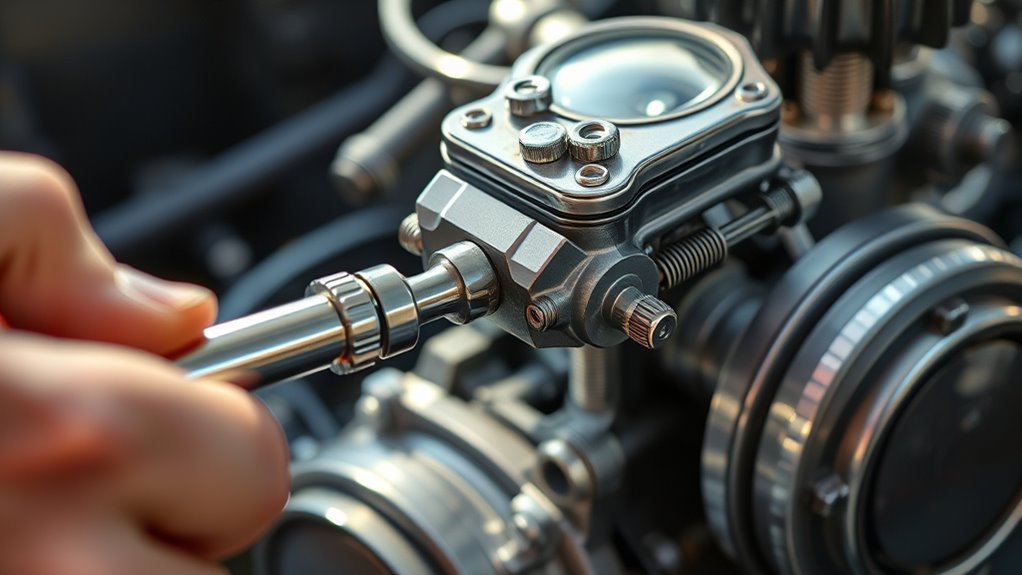

To adjust your throttle cable on the carburetor, first locate the cable housing and adjusting nuts near the carburetor or throttle grip. This initial step is crucial for a proper throttle cable adjustment on the carburetor. Loosen the lock nuts to relieve tension, then tighten the adjustment nut to reduce slack until you feel minimal free play—about 2-3 mm—in the throttle grip.
Make sure the cable moves smoothly without binding. Verify the throttle valve responds promptly to ensure smooth operation. After adjustment, test the throttle’s full range of motion for reliability.
For detailed steps and troubleshooting tips, keep exploring the process to perfect your throttle cable adjustment on the carburetor.
Key Takeaways
- Locate the throttle cable housing and adjusting nuts near the carburetor before starting adjustment.
- Loosen the adjusting nuts to increase cable slack or tighten to reduce slack for proper tension.
- Adjust cable tension to achieve minimal free play (2-3 mm) at the throttle grip for smooth operation.
- Ensure the cable routing is smooth without kinks and avoid twisting the cable during adjustment.
- Test throttle response by rotating the grip fully, confirming the throttle valve moves smoothly and returns promptly.
How to Identify Your Throttle Cable Setup
Before adjusting your throttle cable, you need to accurately identify its setup on your vehicle. Start by examining the throttle cable types commonly used: either a single-pull or dual-pull system. Single-pull cables have one wire operating the throttle, while dual-pull cables manage both throttle and choke functions.
Next, trace the cable routing from the throttle grip or pedal to the carburetor, ensuring it follows a smooth, unobstructed path without sharp bends or kinks that could affect performance.
Note any brackets or guides securing the cable along its route, as these influence tension and movement. Accurately identifying these elements is essential for proper adjustment and avoiding damage.
Document your findings before proceeding to adjust the throttle cable.
When and Why Should You Adjust the Throttle Cable?
Although throttle cables are designed for durability, you should adjust them whenever you notice sluggish throttle response, excessive free play, or difficulty in maintaining consistent engine speed.
Regular adjustments compensate for cable wear and prevent further mechanical issues.
Adjust your throttle cable when you experience:
- Delayed engine acceleration due to slack in the cable
- Noticeable free play exceeding manufacturer specifications
- Sticking or binding of the throttle grip or pedal
- Uneven idle speeds caused by improper cable tension
- Visible fraying or damage indicating cable wear
Timely adjustment guarantees precise throttle control, improves engine responsiveness, and extends cable lifespan.
Neglecting these signs can lead to unsafe riding conditions or increased wear on carburetor components.
Maintaining ideal throttle cable tension preserves throttle response and overall engine performance.
Essential Tools and Safety Tips for Throttle Cable Adjustment
You’ll need a few essential tools to adjust your throttle cable effectively and safely. Gather a set of screwdrivers, adjustable wrenches, and pliers designed for mechanical tasks.
Verify all tools are clean and in good condition, as proper tool maintenance prevents slippage and damage during adjustment.
Ensuring tools are clean and well-maintained prevents slippage and protects both you and your equipment during adjustments.
Always wear appropriate safety gear, including gloves and safety glasses, to protect your hands and eyes from debris or accidental contact with moving parts.
Work in a well-ventilated area and keep the engine off to avoid unexpected throttle movement.
Before starting, inspect the throttle cable for frays or corrosion; damaged cables must be replaced rather than adjusted.
Following these safety protocols and using well-maintained tools will help you perform precise adjustments and avoid injury or equipment damage.
How to Adjust Your Throttle Cable Step-by-Step
First, locate the throttle cable components, including the cable housing, inner wire, and adjusting nuts.
Next, loosen the adjusting nuts to allow for tension changes.
Finally, set the proper tension by tightening the nuts while ensuring smooth throttle operation without slack.
Identify Cable Components
Understanding the key components of your throttle cable is essential before making any adjustments.
You need to recognize the specific cable types and cable materials used in your setup to guarantee proper handling and maintenance.
Most throttle cables consist of several critical parts:
- Inner wire: Transmits throttle motion; typically made of braided steel for durability
- Outer sheath: Protects the inner wire; often a flexible plastic or rubber material
- Adjusting nuts: Allow tension modification at connection points
- End fittings: Connect inner wire to throttle and carburetor mechanisms
- Mounting brackets: Secure the cable assembly in place
Identifying these components helps you understand how adjustments affect throttle response and cable tension, enabling accurate and safe tuning.
Loosen Adjusting Nuts
Begin by locating the adjusting nuts on both ends of the throttle cable assembly. These nuts secure the cable housing and control the cable’s tension.
Using the appropriate wrench, carefully loosen the nuts by turning them counterclockwise. This step is essential in adjustment techniques because it releases the cable, allowing for precise tension changes during subsequent steps.
Make sure you don’t fully remove the nuts, as this could disrupt the cable’s position and complicate cable maintenance.
Loosening the adjusting nuts provides the flexibility needed to fine-tune cable length without damaging components.
Take care to maintain alignment and avoid twisting the cable, as improper handling can cause premature wear.
Mastering this step sets the foundation for effective throttle cable adjustment and reliable carburetor performance.
Set Proper Tension
Two main factors determine proper throttle cable tension: responsiveness and free play.
To set the correct cable tension, guarantee the throttle response is immediate without binding. Follow these steps precisely:
Pull the throttle grip fully and hold it. Adjust the cable by tightening or loosening the adjuster nuts. Check for minimal free play, typically 2-3 mm at the throttle grip.
Release the throttle and confirm it snaps back smoothly to idle. Re-tighten the lock nuts to secure the adjuster in place.
Proper cable tension optimizes throttle response and prevents slippage or delayed acceleration. Avoid excessive tightness that could cause binding or excessive slack leading to lag.
You want a balance that delivers precise control and safe operation every time you twist the throttle.
How to Test Throttle Cable Response After Adjustment
Once you’ve adjusted the throttle cable, you need to verify its responsiveness to confirm proper operation.
Begin throttle cable testing by firmly gripping the throttle grip and smoothly rotating it through its full range of motion.
Observe the carburetor’s throttle valve to make sure it opens and closes without delay or sticking.
Next, release the throttle and confirm it returns promptly to the idle position.
Perform multiple cycles to check for consistent response.
If the throttle valve moves proportionally and without hesitation, your response verification is successful.
Additionally, listen for any unusual sounds indicating friction or binding.
This precise testing confirms the cable’s correct tension and smooth operation, preventing engine performance issues.
Proper throttle cable testing is essential before finalizing adjustments and reassembling components.
How to Troubleshoot Common Throttle Cable Problems
When your throttle cable exhibits irregularities such as sticking, delayed response, or excessive slack, diagnosing the root cause becomes essential to restore proper function.
Start by inspecting the cable for visible throttle cable wear; frayed strands or kinks can impair smooth movement.
Begin by checking the cable for visible wear like frayed strands or kinks that hinder smooth movement.
Next, verify cable routing issues. Ensure the cable follows the correct path without sharp bends or contact with hot engine parts.
Check the throttle lever and carburetor connection for tightness and freedom of movement.
Lubricate the cable if it feels stiff.
Finally, confirm the adjuster nuts are correctly set to eliminate slack without binding.
Addressing these points systematically helps pinpoint and resolve common throttle cable problems, ensuring reliable throttle response and safe engine operation.
Frequently Asked Questions
Can a Faulty Throttle Cable Affect Fuel Efficiency?
Yes, a faulty throttle cable can reduce fuel efficiency by causing poor throttle response and inconsistent engine performance. Cable wear limits precise control, leading to inefficient fuel delivery and increased consumption.
Inspect and adjust the cable regularly.
How Often Should Throttle Cables Be Replaced?
You should replace throttle cables every 2 to 3 years or sooner if wear appears. Follow your maintenance schedule closely to monitor throttle cable lifespan and guarantee peak performance and safety during operation.
Are Throttle Cable Adjustments Different for Electric Bikes?
Yes, electric bike throttle adjustments differ slightly; you’ll focus on optimizing throttle response electronically rather than mechanically. Make certain the throttle sensor calibration matches your controller’s parameters for smooth acceleration without lag or sudden surges.
What Materials Are Throttle Cables Typically Made From?
You’d think throttle cables are made from alien steel, but cable materials typically include stainless steel or galvanized steel for durability. Different throttle types may use nylon-coated cables to reduce friction and guarantee smooth, precise control.
Can I Lubricate My Throttle Cable to Improve Performance?
Yes, you can lubricate your throttle cable to improve performance. Follow proper cable maintenance by applying suitable lubricants using lubrication techniques like cable oiling or spray.
This helps reduce friction and guarantees smooth throttle operation.
Conclusion
Now that you’ve adjusted your throttle cable, you’ll notice smoother throttle response and improved control—just as you intended.
Coincidentally, taking these precise steps not only fine-tunes your carburetor but also prevents common issues like sticking or lag.
By routinely checking and adjusting your throttle cable, you’ll maintain peak engine performance and safety.
Trust the process, use the right tools, and you’ll keep your ride running flawlessly every time you twist the throttle cable on the carburetor.