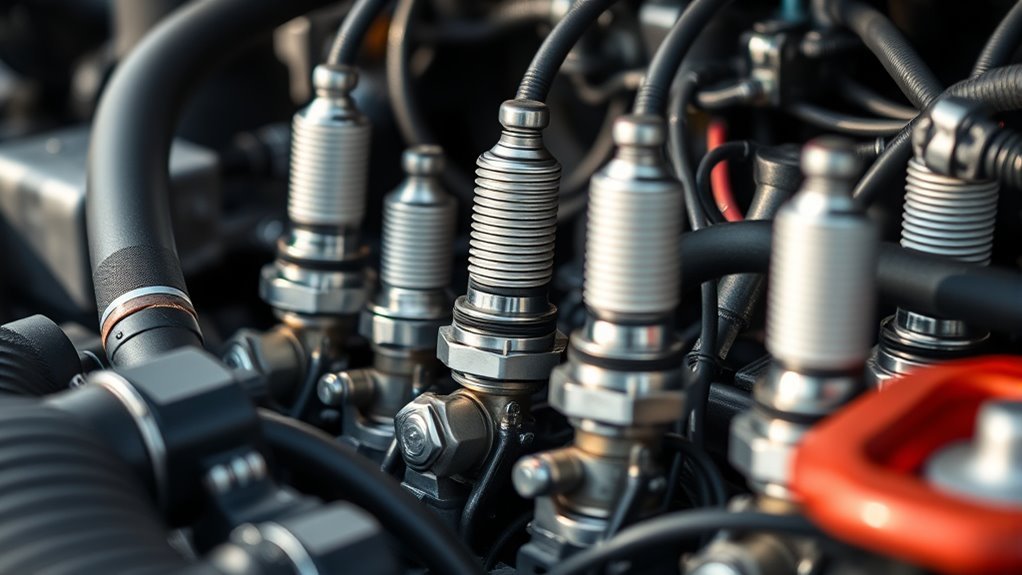

You’ll find spark plugs located in the cylinder head of gasoline engines, positioned to ignite the air-fuel mixture efficiently. In inline engines, they line up in a single row, while V engines have plugs on both sides, making access trickier.
Modern cars often have plug positions designed for easier reach, sometimes situated beneath ignition coils, unlike older models with recessed plugs. Motorcycles and small engines place plugs near the top for simpler maintenance.
Understanding these locations helps prepare you for removal and inspection challenges ahead.
Key Takeaways
- Spark plugs are located in the cylinder head of gasoline engines, igniting the air-fuel mixture in combustion chambers.
- Inline engines have spark plugs arranged in a single row along the cylinder head for easier access.
- V engines position spark plugs on both sides of the engine block, making access more complex.
- Modern coil-on-plug systems place spark plugs directly beneath ignition coils for simpler removal.
- Motorcycles and small engines have spark plugs accessible near the top of the cylinder head or protruding for easy access.
Where Are Spark Plugs Located in Gasoline Engines?
Although the exact location varies by engine design, you’ll typically find spark plugs screwed directly into the cylinder head of gasoline engines. This placement guarantees they ignite the air-fuel mixture efficiently within each combustion chamber.
Depending on the ignition system, different spark plug types are used, such as copper, platinum, or iridium, each offering specific durability and performance characteristics. The spark plug’s electrode gap and heat range must match the engine’s requirements to optimize combustion and prevent misfires.
Spark plug types and specifications vary to enhance durability, performance, and combustion efficiency in different engines.
You’ll notice that spark plugs connect to ignition coils or distributor wires, which deliver the high voltage needed for the spark.
Understanding their precise location and role helps in maintenance and troubleshooting ignition system issues, assuring your engine runs smoothly and efficiently.
Where Spark Plugs Sit in Inline vs. V Engines
In inline engines, you’ll find spark plugs evenly spaced along one side of the cylinder head, making access straightforward.
V engines position spark plugs on both sides of the engine block, aligned with each cylinder bank, which can complicate maintenance.
Understanding these differences helps you locate and service spark plugs efficiently.
Inline Engine Spark Placement
When you examine an inline engine, you’ll find the spark plugs are positioned along the cylinder head in a single row, making them easier to access and service compared to V engines, where spark plugs sit on either side of the engine block. Inline engine types often favor this placement for efficient ignition and maintenance.
The spark plug design suits this layout by providing uniform heat distribution and simplified wiring.
| Aspect | Inline Engine Details |
|---|---|
| Spark Plug Location | Single row along cylinder head |
| Accessibility | High; easy to reach and replace |
| Maintenance | Simplified due to linear layout |
| Spark Plug Design | Standard length, heat range suited |
| Engine Types | Common in 4-cylinder and 6-cylinder |
This setup streamlines repairs and optimizes ignition consistency in inline engines.
V Engine Spark Location
The spark plugs in V engines sit on either side of the engine block, nestled within the cylinder heads that form the characteristic “V” shape.
Unlike inline engines, where spark plugs align in a single row, V engines require spark plugs to be positioned on two separate banks.
This design demands careful consideration of spark plug types to guarantee compatibility with the engine’s combustion chamber and heat range.
When performing spark plug maintenance, you’ll need to access each cylinder head separately, which can complicate replacement or inspection.
Proper torque and gap settings remain critical for peak performance.
Understanding the distinct layout helps you select appropriate spark plug types and maintain them effectively, ensuring reliable ignition and engine efficiency in your V engine setup.
Spark Plug Locations in Modern vs. Older Cars
Although spark plug placement varies widely, modern vehicles typically position them more accessibly than older models. Advances in engine design and the adoption of various spark plug types have influenced this shift.
Modern engines often use coil-on-plug systems, placing spark plugs directly beneath ignition coils atop the cylinder head, simplifying replacement and inspection. Conversely, older cars feature spark plugs recessed within engine blocks or hard-to-reach manifolds, complicating maintenance.
Additionally, older designs frequently required spark plug wires, increasing complexity and potential failure points. Understanding these differences is vital when servicing your vehicle.
Familiarizing yourself with your engine’s layout guarantees efficient spark plug access and replacement, minimizing downtime and optimizing engine performance.
Always consult your vehicle’s manual to identify specific spark plug locations based on its engine design and spark plug types.
Where to Find Spark Plugs in Motorcycles and Small Engines
Because motorcycles and small engines vary widely in design, locating their spark plugs requires familiarity with specific engine layouts.
On most motorcycles, you’ll find the spark plugs positioned on the cylinder head, often accessible near the top of the engine.
Single-cylinder bikes typically have one spark plug, while multi-cylinder models have one per cylinder, aligned along the engine block.
For small engines like lawnmowers or generators, spark plugs usually sit on the cylinder head, protruding outward for easy reach during small engine troubleshooting.
Regular inspection and replacement of spark plugs are essential in motorcycle maintenance to guarantee peak combustion and engine performance.
Knowing these locations helps you quickly diagnose ignition issues and maintain engine reliability without unnecessary disassembly.
How Engine Covers Affect Spark Plug Access
Locating spark plugs on motorcycles and small engines often involves maneuvering through various engine components, including covers that can obstruct direct access.
Different engine cover types, such as plastic, metal, or composite, affect how easily you reach the spark plugs.
Engine cover materials like plastic, metal, or composite impact the ease of accessing spark plugs.
Plastic covers typically require simple removal using basic tools, while metal covers may involve more bolts and careful handling due to weight and heat retention.
Some covers are integrated with other engine parts, increasing access difficulty and necessitating partial disassembly.
Understanding the specific engine cover type on your vehicle helps you anticipate the level of effort and tools required.
Properly maneuvering through these covers guarantees you can efficiently reach spark plugs without causing damage or unnecessary delays during maintenance.
How to Safely Remove and Inspect Spark Plugs
Before you remove spark plugs, make sure the engine is cool to prevent burns and avoid damaging the threads. Use appropriate spark plug tools, such as a ratchet with a spark plug socket, to guarantee a secure grip and avoid rounding the plug hex.
Carefully disconnect the ignition coil or spark plug wire by pulling the boot, not the wire, to prevent damage. Unscrew the spark plug gently, maintaining alignment to protect the cylinder head threads.
For inspection, apply standard inspection techniques: check the electrode gap with a feeler gauge, inspect the porcelain insulator for cracks, and assess deposits or wear on the electrodes.
Replace plugs exhibiting heavy deposits, erosion, or damage.
Proper removal and inspection maintain engine efficiency and prevent costly repairs.
How to Tell If Your Spark Plugs Are Hard to Reach
You’ll find that your engine’s layout considerably affects spark plug accessibility, especially in compact or V-shaped engines.
Accessories like intake manifolds, wiring harnesses, or ignition coils can obstruct direct access to the plugs.
Identifying these obstacles early helps you determine if specialized tools or partial disassembly are necessary.
Engine Layout Impact
Although engine designs vary widely, the layout considerably affects how accessible your spark plugs are. In transverse engine designs, commonly found in front-wheel-drive vehicles, spark plugs are often more cramped due to the compact arrangement of components.
Conversely, longitudinal engine layouts typically provide better access since cylinders align front-to-back. V-type engines introduce complexity; the spark plugs sit between cylinder banks, making them harder to reach compared to inline configurations.
Layout variations impact not only accessibility but also the tools and time you’ll need for maintenance. Recognizing your engine design helps determine whether you’ll require specialized tools or partial disassembly to reach spark plugs.
Accessory Obstructions
When engine accessories like intake manifolds, ignition coils, or wiring harnesses obstruct the spark plugs, accessing them becomes considerably more challenging.
You’ll notice that in certain engine designs, accessory placement directly limits the space around the spark plugs. For example, transverse-mounted engines often have tightly packed accessories, making spark plug access difficult without removing components.
Additionally, overhead camshaft layouts sometimes position ignition coils directly atop spark plugs, requiring coil removal first.
To determine if your spark plugs are hard to reach, inspect the engine bay for any accessories blocking direct access to the spark plug wells.
Understanding your vehicle’s engine design and accessory placement helps you anticipate the need for specialized tools or partial disassembly, ensuring you plan for efficient spark plug maintenance or replacement.
When to Get Professional Help With Spark Plugs
If you notice persistent engine misfires, rough idling, or difficulty starting despite replacing spark plugs, it’s time to seek professional assistance.
These symptoms can indicate underlying issues beyond routine spark plug maintenance, such as ignition system faults or wiring problems.
Attempting further repairs without proper diagnostic tools might worsen the situation. A professional inspection guarantees accurate identification of problems, including coil pack failures or incorrect spark plug gaps.
Additionally, if your vehicle’s spark plugs are hard to access due to accessory obstructions or engine design, a technician’s expertise prevents damage during removal or installation.
Regular professional check-ups complement your maintenance efforts, optimizing engine performance and preventing costly repairs.
Don’t hesitate to get expert help when basic spark plug replacement doesn’t resolve engine issues.
Frequently Asked Questions
What Tools Do I Need to Replace Spark Plugs?
You’ll need a spark plug socket, ratchet wrench, extension bar, torque wrench, and possibly a gap gauge. These replacement tools guarantee proper removal, installation, and precise tightening of the spark plug for peak engine performance.
How Often Should Spark Plugs Be Replaced?
You might think spark plugs last forever, but their lifespan typically ranges from 30,000 to 100,000 miles. Your replacement frequency depends on your vehicle’s specs and driving habits. Check your manual for precise intervals.
Can Bad Spark Plugs Cause Engine Misfires?
Yes, bad spark plugs can cause engine misfires by disrupting ignition timing, which reduces engine performance. You’ll notice rough idling, hesitation, and decreased fuel efficiency as the spark plugs fail to ignite the fuel-air mixture properly.
What Are the Symptoms of Worn Spark Plugs?
You’ll notice spark plug symptoms like rough idling, reduced engine performance, difficulty starting, and increased fuel consumption. These signs indicate worn plugs impair combustion efficiency, causing misfires and overall engine power loss.
Address them promptly for peak performance.
Are Iridium Spark Plugs Better Than Copper Ones?
Yes, iridium spark plugs offer iridium advantages like longer lifespan and better performance, while copper disadvantages include quicker wear and lower durability.
You’ll get improved ignition and fuel efficiency by choosing iridium over copper plugs.
Conclusion
Finding and maintaining your spark plugs is like revealing the engine’s heartbeat. Whether nestled deep in a V engine or tucked under a sleek cover, their location can challenge your reach.
Remember, precise inspection and careful removal keep your engine firing smoothly. If your spark plugs feel like hidden treasures, don’t hesitate to call a professional.
After all, a well-tuned spark plug is the silent spark that drives power and efficiency under your hood. Knowing where spark plugs are located is key to ensuring your engine runs at its best.