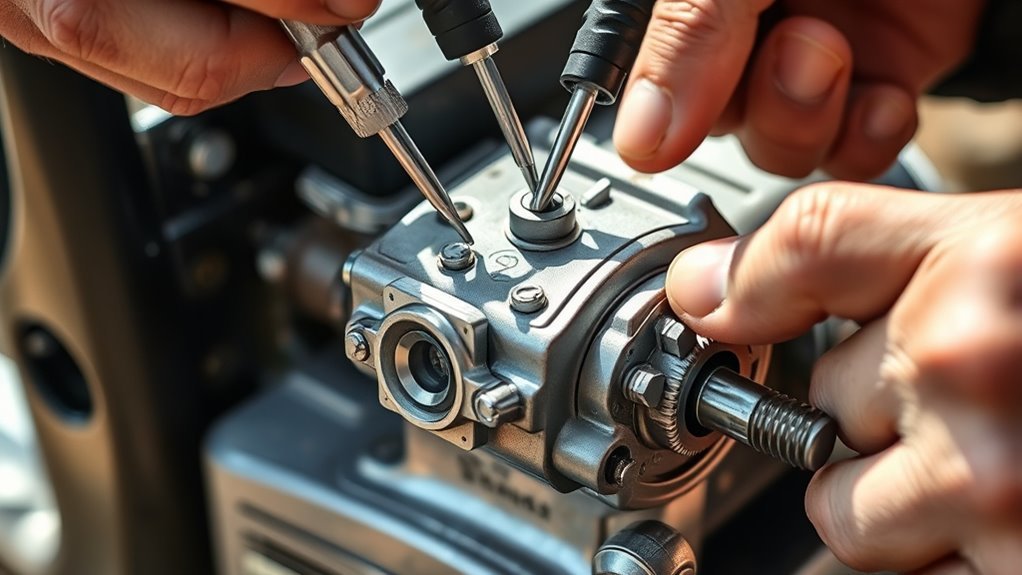
To set your chainsaw carburetor, start by turning the L and H screws clockwise until they’re lightly seated, then back them out 1 to 1.5 turns. This initial adjustment helps establish a baseline for fine-tuning.
Next, warm up the engine to operating temperature. Adjust the L screw to achieve smooth idling, which ensures the engine runs steadily without sputtering.
After that, tweak the H screw to reach maximum RPM without causing strain or overheating. Finally, set the T screw so the chain remains stationary when idling.
This precise adjustment improves performance and prevents stalling. Exploring proper maintenance guarantees your saw runs efficiently.
Key Takeaways
- Turn L and H screws clockwise until seated, then back out 1 to 1.5 turns before starting the engine.
- Warm up the chainsaw engine for about five minutes before making carburetor adjustments.
- Adjust the L screw for smooth idle and the H screw for maximum RPM without engine strain.
- Set the T screw so the chain remains stationary when idling.
- Use a tachometer to ensure RPMs stay within manufacturer specifications during fine-tuning.
How to Tell If Your Chainsaw Carburetor Needs Adjusting
How can you tell if your chainsaw carburetor needs adjusting? You’ll notice specific signs of malfunction that directly affect the engine’s performance.
Key performance indicators include difficulty starting the saw, inconsistent idling, or stalling under load.
Difficulty starting, inconsistent idling, and stalling under load are key signs your chainsaw carburetor needs adjustment
If the throttle response feels sluggish or the engine races uncontrollably at idle, these are clear signs the carburetor settings are off.
Additionally, excessive smoke from the exhaust suggests a rich fuel mixture, while a weak engine sound can indicate a lean mixture.
Monitoring fuel consumption can also help; unusually high usage signals inefficiency.
Essential Tools for Adjusting Your Chainsaw Carburetor
When you notice signs like inconsistent idling or excessive smoke, adjusting the carburetor becomes necessary to restore ideal performance.
To do this effectively, you’ll need specific tools tailored to the carburetor types on your chainsaw.
First, a small flathead or Phillips screwdriver is essential for turning the high-speed (H), low-speed (L), and idle (T) adjustment screws.
A tachometer helps measure engine RPM accurately, guaranteeing your tuning techniques meet manufacturer specs.
Additionally, a spark plug wrench aids in access and inspection during the tuning process.
For some carburetor types, a carburetor cleaner spray is useful to remove deposits before adjustment.
Having these tools ready guarantees precise, safe adjustments, allowing you to optimize fuel-air mixtures and maintain your chainsaw’s peak efficiency.
Step-by-Step Guide to Adjust Your Chainsaw Carburetor
Before adjusting your chainsaw carburetor, gather the necessary tools like a screwdriver and tachometer.
You’ll follow a precise sequence of steps to fine-tune the idle, low-speed, and high-speed screws.
This method guarantees peak engine performance and fuel efficiency.
Necessary Tools Preparation
Preparing the right tools guarantees a smooth and accurate adjustment of your chainsaw carburetor. Proper tool selection is essential for effective carburetor maintenance, ensuring you avoid damaging delicate components.
Gather precision screwdrivers, a tachometer, and a clean workspace before starting. Using the correct tools reduces errors and improves adjustment accuracy.
| Tool | Purpose |
|---|---|
| Flathead screwdriver | Adjusts carburetor screws |
| Phillips screwdriver | Removes carburetor casing screws |
| Tachometer | Measures engine RPM |
| Clean cloth | Wipes off dirt and debris |
Make sure your tools are in good condition and calibrated if necessary. This preparation prevents mechanical errors and streamlines the adjustment process, setting a foundation for precise carburetor tuning.
Adjustment Procedure Steps
Although adjusting your chainsaw carburetor requires attention to detail, following a systematic procedure guarantees peak engine performance.
Proper carburetor tuning optimizes fuel-air mixture, securing reliable starts and smooth operation. Here’s how to proceed:
- Set Idle Screws: Turn the L (low-speed) and H (high-speed) screws clockwise until they lightly seat, then back them out 1 to 1.5 turns. This baseline prevents over-tightening.
- Start and Warm Up Engine: Run the chainsaw until it reaches operating temperature. This step stabilizes engine performance and allows accurate adjustments.
- Fine-Tune Screws: Adjust the L screw for smooth idling, then the H screw for maximum RPM without engine strain. Finally, set the T (idle speed) screw so the chain doesn’t move at idle.
Following these steps secures precise carburetor tuning and maximizes engine performance.
Fine-Tune Your Chainsaw Carburetor for Peak Performance
Once you’ve completed the initial adjustments, you’ll need to fine-tune your chainsaw carburetor to guarantee it runs at peak performance.
Start by warming up the engine for five minutes to stabilize operating conditions.
Adjust the low-speed screw slowly; turn it clockwise to lean the mixture and counterclockwise to enrich it until the engine idles smoothly without stalling.
Carefully adjust the low-speed screw to achieve a smooth idle without stalling by leaning or enriching the mixture.
Next, tweak the high-speed screw to enhance top-end power. Turn it in small increments while testing throttle response.
Always monitor the RPMs with a tachometer to verify you stay within the manufacturer’s recommended range. This precise carburetor tuning maximizes fuel efficiency and power output, ensuring ideal performance.
Finalize by adjusting the idle speed screw so the chain doesn’t move at idle but the engine runs steadily.
This systematic process ensures effective performance enhancement.
Common Chainsaw Carburetor Problems and How to Fix Them
If your chainsaw engine hesitates, stalls, or runs unevenly, the carburetor is likely the culprit. Address these common problems to restore performance:
- Carburetor Leaks: Inspect for fuel seepage around gaskets and diaphragms. Replace damaged seals promptly to prevent air-fuel mixture inconsistencies.
- Clogged Fuel Filter: A dirty fuel filter restricts fuel flow, causing sputtering or stalling. Clean or replace the filter regularly to maintain proper fuel delivery.
- Improper Idle Adjustment: If the engine stalls at idle, adjust the idle screw according to the manufacturer’s specs for stable running.
Simple Tips to Keep Your Chainsaw Carburetor Running Smoothly
You’ll keep your chainsaw carburetor running smoothly by sticking to a regular cleaning routine and using the proper fuel mixture.
Clean the carburetor components to prevent buildup that can clog jets and passages.
Always mix fuel and oil at the manufacturer’s recommended ratio to guarantee peak engine performance.
Regular Cleaning Routine
Performing a regular cleaning routine on your chainsaw carburetor guarantees peak performance and extends the tool’s lifespan.
Consistent carburetor maintenance prevents buildup that affects fuel flow and engine efficiency. Use appropriate cleaning supplies like carburetor cleaner, compressed air, and small brushes.
Follow these steps for effective cleaning:
- Disassemble Carefully: Remove the carburetor from the chainsaw, noting the position of all parts to avoid misassembly.
- Clean Thoroughly: Spray carburetor cleaner on all components, focusing on jets and passages. Use compressed air to clear debris.
- Inspect and Reassemble: Check for worn or damaged parts. Replace if necessary, then reassemble and reinstall the carburetor securely.
Adhere to this routine regularly to maintain smooth operation and prevent costly repairs.
Proper Fuel Mixture
Maintaining a clean carburetor sets the foundation for ideal fuel delivery, but achieving smooth operation also depends on using the proper fuel mixture. Start by selecting high-quality fuel with minimal ethanol content, as poor fuel quality can cause deposits and clog jets.
Use fresh gasoline and avoid storage over 30 days to prevent degradation. Follow precise mixing techniques: measure oil and fuel accurately, typically at a 50:1 ratio unless your chainsaw’s manual specifies otherwise.
Mix thoroughly in a clean container before filling the tank, guaranteeing uniform distribution of oil to lubricate the engine properly. Avoid over-oiling, which can foul the spark plug and carburetor.
Correct fuel mixture guarantees peak combustion, reduces engine wear, and maintains carburetor performance, ultimately extending your chainsaw’s lifespan and reliability.
Frequently Asked Questions
Can I Use a Universal Carburetor for Different Chainsaw Models?
You can use a universal carburetor, but universal compatibility isn’t guaranteed. Expect performance differences due to variations in engine specs.
Always check fitment and tune adjustments for ideal chainsaw operation and efficiency.
How Often Should I Replace My Chainsaw Carburetor?
You should replace your chainsaw carburetor every 1-3 years, depending on usage and maintenance. Monitor carburetor lifespan closely, and adjust replacement frequency if you notice performance issues, fuel leaks, or difficulty starting the saw.
Does Altitude Affect Chainsaw Carburetor Performance?
Yes, altitude affects chainsaw carburetor performance. You’ll need altitude adjustments to maintain ideal carburetor tuning, ensuring correct air-fuel mixture.
Adjust screws carefully to prevent engine flooding or stalling during high-altitude use.
Can Bad Fuel Damage the Carburetor?
Yes, poor fuel quality can clog and corrode your carburetor, leading to performance issues. You should always use fresh, clean fuel and perform regular carburetor maintenance to prevent damage and guarantee efficient operation.
Is Professional Servicing Necessary for Carburetor Issues?
Think of your carburetor as your chainsaw’s heart; without professional diagnostics, hidden issues can persist. You should seek expert carburetor maintenance to guarantee peak performance, prevent damage, and extend your tool’s lifespan effectively.
Conclusion
Think of your chainsaw carburetor as the heart of your tool—when it’s finely tuned, everything runs smoothly. By following the steps to adjust it, you’ll guarantee ideal fuel and air flow, boosting performance and longevity. Regular maintenance and quick fixes prevent common issues from slowing you down.
Keep your carburetor in top shape, and your chainsaw will respond like a well-oiled machine, ready for any cutting task you throw its way. Properly setting the chainsaw carburetor ensures optimal engine efficiency and reliability, making your work easier and more effective.