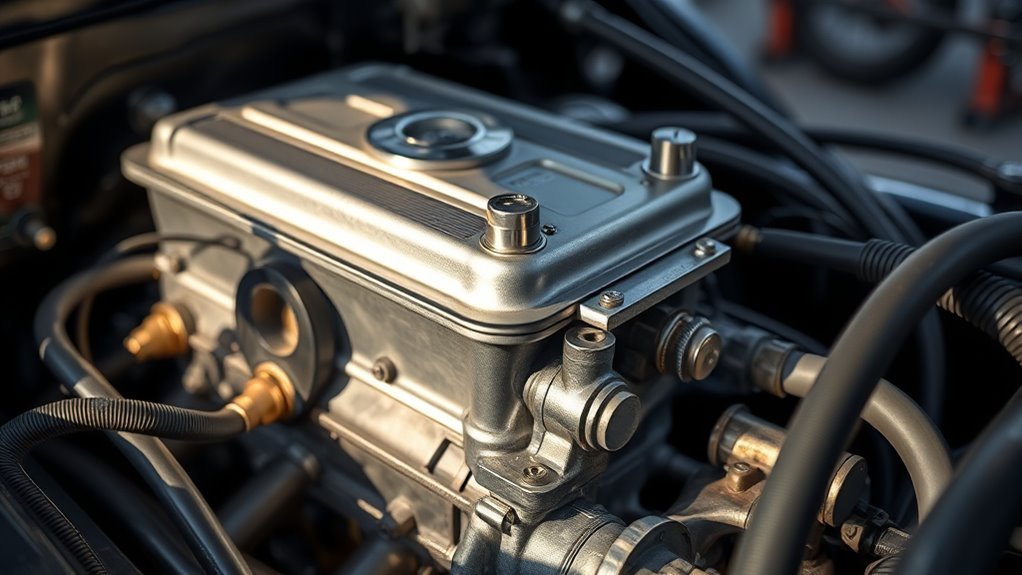
You need a carburetor sized based on your engine’s displacement, max RPM, and driving style to guarantee proper airflow and performance. Choosing the right size carburetor is essential for optimizing engine efficiency and power output.
Use the formula CFM = (CID × RPM × VE) / 3456 to estimate airflow needs, with volumetric efficiency around 0.85–0.95. Match the carburetor size to your engine type and consider your driving habits—larger for aggressive driving, smaller for fuel economy.
Selecting the right size prevents power loss and poor fuel atomization. Keep exploring to find the ideal fit and tuning tips.
Key Takeaways
- Calculate carburetor size using engine displacement, max RPM, and volumetric efficiency with the formula: CFM = (CID × RPM × VE) / 3456.
- Match carburetor size to your engine type and modifications to avoid performance loss or engine damage.
- Consider your driving style: larger carburetors suit aggressive driving, smaller ones favor fuel efficiency and steady driving.
- Avoid oversized carburetors to prevent poor atomization and throttle response; undersized ones restrict airflow and reduce power.
- Regularly tune and adjust your carburetor for optimal performance, using proper tools and following manufacturer specifications.
How Do Engine Displacement and RPM Affect Carburetor Size?
How do engine displacement and RPM influence the ideal carburetor size for your engine?
Engine displacement directly correlates with the volume of air-fuel mixture needed per engine cycle. A larger displacement demands a carburetor capable of delivering a higher airflow rate.
Meanwhile, RPM affects how frequently the engine cycles per minute, impacting the total airflow requirement. Understanding these engine characteristics is essential for precise performance tuning.
Selecting a carburetor too small restricts airflow, limiting power, while too large causes poor throttle response and fuel wastage.
You must balance displacement and maximum RPM to determine airflow needs, ensuring the carburetor matches peak engine demands without sacrificing efficiency.
This technical approach guarantees optimized fuel delivery aligned with your engine’s operational parameters.
How to Calculate the Right Carburetor Size for Your Engine
Calculating the right carburetor size for your engine requires understanding the relationship between airflow demand and engine specifications.
To begin, use carburetor calculation methods that incorporate engine displacement (in cubic inches), maximum RPM, and volumetric efficiency.
Start by factoring in engine displacement, max RPM, and volumetric efficiency for carburetor sizing.
The basic formula is: CFM = (CID × RPM × VE) / 3456, where CFM is cubic feet per minute of airflow, CID is cubic inch displacement, RPM is engine speed, and VE is the volumetric efficiency expressed as a decimal (typically 0.85–0.95).
This calculation helps you determine the engine airflow requirements essential for selecting the correct carburetor size.
Match Carburetor Size to Your Vehicle and Driving Style
You need to guarantee your carburetor size matches your vehicle’s engine specifications to maintain peak performance.
Consider how your driving style, whether aggressive acceleration or steady cruising, affects airflow and fuel delivery requirements.
Selecting the right size balances engine efficiency and responsiveness tailored to your specific use.
Vehicle Engine Compatibility
Selecting the correct carburetor size hinges on matching it precisely to your vehicle’s engine specifications and intended driving conditions. Different engine types, such as V6, V8, or inline-4, demand varying carburetor sizes to maximize airflow and fuel delivery.
You must consider displacement, camshaft profile, and cylinder head design when selecting a carburetor. Additionally, if your vehicle has undergone modifications like increased displacement, forced induction, or upgraded exhaust systems, you’ll need a carburetor that accommodates those changes to maintain proper air-fuel ratios.
Failing to match carburetor size with your engine’s requirements can lead to poor performance, reduced fuel efficiency, or engine damage.
Driving Style Considerations
Although engine specifications set the foundation for choosing a carburetor, your driving style plays an essential role in fine-tuning the size selection. If you prioritize aggressive acceleration and high RPM performance, a larger carburetor can deliver the increased airflow needed to meet those performance goals.
Conversely, if you focus on fuel efficiency or smooth, steady driving, a smaller carburetor offers better throttle response and economical fuel consumption.
Consider your typical driving conditions, whether city stop-and-go, highway cruising, or track racing, as these directly impact carburetor sizing.
Aligning your carburetor choice with both your engine’s capabilities and your driving style guarantees peak performance, responsiveness, and fuel efficiency.
Ultimately, matching carburetor size to your performance goals and driving habits assures a balanced, efficient engine setup.
How Different Carburetor Sizes Impact Performance and Fuel Efficiency
Choosing the right carburetor size directly affects your engine’s performance and fuel efficiency.
Larger carburetors provide increased airflow for higher power but can reduce fuel economy under light loads.
Conversely, smaller carburetors improve fuel efficiency but may limit maximum performance, so balancing these factors is key to optimizing your setup.
Performance Variations by Size
When you adjust carburetor size, you directly influence how your engine breathes and consumes fuel. A larger carburetor allows more air-fuel mixture, boosting top-end power but potentially sacrificing low-end torque and throttle response.
Conversely, a smaller carburetor enhances low RPM drivability and throttle sensitivity but may restrict maximum airflow, limiting peak horsepower.
In carburetor tuning, size comparison is essential: matching size to engine displacement and intended use guarantees ideal volumetric efficiency.
Oversizing can cause poor atomization and slower throttle response, while undersizing may result in lean conditions at high RPMs.
Understanding these performance variations by size helps you select a carburetor that balances power delivery and responsiveness, vital for precise tuning and maximizing your engine’s potential across its operating range.
Fuel Efficiency Considerations
Since carburetor size directly affects the air-fuel mixture, it plays a critical role in fuel efficiency and overall engine performance.
Choosing a larger carburetor can improve throttle response and top-end power but often results in a richer fuel mixture at low RPMs, reducing fuel economy.
Conversely, a smaller carburetor promotes a leaner fuel mixture, enhancing fuel efficiency but may limit maximum airflow and throttle response under high demand.
To optimize fuel efficiency, you need a carburetor that matches your engine’s displacement and typical operating conditions.
Oversized carburetors can cause inefficient fuel atomization and waste fuel, while undersized units restrict airflow, limiting performance.
Balancing carburetor size guarantees precise fuel mixture control and responsive throttle behavior, delivering both fuel economy and sufficient performance for your driving needs.
Common Carburetor Size Mistakes to Avoid
Although selecting the correct carburetor size might seem straightforward, many enthusiasts make critical errors that compromise engine performance and efficiency.
One common mistake is falling for carburetor myths, such as assuming a larger carburetor always delivers better power. In reality, oversizing can reduce throttle response and fuel atomization, leading to poor drivability. Conversely, undersizing limits airflow, restricting horsepower potential.
Oversizing carburetors can harm throttle response, while undersizing restricts airflow and horsepower. Choose wisely.
Another misconception is neglecting the engine’s specific displacement and intended use, which are essential for matching carburetor size accurately. You should avoid choosing based solely on generic recommendations or aesthetics.
Instead, rely on precise calculations considering engine CFM requirements, RPM range, and fuel delivery needs. Steering clear of these pitfalls guarantees optimized combustion, balanced air-fuel mixture, and overall engine reliability.
Tips for Testing and Adjusting Your Carburetor After Installation
After installing your carburetor, you’ll need to methodically test and adjust it to guarantee peak engine performance. Begin with carburetor tuning by warming the engine to normal operating temperature. Check for smooth idle and adjust the idle mixture screws to eliminate hesitation or stalling.
Use a timing light to verify ignition timing aligns with manufacturer specs. Finally, perform idle adjustments to stabilize RPMs within the recommended range. Here’s a concise guide for your adjustments:
| Adjustment Step | Tool Needed | Target Outcome |
|---|---|---|
| Warm engine | None | Reach operating temperature |
| Idle mixture tuning | Screwdriver | Smooth, stable idle |
| Ignition timing check | Timing light | Correct spark timing |
| Idle speed adjustment | Tachometer, screwdriver | Steady RPM within spec |
Following these steps guarantees accurate carburetor tuning and peak performance.
Frequently Asked Questions
Can I Use the Same Carburetor Size on Different Engine Brands?
You can use the same carburetor size on different engine brands if carburetor compatibility is confirmed. However, mismatched sizes can reduce engine performance.
Always verify specifications to ascertain the ideal fuel-air mixture and efficiency.
How Does Altitude Affect Carburetor Size Requirements?
You’ll need a smaller carburetor at higher altitudes because thinner air reduces carburetor performance. Proper altitude adjustments guarantee an ideal air-fuel mix, preventing engine lean conditions and maintaining efficiency and power output.
What Tools Do I Need to Install a New Carburetor?
You’ll need essential hand tools like screwdrivers, wrenches, pliers, and a socket set for carburetor installation tools.
Additionally, a gasket scraper and torque wrench help guarantee a precise, secure carburetor installation.
Are There Specific Carburetor Sizes for Turbocharged Engines?
Imagine your turbocharger specifications like a finely tuned orchestra; yes, specific carburetor sizes match turbocharged engines to optimize engine performance. This ensures precise air-fuel mixtures that deliver maximum power without lag or inefficiency.
How Often Should I Clean or Rebuild My Carburetor?
You should perform carburetor maintenance every 12,000 to 15,000 miles or annually. Rebuild frequency depends on usage and fuel quality, but typically every 2-3 years guarantees peak performance and prevents buildup-related issues.
Conclusion
Choosing the right carburetor size is essential—did you know that an improperly sized carburetor can reduce engine efficiency by up to 15%? By accurately calculating based on your engine’s displacement and RPM, you guarantee the best air-fuel mixture, enhancing performance and fuel economy.
Remember, matching the carburetor to your driving style prevents common pitfalls. After installation, always test and fine-tune for peak results. This precision keeps your engine running smoothly and efficiently.
In conclusion, understanding what size carburetor do I need is key to optimizing your engine’s power and longevity.