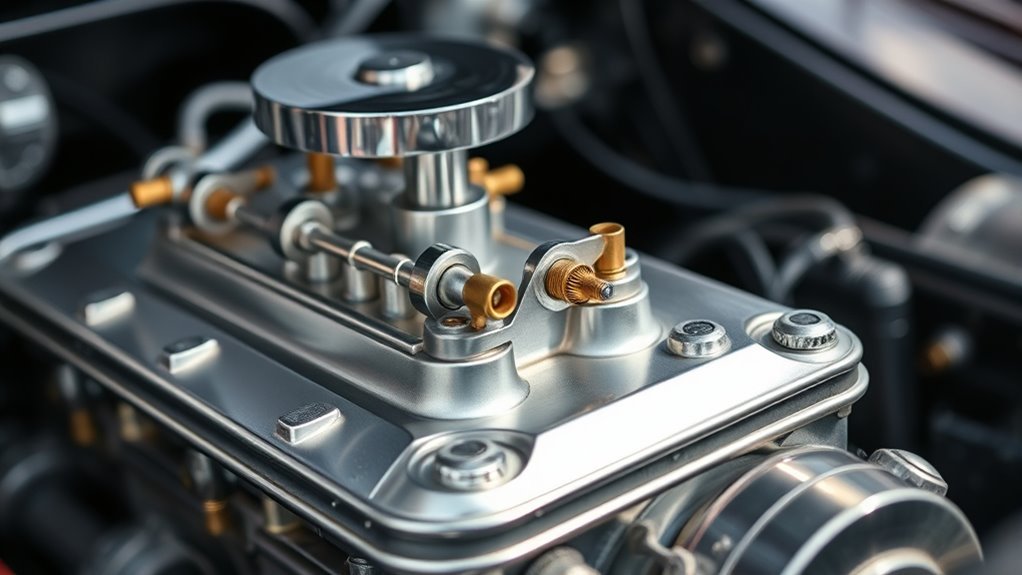
A carburetor mixes air and fuel in precise proportions before combustion, so your engine runs efficiently and smoothly. It uses a venturi to increase airflow speed, which draws fuel from the float chamber, while the throttle valve controls air volume to adjust engine speed.
Chokes and jets fine-tune the mixture for starting and driving conditions.
If you want to understand how parts work together and how it compares to modern fuel systems, keep exploring this essential engine component.
Key Takeaways
- A carburetor mixes air and fuel in precise ratios for combustion in older engines and small machinery.
- It uses a venturi to increase airflow speed, creating pressure that draws fuel into the air stream.
- The throttle valve controls airflow volume, regulating engine speed and fuel flow.
- The choke valve enriches the mixture for easier cold engine starts.
- Carburetors adjust fuel delivery to optimize engine performance and fuel efficiency under varying conditions.
What Is a Carburetor and Why Is It Important
Although modern engines often use fuel injection, a carburetor remains an essential component in many older vehicles and small engines because it precisely mixes air and fuel before combustion.
You’ll find several carburetor types, including the updraft, downdraft, and sidedraft, each designed to optimize airflow and fuel delivery for specific engine configurations.
Understanding these types helps you appreciate their engineering and application.
The carburetor’s historical significance lies in its role as the primary fuel delivery system before electronic controls emerged. It enabled early automotive and aviation advancements by providing reliable, adjustable fuel-air mixtures.
The carburetor powered early vehicles and aircraft with dependable, adjustable fuel-air mixtures before electronic controls existed.
When you work with or restore vintage engines, knowing the carburetor’s function and varieties guarantees you maintain performance and efficiency, highlighting why it remains a critical component despite newer technologies.
How a Carburetor Mixes Air and Fuel
When air flows through the carburetor’s venturi, it speeds up, creating a pressure drop that draws fuel from the bowl into the airstream. This initiates the precise mixing process, ensuring the correct air fuel ratio for combustion.
You’ll notice that as the airflow increases, more fuel is pulled in, maintaining balance. The carburetor finely tunes this ratio to enhance engine performance and fuel efficiency.
| Parameter | Role in Mixing Process |
|---|---|
| Air Velocity | Increases, creating suction |
| Pressure Drop | Draws fuel into airstream |
| Fuel Flow Rate | Adjusts to match air volume |
| Air Fuel Ratio | Maintains ideal combustion |
The Main Parts That Make a Carburetor Work
A carburetor’s efficiency depends on several key components working in harmony.
First, the venturi narrows the airflow path, increasing velocity and lowering pressure to draw fuel in. The throttle valve controls airflow volume, directly impacting engine speed.
Fuel flows from the float chamber, regulated by the float and needle valve to maintain a consistent level. The main jet meters fuel into the venturi, ensuring the correct fuel air mixture.
Additionally, the choke valve restricts air during startup for a richer mixture.
Each of these carburetor components must function precisely to balance fuel and air delivery, optimizing combustion. If any part malfunctions, it disrupts the fuel air mixture, leading to poor engine performance or stalling.
Understanding these parts helps you diagnose and maintain your carburetor effectively.
How Carburetors Adjust Fuel Flow for Different Driving Conditions
You control the throttle valve to regulate air intake, directly influencing fuel flow based on engine demand.
When starting cold, the choke restricts air, enriching the mixture for smooth ignition.
Additionally, the idle mixture control fine-tunes fuel delivery at low engine speeds to maintain stable operation.
Throttle Valve Operation
Although the carburetor’s main function is to mix air and fuel, the throttle valve plays a critical role in regulating how much of this mixture enters the engine.
When you press the accelerator, the throttle valve opens, increasing airflow and simultaneously adjusting fuel flow to maintain the proper air fuel ratio.
This balance guarantees efficient combustion and ideal throttle response. The valve’s position directly affects the pressure differential inside the carburetor’s venturi, which controls fuel draw from the jets.
By precisely modulating the throttle valve, the carburetor adapts fuel delivery to varying load and speed demands, preventing lean or rich conditions.
This mechanism lets you experience smooth acceleration and consistent engine performance across different driving conditions.
Choke Functionality Role
Alongside throttle valve regulation, the choke mechanism fine-tunes fuel delivery during engine start-up and varying temperature conditions.
When you start a cold engine, the choke restricts airflow, enriching the fuel mixture to guarantee smoother ignition.
Different choke types, manual, automatic, or thermostatic, control this process based on temperature or user input.
Manual choke types require you to adjust the choke lever, while automatic systems use bi-metallic springs or vacuum actuators for precise choke adjustment.
Proper choke adjustment prevents flooding or lean mixtures, enhancing combustion efficiency.
As the engine warms, the choke gradually opens, normalizing the air-fuel ratio for peak performance.
Understanding how to manage choke types and adjustment helps you maintain engine responsiveness and fuel economy under diverse driving conditions.
Idle Mixture Control
When the engine idles, the carburetor adjusts the fuel flow through the idle mixture control to maintain ideal combustion and prevent stalling.
You’ll find that this system fine-tunes the air-fuel ratio at low throttle openings, ensuring the engine runs smoothly at a stable idle speed.
The idle mixture adjustment screw regulates the amount of fuel entering the idle circuit, directly impacting engine responsiveness and emissions during minimal throttle use.
If the mixture is too rich or lean, you might notice rough idling or hesitation.
By precisely calibrating this mixture adjustment, you control combustion quality and maintain consistent idle speed under varied conditions such as temperature changes or accessory loads.
Understanding this allows you to optimize engine performance and fuel efficiency during idle phases.
Common Carburetor Problems to Watch For
Since a carburetor controls the air-fuel mixture, any malfunction can directly impact engine performance.
You need to watch for fuel leaks, which not only waste fuel but pose safety risks.
Airflow issues can cause uneven mixtures, leading to rough idling or poor throttle response. Clogging problems, often from dirt or varnish buildup, restrict fuel flow and cause tuning troubles.
Idle problems frequently stem from worn jets or passages, disrupting stable engine operation. Flooding issues occur when excess fuel overwhelms the combustion chamber, often due to stuck needles or float malfunctions.
Vapor lock, influenced by temperature effects, can interrupt fuel delivery in hot conditions.
Continuous wear and tear degrade components, so recognizing these symptoms early helps maintain ideal carburetor function and engine reliability.
Simple Ways to Maintain Your Carburetor
You should start by regularly inspecting your carburetor for dirt buildup and worn components to prevent performance issues.
Use specialized cleaning sprays and brushes to remove deposits without damaging sensitive parts.
Consistent maintenance guarantees ideal fuel-air mixture and prolongs your engine’s efficiency.
Cleaning Techniques
Maintaining your carburetor’s performance starts with regular cleaning to prevent buildup that can disrupt fuel flow and air mixture. You’ll need essential cleaning supplies like carburetor cleaner spray, soft brushes, compressed air, and protective gloves.
Begin by removing the carburetor carefully, then disassemble it to access jets, float bowls, and passages. Soak metal parts in carburetor cleaner to dissolve varnish and deposits. Use brushes and compressed air to clear small orifices thoroughly.
Pay close attention to the throttle plate and choke mechanisms to guarantee smooth operation.
Cleaning frequency depends on usage and environment but aim for at least once a year or every 10,000 miles. Following these cleaning techniques keeps your carburetor functioning efficiently and prolongs engine life.
Regular Inspection Tips
Although cleaning is crucial, regular inspections play an important role in identifying early signs of wear or malfunction in your carburetor.
During carburetor inspection, start by checking for fuel leaks around gaskets and connections, as these can indicate deterioration.
Examine the throttle linkage and choke for smooth operation without sticking. Inspect the float bowl for sediment or corrosion, which can impair fuel flow.
Pay close attention to the condition of the jets; clogged or damaged jets require immediate attention.
Routine maintenance also involves verifying that all screws and fasteners are tight to prevent air leaks that disrupt the air-fuel mixture.
How a Carburetor Differs From Modern Fuel Injection
While both carburetors and modern fuel injection systems deliver fuel to an engine, they operate on fundamentally different principles. A carburetor relies on vacuum pressure to mix air and fuel mechanically, which can limit carburetor efficiency due to variations in airflow and engine load.
In contrast, fuel injection uses electronic controls to precisely meter fuel delivery, optimizing combustion and improving responsiveness.
You’ll notice that carburetors require manual tuning to maintain proper fuel-air ratios, whereas fuel injection systems automatically adjust in real time using sensors.
This precision enhances fuel economy, reduces emissions, and improves cold starts.
Understanding these differences helps you appreciate why fuel injection has largely replaced carburetors in modern engines, delivering more efficient and consistent fuel delivery under all operating conditions.
Frequently Asked Questions
Can a Carburetor Be Used With Alternative Fuels Like Ethanol?
Yes, you can use a carburetor with ethanol, but ethanol compatibility requires adjustments to fuel jets and seals.
Alternative fuel use demands careful tuning to prevent corrosion and guarantee the best air-fuel mixture for efficient combustion.
How Does Altitude Affect Carburetor Performance?
Think of altitude adjustments as tuning a delicate orchestra; as you climb, thinner air demands a leaner fuel mixture. You’ll need to adjust jets or screws to guarantee peak combustion, preventing engine bogging or overheating at high altitudes.
What Tools Are Needed to Rebuild a Carburetor?
You’ll need screwdrivers, wrenches, carburetor cleaner, a rebuild kit, and a small brush for carburetor maintenance. These tools help you carefully remove parts and follow the rebuilding process to restore proper function efficiently.
Can a Carburetor Improve Engine Horsepower?
Yes, with precise carburetor tuning, you can achieve noticeable horsepower gains by optimizing air-fuel mixture and fuel delivery.
Proper adjustments enhance combustion efficiency, boosting your engine’s power output and overall performance considerably.
Are Carburetors Environmentally Friendly Compared to Fuel Injection?
Carburetors are like old maps, less precise, so they produce higher carburetor emissions and lower fuel efficiency. You won’t find them environmentally friendly compared to modern fuel injection’s tighter control and cleaner performance.
Conclusion
Think of your carburetor like a skilled chef blending precise ingredients for a perfect recipe. Too much or too little fuel throws off the balance and performance. Just as a chef adjusts seasoning for taste, your carburetor finely tunes the air-fuel mix to suit driving conditions.
By understanding its parts and maintenance needs, you guarantee your engine runs efficiently. This helps avoid common issues that can degrade performance over time. Keep it balanced, and your ride stays smooth.
The key to a well-running engine lies in a properly functioning carburetor.